Copyright 2020 by Gary L. Pullman
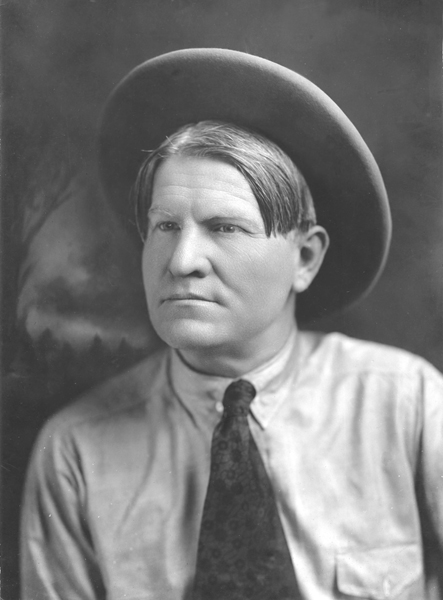
Born
in Oak Hill, Missouri, near St. Louis, a year before the end of the
American Civil War, Charles
M. Russell became an early devotee of the American West, working
first as a shepherd and then as a cowboy on Montana ranches. After
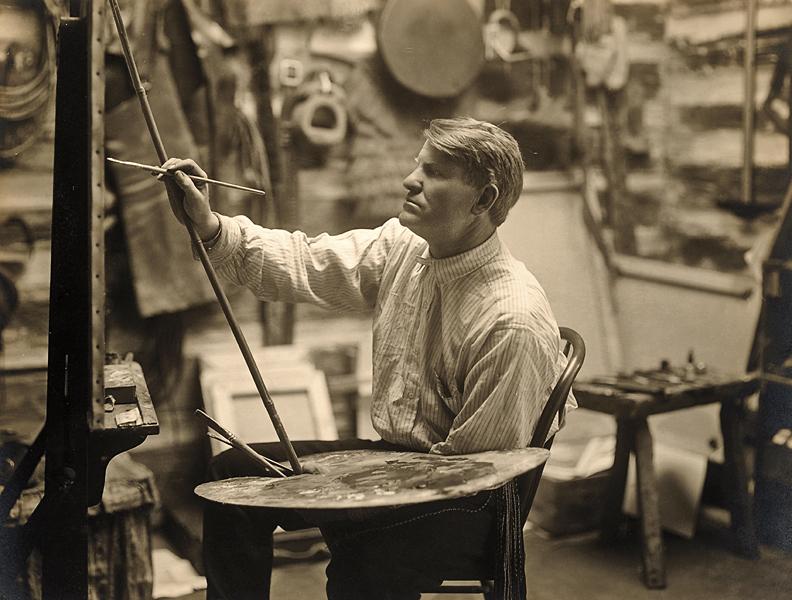
marrying Nancy Cooper, in 1896, Russell began his career as a
full-time artist, “painting and sculpting” inside his “log
cabin studio next to their home” in Great Falls, where he died in
1926, leaving a legacy of work chronicling and commemorating the time
and place he'd loved all the days of his life.
In
over two thousand paintings, Russell captures the spirit
and adventure of the Wild West. His work depicts roundups, bronco
busting, the fording of rivers, cowboys' encounters with wild
animals, buffalo hunts, camping, gambling, scouting, gold mining,
hunting, and much more.
Many
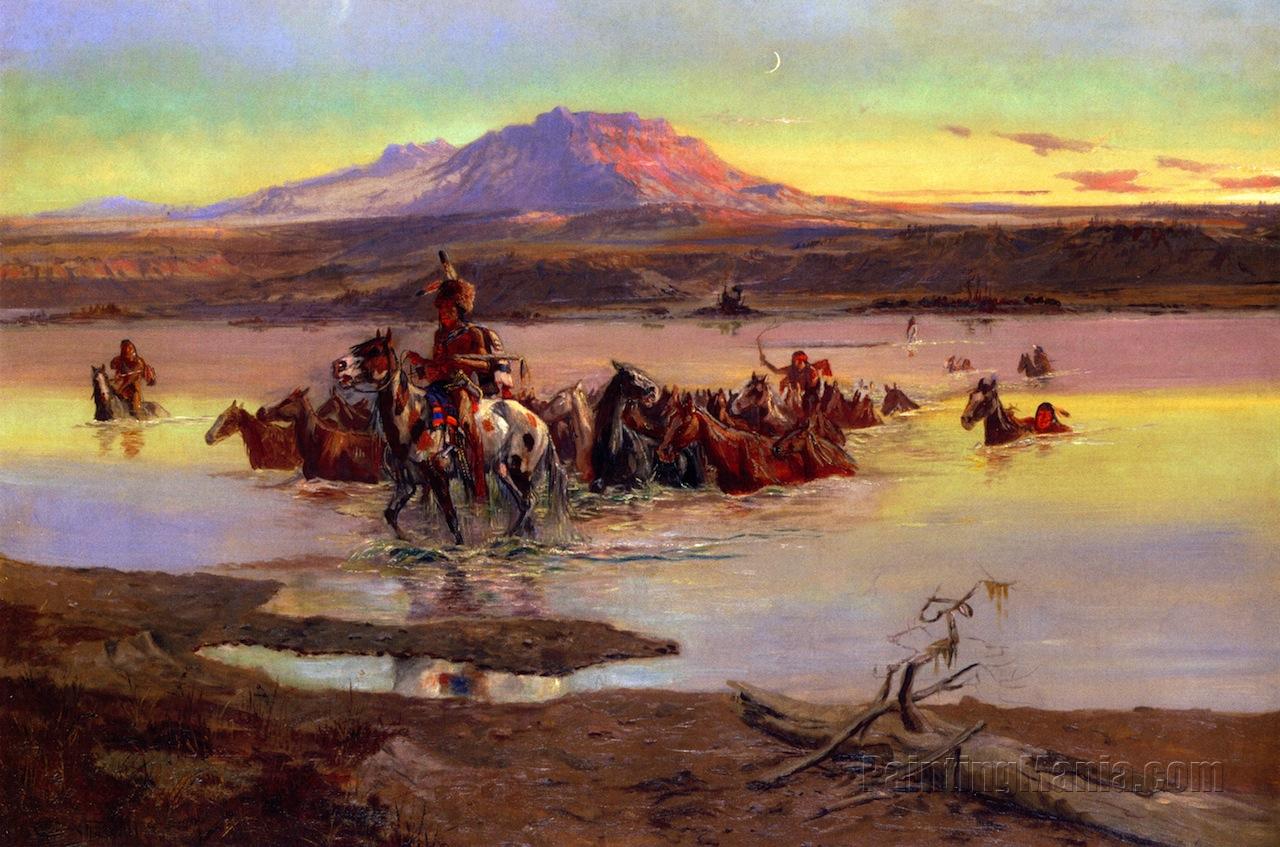
of his paintings are also devoted to the nomadic life of Native
Americans, as they hunt buffalo, fight cavalry soldiers, attack
frontiersmen, travel from campsite to campsite, grieve fallen
warriors, greet the famous explorers Lewis and Clark, encounter other
tribes, worship, communicate by smoke signals, and perform other
tasks of daily life.
Several
tribes are portrayed, including the Piegan, Crow, Sioux, Blackfoot,
Chinook, Navajo, Shoshone, Cree, Mandan, and Kootenai. By today's
standards, Russell's portraits of Native Americans are, at times,
politically incorrect. In his art, which depicts its subjects'
encounters with both other tribes than their own and with white men,
whom they see variously as traders, fighters, settlers, and invaders,
battles, bloodletting, and death are likely to follow.
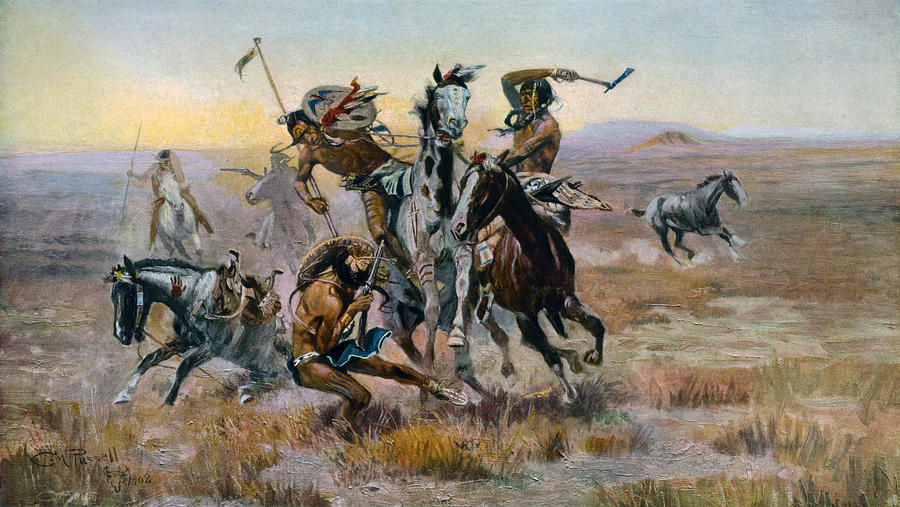
More
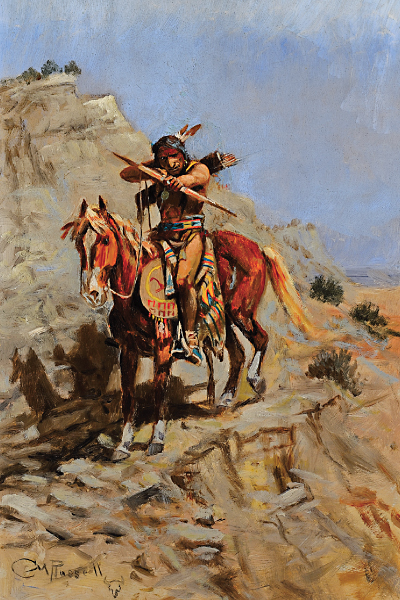
than a few of the paintings are dedicated to displays of Native
Americans at war, both with each other and with whites. as the works'
titles suggest: Scouting the Enemy,
On the Warpath, The
Battle Between the Blackfeet and the Piegans,
War Council, The
Making of a Warrior, Planning
the Attack, The
Attack, Indian War
Party, Sun River War
Party, Battle of Belly
River, Mandan Warrior,
Return of the Warriors,
Cree War Party, The
War Party, and WAR.
When
Native Americans are not waging war, they are often engaged in other
hostile acts, against other tribes or against white men, as they are
in such paintings as Sioux Torturing a Blackfoot Brave,
Planning the Attack on the Wagon Train,
The Horse Thieves,
Blackfeet Burning Crow Buffalo Range,
and Crow Sheep Stealer.
Not
all of Russell's paintings depict Native Americans as uncivilized,
battle-driven killers, thieves, and arsonists, of course. A couple
show individuals as “noble” and “romantic” figures. In a
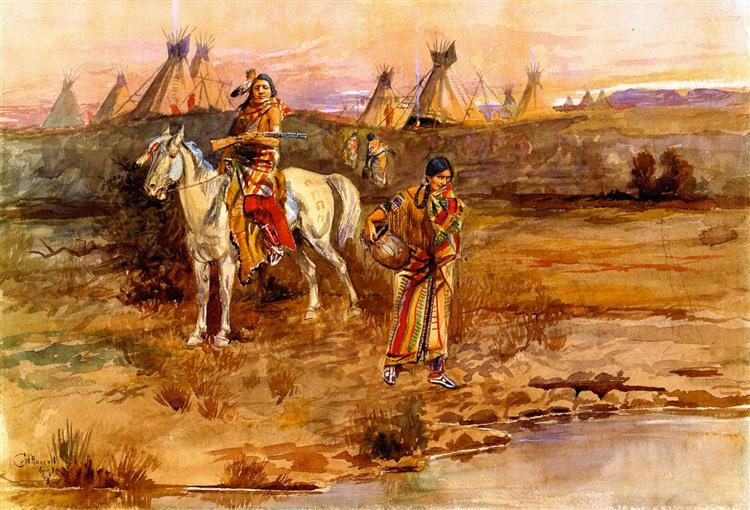
number of works, Russell's Native American subjects are even
portrayed in a seemingly lighthearted or humorous fashion (A
Piegan Flirtation, Indian
Beauty Parlor, Waiting
and Mad), a reverent manner
(Invocation to the Sun, Sun Worship in Montana),
or a diplomatic pose (Lewis and Clark Meeting
Indians at Ross' Hole, Lewis
and Clark Reach Shoshone Camp Led by Sacajawea the Bird Woman,
Indians Discovering Lewis and Clark,
Lewis and Clark Meeting the Mandan Indians).
One
can't help but to notice, however, that in the diplomatic series
involving the meetings between Lewis and Clark and various tribes,
the white explorers receive top billing in the titles, and it is
usually they, not the Native Americans, who are assigned the active
role; it is they who meet; even when Sacajawea leads, her name
appears after theirs, and they are assigned the primary active role:
they “reach” the Shoshone's camp. It is almost as an afterthought
that their guide's action, in leading them, is mentioned. Clearly, in
Russell's view of the American West, whites are the protagonists. His
Native Americans are the villains or supporting characters or, in
some cases, even window dressing.
Russell's
work tends to show Native Americans as treacherous and militant or,
in the comparatively rare moments in which they are not burning a
field, torturing an enemy, plotting battles, or waging war, as
comical, paganistic (animistic), or helpful to the active, purposeful
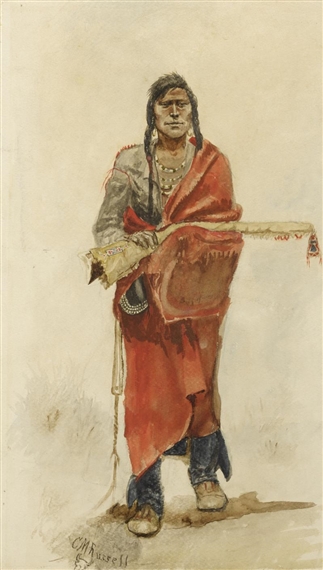
white men they serve. There is only one other major category of
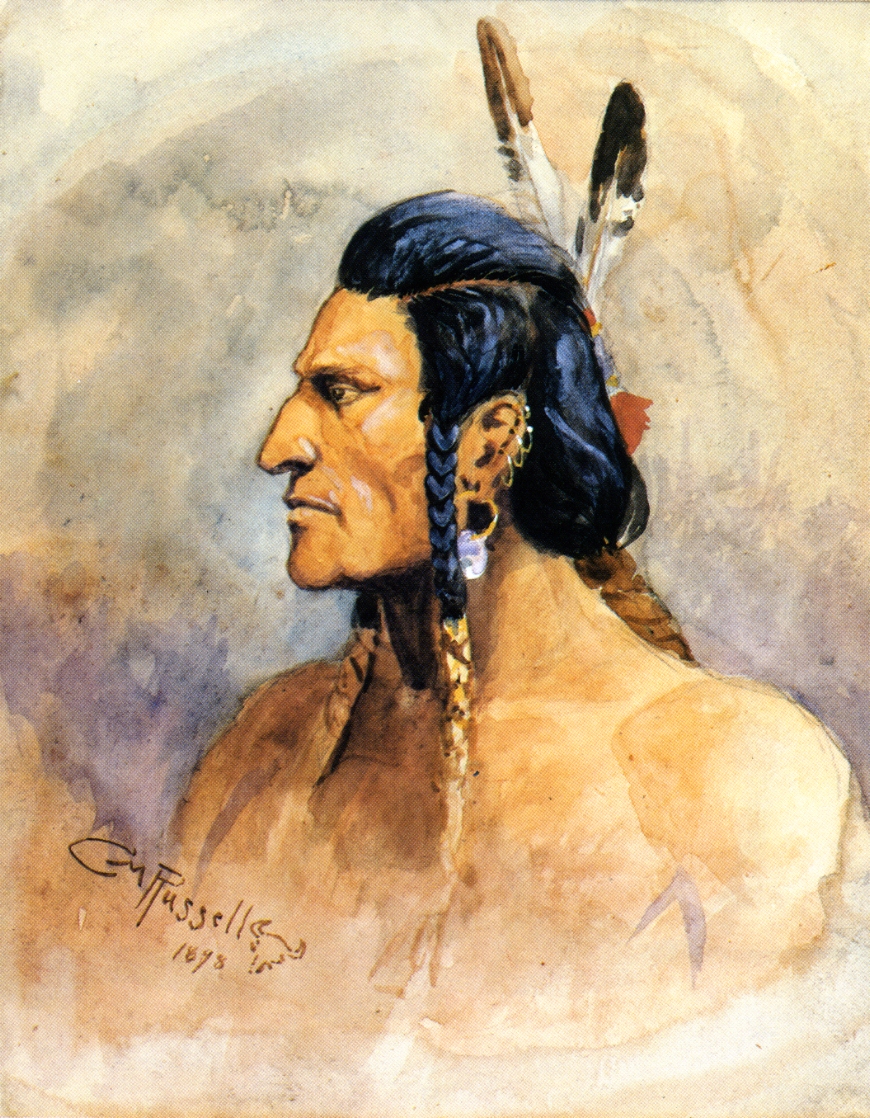
Native American on display in the artist's gallery of “Indians”:
the stereotypical representative, usually in portraiture, of Indian
Brave, Indian Buck,
Indian Squaw, and [Portrait
of an] Indian.
Although
Russell is largely positive in his portrayal of white men as the
heroic tamers of the Wild West, he also lampoons them on occasion and
shows them in a bad light at times. In one painting, a cowboy tries
to “bargain” with a Native Indian “for an Indian girl.”
In
another work, Whooping It Up, a band of cowboys, apparently drunk, gallop down the
main street, past a saloon, shooting their revolvers at the sky and
frightening a Chinese pedestrian, who drops a basket of laundry,
scattering chickens, while a dog runs in the opposite direction and,
across the street, men look on from the boardwalk in front of a
saloon, while Asian women in front of Hop Lee's Laundry stare in
fear. The white men's behavior is reckless and dangerous, but no one
seems ready to intercept or challenge them.
In
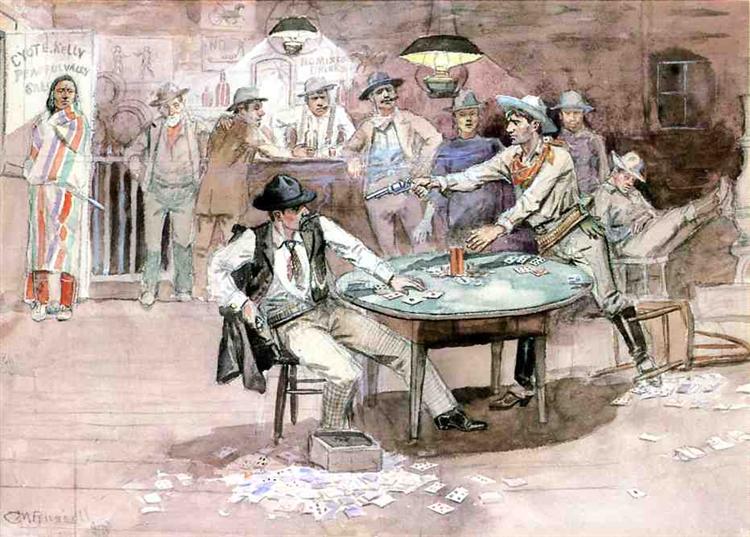
the ironically titled Peaceful Valley Saloon, gamblers are
about to duel at their table, possibly to settle a charge of cheating
at cards; one hold his extended weapon, while his adversary begins to
draw his own six-shooter from his holster. None of the other patrons
of the saloon, including the bartender, appears concerned, suggesting
they have seen such behavior before. Adding to the irony is the
Native American who looks on, rifle in hand, a stoic expression on
his face, since, often, in Russell's' work, Native Americans are
depicted as hostile and violent.
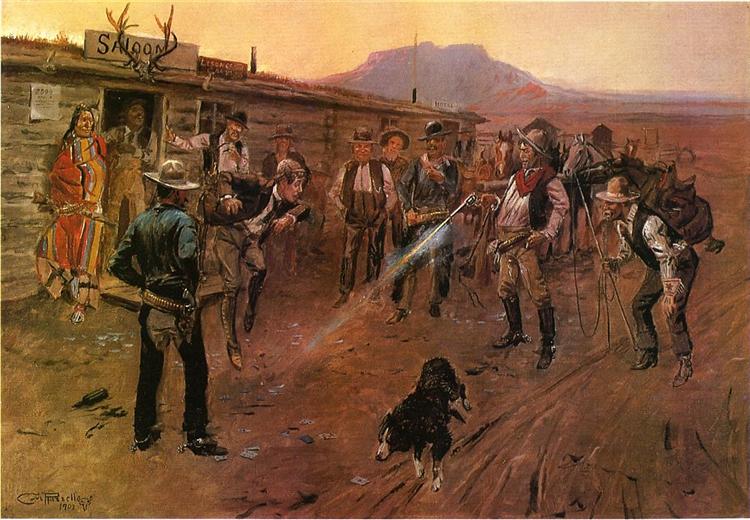
In
The Tenderfoot, a cowboy makes a new arrival to the West, who
is still dressed in the fashion of the East, “dance” by shooting
his pistol at the dude's feet, much to the amusement of the other
frontiersmen gathered outside the saloon before which the spectacle
takes place and to the consternation of a fleeing dog. Even the token
Indian in the group looks amused by the potentially dangerous
shenanigans.
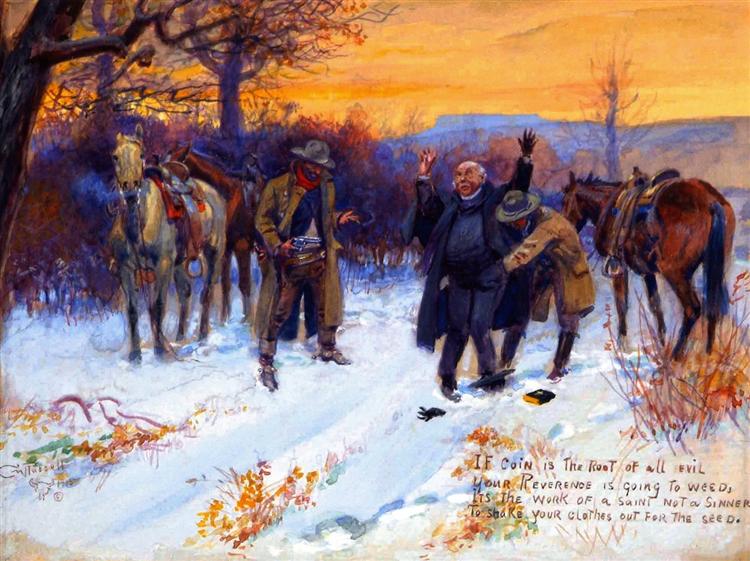
Outlaws,
as such, are fairly rarely represented in Russell's work. However, a
pair of highway robbers appears in Fleecing the Priest, and,
as the painting's title indicates, their victim is a man of the
cloth. As one of the robbers holds a gun on the clergyman, who stands
between the two outlaws, his hands overhead, looking frightened, the
other reaches deep into the left pocket of the unfortunate soul's
trousers. The lining protruding from the other pocket suggests that
it has already been searched. Four lines of partially rhyming verse
explain the villains' attitude toward the man they are robbing:
If coin is the root of all evil
Your reverence is going to weed;
It's the work of a saint, not a
sinner,
To shake your clothes out for
seed.
When
Russell's depictions of the Wild West depart from the heroic white
Westerner to the criminal element, the deviation is also one from the
sublime to the ridiculous, for the painter almost always depicts the
cowboy or the sheriff or the soldier as an exalted hero, while he
portrays the outlaw as an absurd buffoon. The True West, he implies,
is about the men who tamed the wilderness and civilized the frontier;
it is not about those who, like robbers, attempted to subvert law and
order, nor is it about those who, like Native Americans, fought
against or stood in the way of progress.
Russell's
paintings show rugged Western terrain, its plains and mountains,
canyons and gorges, deserts and snowy highlands, rivers and lakes,
pines and cacti. The landscapes also depict the wildlife of the West:
buffalo, mustangs, wolves, bears, big horn sheep, elk, and deer. Such
paintings reflect the reality, in the untamed West, of the need to
“kill or be killed.” The frontier is a land “red in tooth and
claw,” in which “only the strong survive” in a constant contest
in which “the survival of the fittest” is enacted every day,
whether among plants, animals, or men.
Signs
of stable, established civilization—white civilization, that is—are
few and far between in Russell's oeuvre: an occasional cabin,
a trading post, a saloon, a fort, storefronts along a boardwalk
adjacent to false-fronted buildings built mostly of wood. Only rarely
is there a brick or stone edifice suggesting commitment and
permanence. Most of the signs of white civilization, the foil of
which, in Russell's art, is the nomadic culture of the Native
American, as represented by temporary camps of tepees and clothing of
blankets, loincloths, beads, moccasins, robes, and headdresses,
buckskin dresses or skirts, and coarse blouses, are transient: chuck
wagons, buckboards, stagecoaches, trains.
Russell's
vision of the West is flawed. Stereotypical at best, it borders upon
racism at times in its depiction of white men as the rowdy, uncouth
bringers of civilization to the untamed West and of Native Americans
as typically (that is, stereotypically) savage and militant,
uncivilized and hostile, wild and brutal. White men have come to tame
the West, and that includes the savage, uncivilized Native Americans
who attack the newcomers' camps, settlers' cabins, wagon trains, and
railroad cars. For the West to be tamed, the Native American must be
defeated, killed, banished, and otherwise controlled. These ideas are
implicit in Russell's art. It is politically incorrect.
There
is, however, truth in his depictions of Native Americans as well as
implicit falsehoods or misrepresentations. The cowboy, the farmer,
the rancher, the sheriff, the railroad worker, the miner, the
soldier, and the other white figures of the West did bring
civilization—their
civilization—to the West. They built towns. Schools. Churches.
Telegraph lines. Railroads. Stockyards. Gold and silver mines.
Russell's
heroes built cabins and houses and towns on plains. They laid rails
so that trains could travel over mountains, bridge canyons and
gorges, and cross miles of desert wasteland. Their boats journeyed up
and down rivers and across lakes. They built houses from oaks and
pines and quenched their thirst on the juices of cacti. They hunted
buffalo, elk, and deer. They captured and domesticated mustangs. They
killed dangerous wolves and bears. They made the West habitable and
safe—or safer, at least, than it had ever been.
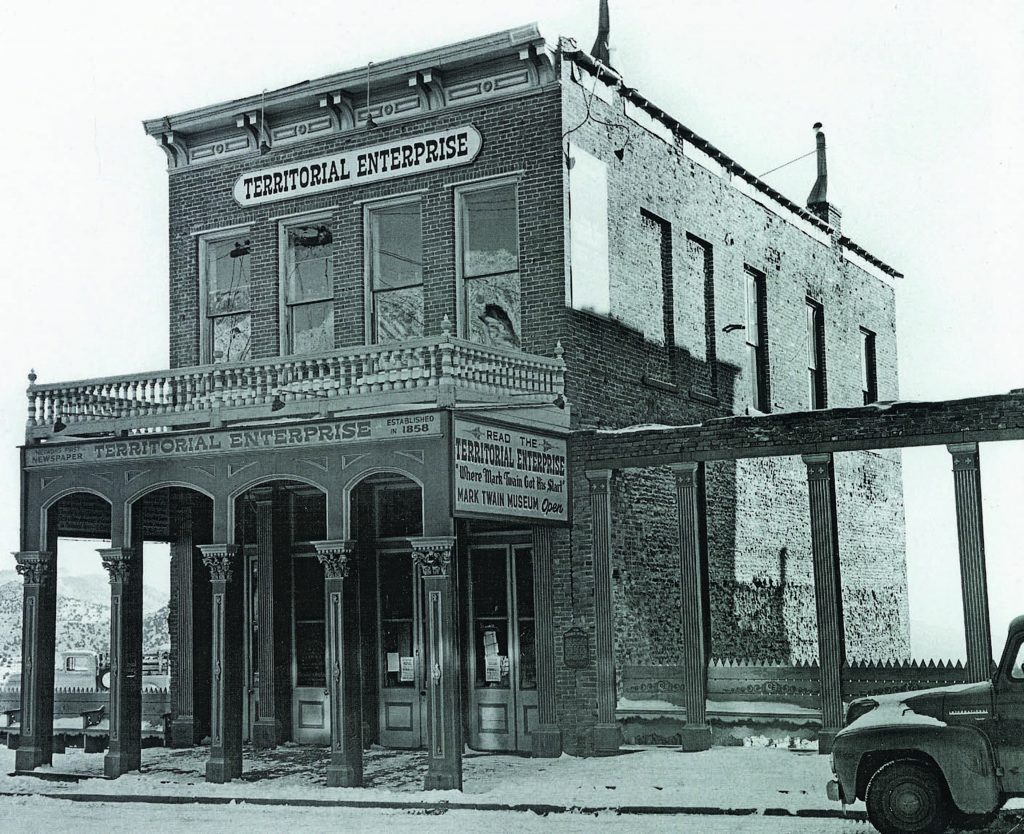
Eventually,
they, or their children, also built newspaper offices, libraries,
museums, art galleries, department stores, and a host of other
pedagogical, religious, commercial, technological, journalistic, and
artistic institutions; they spread Western culture throughout the New
World. In that sense, the Western heroes Russell's art depicts were
heroic, indeed; they were larger than life; they were knights in
Stetsons and gun belts and boots.
Despite
Russell's lopsided and oversimplified view of Nature and Civilization
and their respective human masters, the Native American and the
mostly white Westerner, the painter constructed a vast, panoramic
vision of this conquest of the Wild West that continues to have a
powerful effect on the imagination and the emotions. It is a vision
which, although in need of correction and further development, is one
that can still be considered inspirational to a significant degree.