Showing posts with label sheriff. Show all posts

Friday, August 13, 2021

ORDER HERE, ORDER NOW! An Adventure of the Old West series!


Don't miss these other great books in the exciting Adventure of the Old West series!

Order Here, Order Now!


  Bane Messenger Bounty Hunter

(A novella prequel to the series)

Available at Amazon, Apple Books, Barnes & Noble, and Kobo

(e-book format)

Click HERE to order from your favorite retailer.


A prequel to the series An Adventure of the Old West, this action-packed short story introduces Bane Messenger, a Union veteran of the Civil War, who teams with former Confederate commander Colonel Jake Miller to become a bounty hunter.

On the trail of a vicious outlaw wanted for kidnapping and murder during a series of robberies, Bane hones his tracking, reconnaissance, and fighting skills.

His final showdown with his deadly quarry will show Bane just how good he is with a gun and launch his career as a man who makes a living by bringing killers to justice, dead or alive.


Good with a Gun

(Book 1 of the series)

Available at Amazon, Apple Books, Barnes & Noble, and Kobo

(e-book format)

Click HERE to order from your favorite retailer. 


Bounty hunter Bane Messenger is good with a gun, but he wants more out of life than hunting down fugitives from the law. He wants a wife and children. He wants a home of his own. He wants to know why his father abandoned his mother and him. 

But all he knows is how to track and capture or kill the worst sort of men who roam the West, taking what they want, whether money, property, or women, at the point of a gun.

When he meets the right woman, though, he vows his life will change; he will change, if he can. 


The Valley of the Shadow

(Book 2 of the series)

Available at Amazon, Apple Books, Barnes & Noble, and Kobo

(e-book format)

Click HERE to order from your favorite retailer. 


Mysterious strangers. Big money. Corrupt politicians. Murder. Mayhem. Hired guns. After a drunk is broken out of Excelsior, Nevada's, jailhouse, former bounty hunter Bane Messenger joins a posse to hunt down the escaped prisoner and his accomplices.

Surviving an ambush in which the sheriff and deputy are killed, Bane tracks down the assassins. But, when he returns to Excelsior, he finds that the town's last lawman has also been murdered. Now, a cartel controls the town, using paid gunmen to enforce new laws for their own benefit.

Determined to bring law and order back to his hometown, Bane faces a fierce fight only guns can settle, but he learns there's more to enforcing justice than just being good with a gun.


Blood Mountain

(Book 3 of the series)

Available at Amazon, Apple Books, Barnes & Noble, and Kobo

(e-book format)

Click HERE to order from your favorite retailer. 


After years as a bounty hunter and a sheriff, Bane Messenger wants to enjoy a quiet life with his family. They buy land in Nevada's Great Basin, planning to build a remote family retreat, but when they visit the property, armed men attack them, intent upon forcing them to vacate the premises, claiming Bane and his family are trespassing on private property.

Before this new nightmare ends, Bane will strike it rich, be tried for kidnapping and murder, and take on an “army” of veteran soldiers determined to kill him and his entire family.

On the Track of Vengeance 

(Book 4 of the series)

Available at Amazon, Apple Books, Barnes & Noble, and Kobo

(e-book format)

Click HERE to order from your favorite retailer. 


The runaway action never stops in On the Track of Vengeance, the fourth book in An Adventure of the Old West series. When outlaw gangs sabotage railroads, resulting in the deaths of innocent passengers and crew members, the president of the United States becomes directly involved, appointing Bane Messenger a U. S. marshal answerable to him alone.

Teamed with trustworthy deputies, Bane takes on the desperate men, who care only for vengeance and are willing to do anything to strike back at the railroads and the government they blame for their misfortunes. But the stakes soar when Bane learns that the outlaws plan to sabotage a train carrying his wife and father.

With their lives hanging in the balance and no way to warn them, Bane races to the scene. Can he stop the outlaws in time or will Pamela and Bradford become the latest victims of the cruel men who care for nothing but vengeance?


Saturday, August 1, 2020

Charles M. Russell's Portrait of the American West

Copyright 2020 by Gary L. Pullman


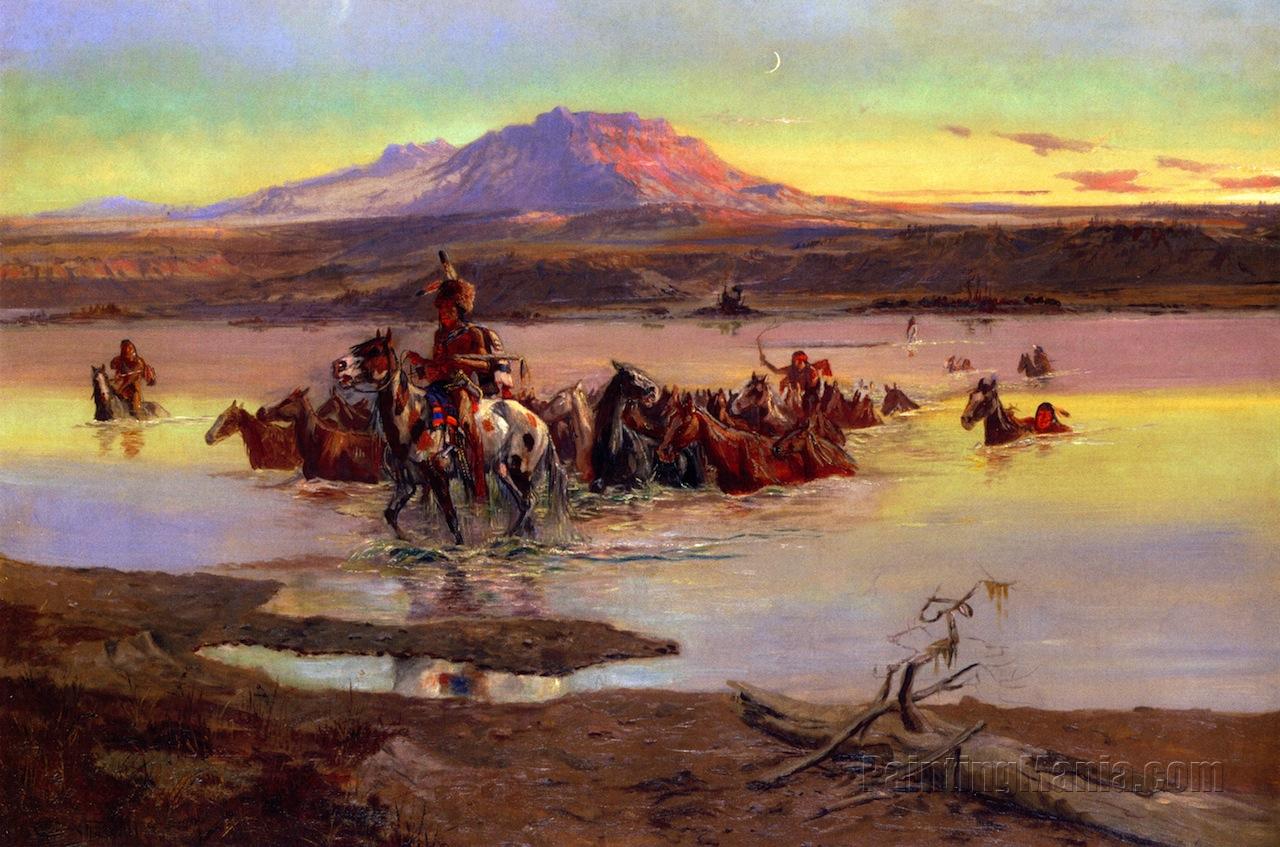
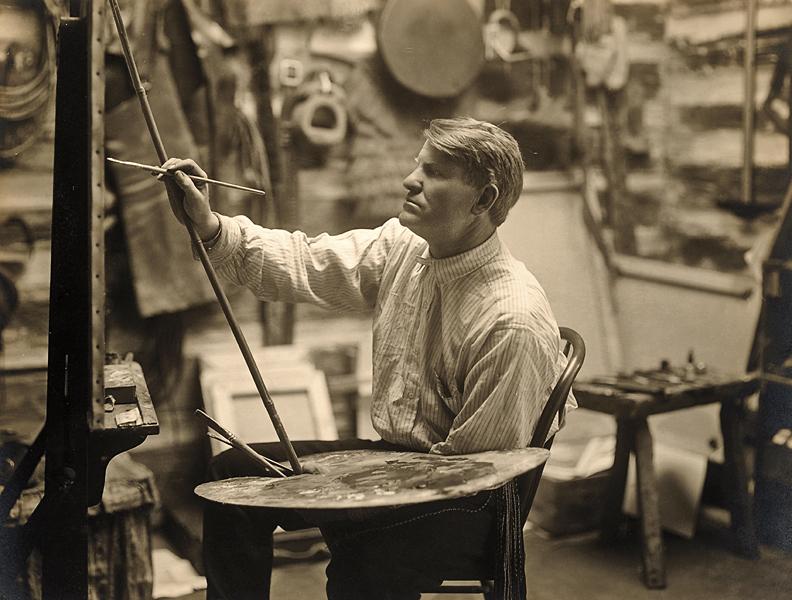
Born in Oak Hill, Missouri, near St. Louis, a year before the end of the American Civil War, Charles M. Russell became an early devotee of the American West, working first as a shepherd and then as a cowboy on Montana ranches. After marrying Nancy Cooper, in 1896, Russell began his career as a full-time artist, “painting and sculpting” inside his “log cabin studio next to their home” in Great Falls, where he died in 1926, leaving a legacy of work chronicling and commemorating the time and place he'd loved all the days of his life.


In over two thousand paintings, Russell captures the spirit and adventure of the Wild West. His work depicts roundups, bronco busting, the fording of rivers, cowboys' encounters with wild animals, buffalo hunts, camping, gambling, scouting, gold mining, hunting, and much more.


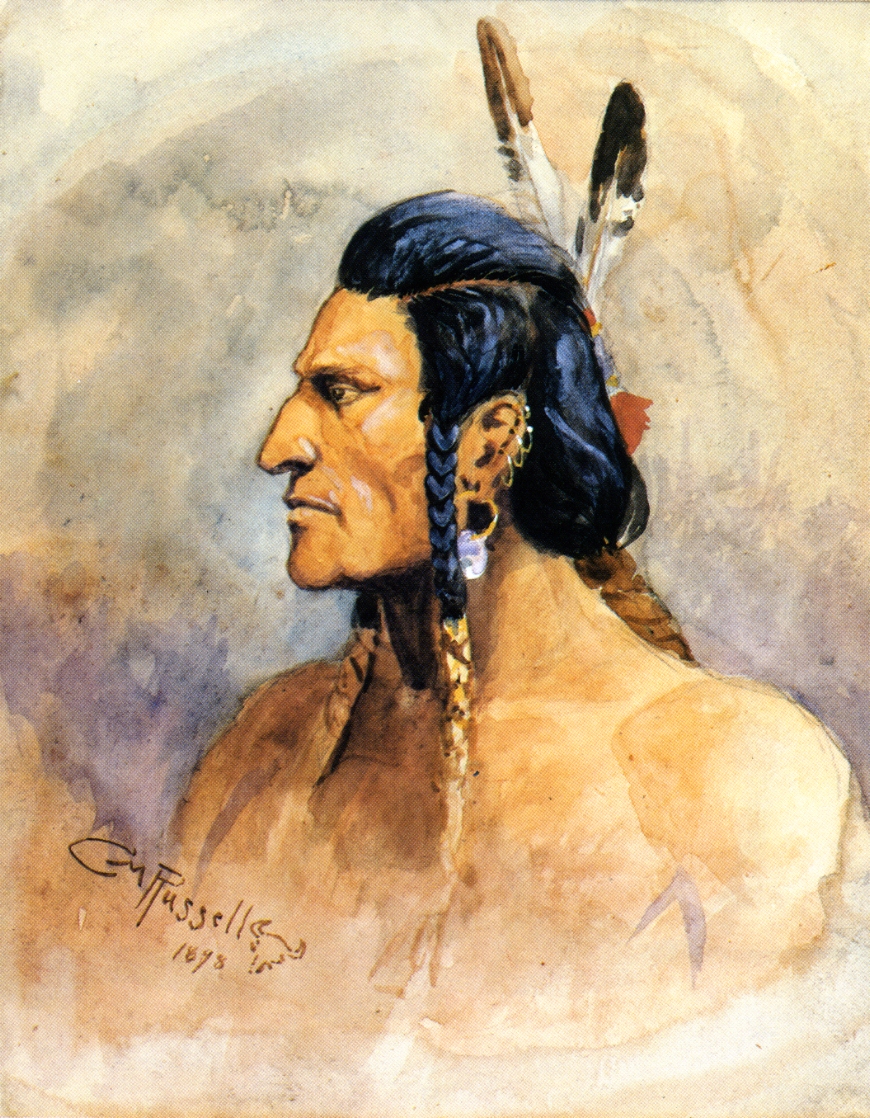
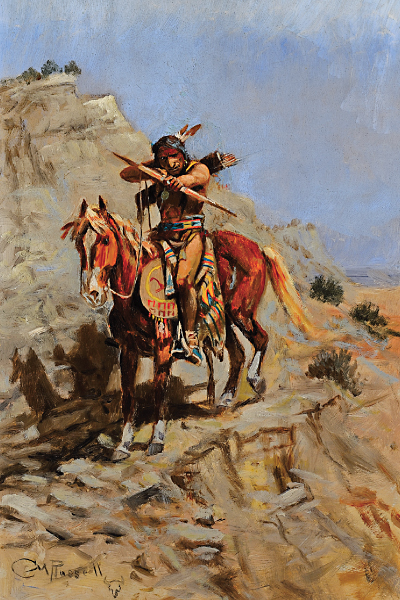
Many of his paintings are also devoted to the nomadic life of Native Americans, as they hunt buffalo, fight cavalry soldiers, attack frontiersmen, travel from campsite to campsite, grieve fallen warriors, greet the famous explorers Lewis and Clark, encounter other tribes, worship, communicate by smoke signals, and perform other tasks of daily life.


Several tribes are portrayed, including the Piegan, Crow, Sioux, Blackfoot, Chinook, Navajo, Shoshone, Cree, Mandan, and Kootenai. By today's standards, Russell's portraits of Native Americans are, at times, politically incorrect. In his art, which depicts its subjects' encounters with both other tribes than their own and with white men, whom they see variously as traders, fighters, settlers, and invaders, battles, bloodletting, and death are likely to follow.


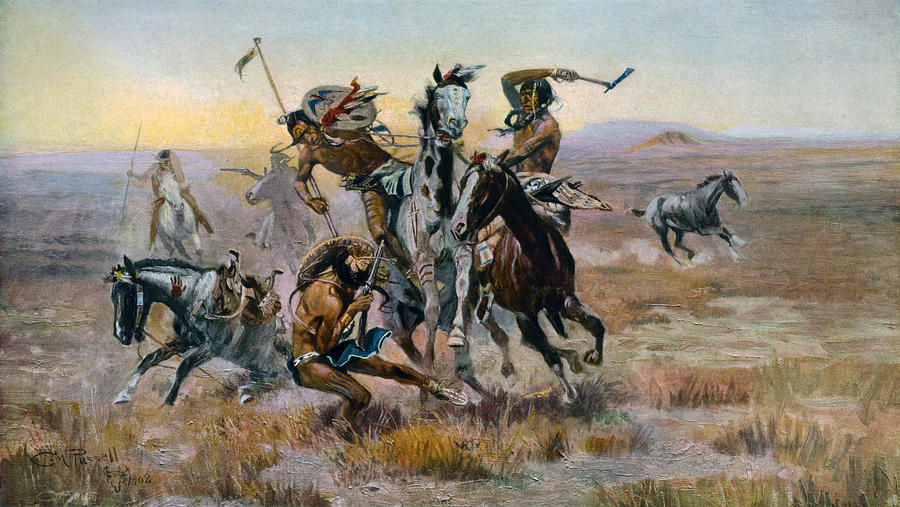
More than a few of the paintings are dedicated to displays of Native Americans at war, both with each other and with whites. as the works' titles suggest: Scouting the Enemy, On the Warpath, The Battle Between the Blackfeet and the Piegans, War Council, The Making of a Warrior, Planning the Attack, The Attack, Indian War Party, Sun River War Party, Battle of Belly River, Mandan Warrior, Return of the Warriors, Cree War Party, The War Party, and WAR.


When Native Americans are not waging war, they are often engaged in other hostile acts, against other tribes or against white men, as they are in such paintings as Sioux Torturing a Blackfoot Brave, Planning the Attack on the Wagon Train, The Horse Thieves, Blackfeet Burning Crow Buffalo Range, and Crow Sheep Stealer.


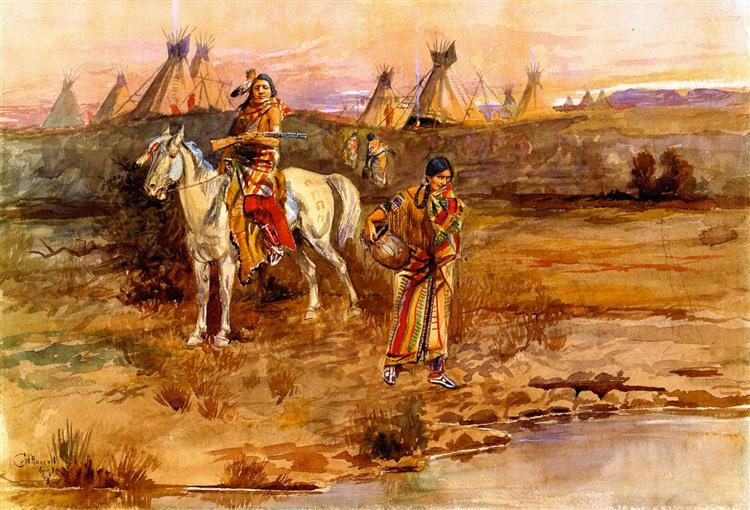
Not all of Russell's paintings depict Native Americans as uncivilized, battle-driven killers, thieves, and arsonists, of course. A couple show individuals as “noble” and “romantic” figures. In a number of works, Russell's Native American subjects are even portrayed in a seemingly lighthearted or humorous fashion (A Piegan Flirtation, Indian Beauty Parlor, Waiting and Mad), a reverent manner (Invocation to the Sun, Sun Worship in Montana), or a diplomatic pose (Lewis and Clark Meeting Indians at Ross' Hole, Lewis and Clark Reach Shoshone Camp Led by Sacajawea the Bird Woman, Indians Discovering Lewis and Clark, Lewis and Clark Meeting the Mandan Indians).


One can't help but to notice, however, that in the diplomatic series involving the meetings between Lewis and Clark and various tribes, the white explorers receive top billing in the titles, and it is usually they, not the Native Americans, who are assigned the active role; it is they who meet; even when Sacajawea leads, her name appears after theirs, and they are assigned the primary active role: they “reach” the Shoshone's camp. It is almost as an afterthought that their guide's action, in leading them, is mentioned. Clearly, in Russell's view of the American West, whites are the protagonists. His Native Americans are the villains or supporting characters or, in some cases, even window dressing.


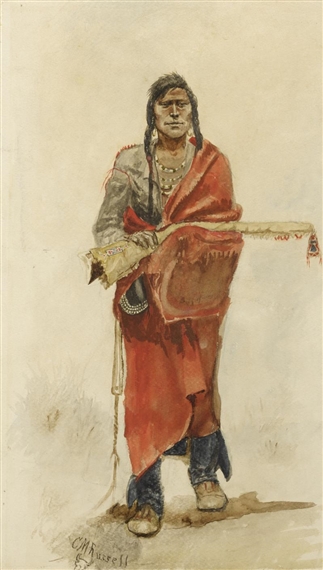
Russell's work tends to show Native Americans as treacherous and militant or, in the comparatively rare moments in which they are not burning a field, torturing an enemy, plotting battles, or waging war, as comical, paganistic (animistic), or helpful to the active, purposeful white men they serve. There is only one other major category of Native American on display in the artist's gallery of “Indians”: the stereotypical representative, usually in portraiture, of Indian Brave, Indian Buck, Indian Squaw, and [Portrait of an] Indian.


Although Russell is largely positive in his portrayal of white men as the heroic tamers of the Wild West, he also lampoons them on occasion and shows them in a bad light at times. In one painting, a cowboy tries to “bargain” with a Native Indian “for an Indian girl.”


In another work, Whooping It Up, a band of cowboys, apparently drunk, gallop down the main street, past a saloon, shooting their revolvers at the sky and frightening a Chinese pedestrian, who drops a basket of laundry, scattering chickens, while a dog runs in the opposite direction and, across the street, men look on from the boardwalk in front of a saloon, while Asian women in front of Hop Lee's Laundry stare in fear. The white men's behavior is reckless and dangerous, but no one seems ready to intercept or challenge them.


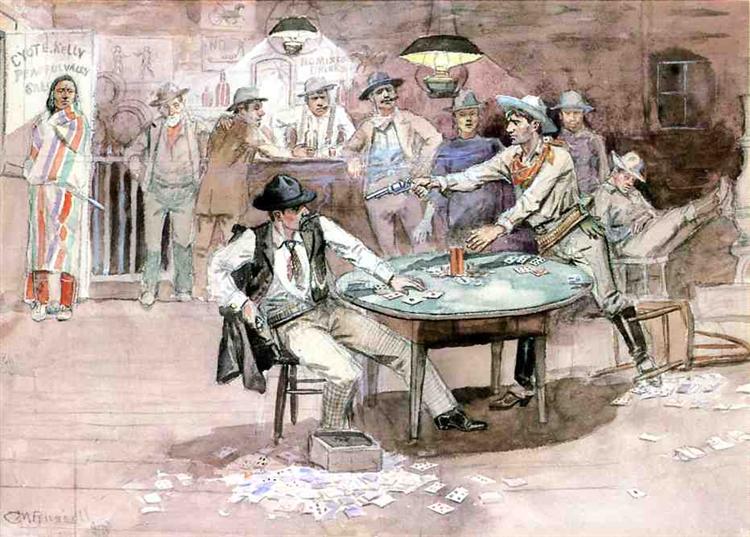
In the ironically titled Peaceful Valley Saloon, gamblers are about to duel at their table, possibly to settle a charge of cheating at cards; one hold his extended weapon, while his adversary begins to draw his own six-shooter from his holster. None of the other patrons of the saloon, including the bartender, appears concerned, suggesting they have seen such behavior before. Adding to the irony is the Native American who looks on, rifle in hand, a stoic expression on his face, since, often, in Russell's' work, Native Americans are depicted as hostile and violent.


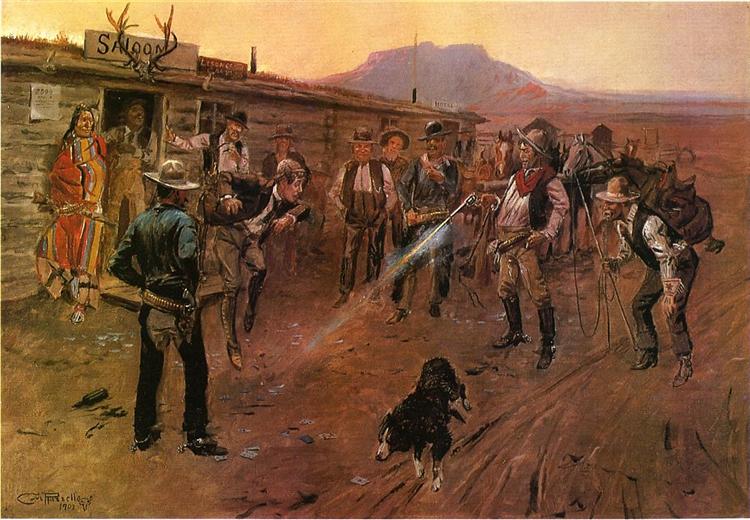
In The Tenderfoot, a cowboy makes a new arrival to the West, who is still dressed in the fashion of the East, “dance” by shooting his pistol at the dude's feet, much to the amusement of the other frontiersmen gathered outside the saloon before which the spectacle takes place and to the consternation of a fleeing dog. Even the token Indian in the group looks amused by the potentially dangerous shenanigans.


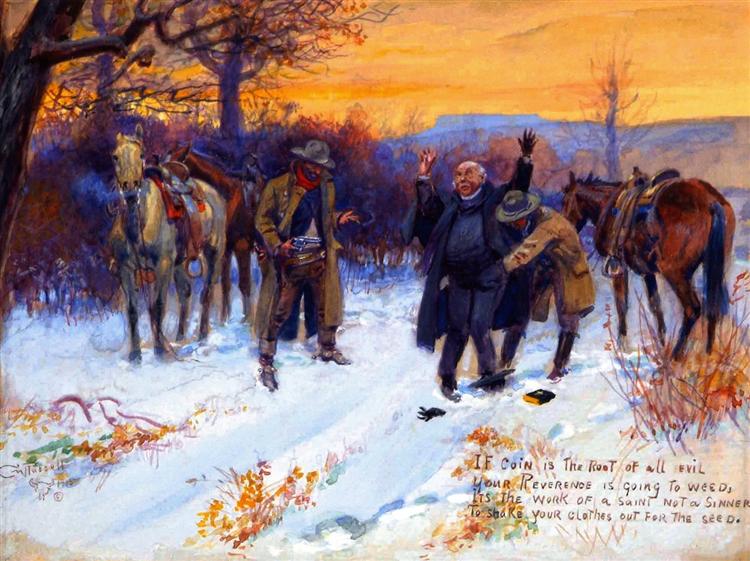
Outlaws, as such, are fairly rarely represented in Russell's work. However, a pair of highway robbers appears in Fleecing the Priest, and, as the painting's title indicates, their victim is a man of the cloth. As one of the robbers holds a gun on the clergyman, who stands between the two outlaws, his hands overhead, looking frightened, the other reaches deep into the left pocket of the unfortunate soul's trousers. The lining protruding from the other pocket suggests that it has already been searched. Four lines of partially rhyming verse explain the villains' attitude toward the man they are robbing:

If coin is the root of all evil
Your reverence is going to weed;
It's the work of a saint, not a sinner,
To shake your clothes out for seed.


When Russell's depictions of the Wild West depart from the heroic white Westerner to the criminal element, the deviation is also one from the sublime to the ridiculous, for the painter almost always depicts the cowboy or the sheriff or the soldier as an exalted hero, while he portrays the outlaw as an absurd buffoon. The True West, he implies, is about the men who tamed the wilderness and civilized the frontier; it is not about those who, like robbers, attempted to subvert law and order, nor is it about those who, like Native Americans, fought against or stood in the way of progress.


Russell's paintings show rugged Western terrain, its plains and mountains, canyons and gorges, deserts and snowy highlands, rivers and lakes, pines and cacti. The landscapes also depict the wildlife of the West: buffalo, mustangs, wolves, bears, big horn sheep, elk, and deer. Such paintings reflect the reality, in the untamed West, of the need to “kill or be killed.” The frontier is a land “red in tooth and claw,” in which “only the strong survive” in a constant contest in which “the survival of the fittest” is enacted every day, whether among plants, animals, or men.


Signs of stable, established civilization—white civilization, that is—are few and far between in Russell's oeuvre: an occasional cabin, a trading post, a saloon, a fort, storefronts along a boardwalk adjacent to false-fronted buildings built mostly of wood. Only rarely is there a brick or stone edifice suggesting commitment and permanence. Most of the signs of white civilization, the foil of which, in Russell's art, is the nomadic culture of the Native American, as represented by temporary camps of tepees and clothing of blankets, loincloths, beads, moccasins, robes, and headdresses, buckskin dresses or skirts, and coarse blouses, are transient: chuck wagons, buckboards, stagecoaches, trains.


Russell's vision of the West is flawed. Stereotypical at best, it borders upon racism at times in its depiction of white men as the rowdy, uncouth bringers of civilization to the untamed West and of Native Americans as typically (that is, stereotypically) savage and militant, uncivilized and hostile, wild and brutal. White men have come to tame the West, and that includes the savage, uncivilized Native Americans who attack the newcomers' camps, settlers' cabins, wagon trains, and railroad cars. For the West to be tamed, the Native American must be defeated, killed, banished, and otherwise controlled. These ideas are implicit in Russell's art. It is politically incorrect.


There is, however, truth in his depictions of Native Americans as well as implicit falsehoods or misrepresentations. The cowboy, the farmer, the rancher, the sheriff, the railroad worker, the miner, the soldier, and the other white figures of the West did bring civilization—their civilization—to the West. They built towns. Schools. Churches. Telegraph lines. Railroads. Stockyards. Gold and silver mines.


Russell's heroes built cabins and houses and towns on plains. They laid rails so that trains could travel over mountains, bridge canyons and gorges, and cross miles of desert wasteland. Their boats journeyed up and down rivers and across lakes. They built houses from oaks and pines and quenched their thirst on the juices of cacti. They hunted buffalo, elk, and deer. They captured and domesticated mustangs. They killed dangerous wolves and bears. They made the West habitable and safe—or safer, at least, than it had ever been.


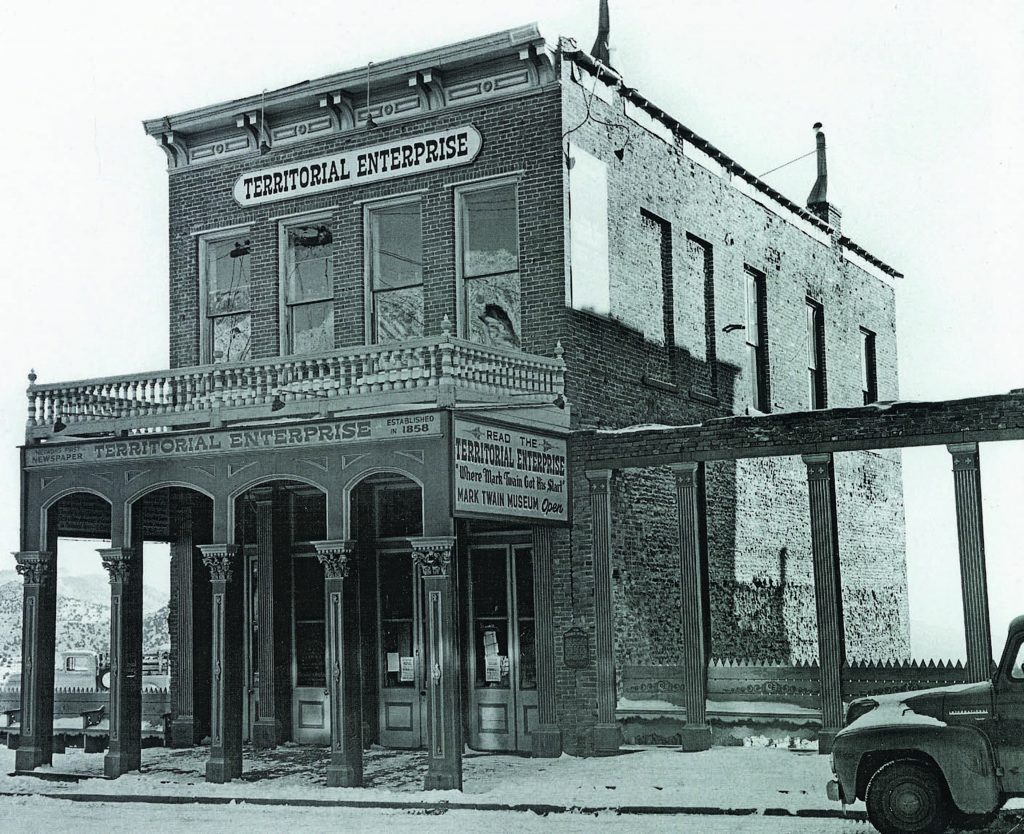
Eventually, they, or their children, also built newspaper offices, libraries, museums, art galleries, department stores, and a host of other pedagogical, religious, commercial, technological, journalistic, and artistic institutions; they spread Western culture throughout the New World. In that sense, the Western heroes Russell's art depicts were heroic, indeed; they were larger than life; they were knights in Stetsons and gun belts and boots.


Despite Russell's lopsided and oversimplified view of Nature and Civilization and their respective human masters, the Native American and the mostly white Westerner, the painter constructed a vast, panoramic vision of this conquest of the Wild West that continues to have a powerful effect on the imagination and the emotions. It is a vision which, although in need of correction and further development, is one that can still be considered inspirational to a significant degree.


Thursday, October 3, 2019

Using Generic Incidents to Plot Your Western Novel (or Fiction of Any Other Genre): Part 2

Copyright 2019 by Gary L. Pullman


In Part 1 of this series, I explained how I strip the particular incidents of a plots to the bone, transforming them into generic expressions of action similar to the narrative motifs, or functions or dramatic personae, identified by Vladimir Propp in Morphology of the Folktale.

By doing so, I have developed a good size list of the types of incidents (and, indeed, their relationships to one another) that typically occur in Western movies (or novels).

The same technique, of course, can be applied to any other genre as well, providing similar indices of motifs for any type of fiction from action-adventure thrillers to science fiction or young adult novels.


In addition to the generic incidents I compiled on the basis of James L. Neibaur's summary of A Fistful of Dollars, I added additional generic incidents his summaries of other plots of Clint Eastwood's Westerns.

Neibaur's summary of A Fistful of Dollars (1964) disclose these generic incidents:

  • The hero proves his worth.
  • The hero is hired to join a gang.
  • The hero plays two rival gangs against one another.
  • While the gangs fight each other, the hero seeks to benefit himself at their expense.
  • The hero commits an act that makes him somewhat sympathetic but does not make him less mysterious.
  • To avenge and protect his injured friends or supporters, the hero tricks the villain and kills him.

These generic incidents are based on Neibaur's summary of A Few Dollars More.
  • A hero's rival acts.
  • A hero acts.
  • A hero's rival acts again.
  • A hero's rival and a hero exhibit their respective skills, trying to intimidate one another, but, instead, impress each other and join forces against a common enemy.
  • To carry out their plan, a hero's rival and a hero split up.
  • The plan of a hero's rival and a hero's unites them after they earlier separated.
  • A hero's rival and a hero attempt to double cross a villain, but they are discovered and captured.
  • A hero's rival and a hero are released by a member of a villain's gang so the gang can hunt them down and kill them.
  • A villain plans to double cross his gang, but a member of the gang figures out the villain's plan and partners with the villain.
  • A hero's rival and a hero kill off a gang, one by one.
  • A villain gains the upper hand against a hero's rival.
  • A hero intervenes, restoring the balance of power between a hero's rival and a villain.
  • A hero's rival kills a villain.
  • A hero's rival reveals a secret, telling a hero what motivated the rival to hunt down and kill a villain.
  • A hero's rival rewards a hero.
  • A hero eliminates a final threat.


These generic incidents are derived from Neibaur's summary of Hang 'Em High.
  • An innocent man runs afoul of the law.
  • An innocent man is punished.
  • A lawman rescues an innocent man, but takes him into custody and presents him to a judge.
  • An innocent man is found to be innocent.
  • An innocent man receives the means to avenge himself.
  • An innocent man kills one of the men who unfairly punished him.
  • An innocent man receives information about his other persecutors' whereabouts.
  • An innocent man arrests a second persecutor.
  • An innocent man teams up with a sheriff.
  • An innocent man and a sheriff arrest three more of the innocent man's persecutors.
  • An innocent man defends two of his persecutors in court, because they had no part in punishing him, but to no avail; they are sentenced to be executed.
  • An innocent man is paid money that is due to him.
  • Two of the innocent man's persecutors flee, but three others conspire to kill the innocent man who now also hunts them.
  • Three men ambush and attack an innocent man.
  • Injured, an innocent man survives; he is nursed back to health by a woman for whom he develops feelings.
  • An innocent man shoots it out with two men who attacked him earlier, killing them; the third attacker kills himself.
  • An innocent man rides out of town, seeking the two remaining men who persecuted him.

These generic incidents are extracted from Neibaur's plot summary of Two Mules for Sister Sara (1970):
  • A villain is violent toward an innocent woman.
  • In an unexpected way, a hero responds to a violent act against an innocent woman.
  • A villain flees; a hero shoots him.
  • Both a female victim of violence and a hero support a revolutionary force or cause.
  • A female victim of violence poses as a person different from herself, a pose which alters a hero's behavior.
  • A hero is attracted to a female victim of violence posing as someone other than herself.
  • A hero acts in such a way as to protect and impress a female victim of violence posing as someone else.
  • A hero is wounded as he supports a revolutionary cause.
  • A female victim of violence follows a hero's instructions, removing a bullet from the wounded hero.
  • A female victim of violence posing as someone else discloses her true identity.
  • A hero fights alongside a revolutionary force.
  • A hero is rewarded.
  • A hero and female a victim of violence ride off together.


These generic incidents make up the plot structure of Joe Kidd (1972):
  • A young man is in jail with two older Mexican men who disparage him.
  • A jailed young man assaults one of the two heckling Mexican men who share his jail cell.
  • A judge fines a young man for poaching; when the young man is unable to pay the fine, he is jailed for several days.
  • Several Mexican men storm a courtroom, holding the judge at gunpoint while they complain that their land has been stolen, but their proof has been destroyed.
  • A young man helps a judge to escape from men who hold him hostage in his own courtroom.
  • A wealthy landowner forms a posse to capture the leader of a group of Mexican men.
  • A Mexican leader bails a young man out of jail and invites him to join his band, but the young man declines.
  • After a Mexican leader raids a young man's ranch, he joins a wealthy landowner's posse.
  • When a wealthy landowner holds Mexican villagers hostage until a Mexican leader surrenders himself, a young man who just joined the landowner's posse saves the hostages and leaves the posse to capture the Mexican leader by himself.
  • A young man returns to town with a captured Mexican fugitive, only to find a wealthy landowner and his posse waiting to kill his captive.
  • A young man kills the members of a corrupt posse.
  • In a one-on-one duel, a young man kills a wealthy landowner who led a corrupt posse.

These generic incidents are extracted from Neibaur's summary of The Outlaw Josie Wales (1976):
  • A man's family is murdered.
  • A man seeks revenge.
  • A man joins a group of other men.
  • A man kills to protect a group of which he is a member.
  • A man teams up with one of the survivors of a group of which he was a member.
  • A man seeks vengeance by himself.
  • A reward is put on a man's head; bounty hunters pursue him.
  • A man gathers a diverse group of people.
  • A group overpowers an adversarial group.
  • A man attacks another man.
  • A man attacking another man is himself killed with his own weapon.
  • A man rescues a woman from a gang of would-be rapists.
  • A man rescues women from a physical attack by a group.
  • A man passes on the chance to fight his chief adversary after the adversary has been seriously wounded.
In listing these generic incidents, I separated them by movie to show how such incidents have been structured to generate plots for complete stories (i. e., films). However, there's no reason generic incidents cannot be mixed and matched, as long as doing so doesn't disrupt or destroy the narrative continuity of the selected incidents.


These generic incidents are derived from Neibaur's summary of Unforgiven (1992):
  • Men commit a despicable act against a woman.
  • A sheriff is lenient in dealing with men who commit a despicable act against a woman.
  • A reward is offered for killing men who commit a despicable act against a woman.
  • A young man plans to collect a reward offered for killing two men who committed a despicable act against a woman.
  • A young man seeks to recruit an older man to help him to kill two men for whom a reward is offered.
  • An old man, having no interest in helping a young man kill two wanted men for half the reward offered for their deaths, refuses to partner with the young man.
  • An old man who'd refused to partner with a younger man changes his mind and agrees to help him track and kill two wanted men in exchange for half the reward for their deaths.
  • A sheriff and his deputies beat an old man and throw him out of a business establishment.
  • A young man and an old man's former partner nurse the old man back to health after he has been brutally beaten.
  • A group of men find one of the wanted men they are hunting.
  • A group of men ambush another group of men, killing one of the latter's members.
  • A young man finds the second of two wanted men whom he and his partner are hunting, and he kills their quarry.
  • A young man and his older partner escape the wrath of a group of men, one of whose members he young man earlier killed.
  • Distraught over having killed a man, a young man dissolves his partnership with an older man and leaves.
  • An old man learns that his former partner was killed and that his former partner's corpse is on display in a coffin on a town street.
  • An old man instructs his former partner, a young man, to deliver his original (past) partner's share of a reward to his widow and to deliver the old man's own share to his children.
  • An old man avenges his murdered former partner.
  • As a sheriff forms a posse, an old man kills the sheriff's recruits.
  • An old man kills a sheriff.
  • An old man returns to his children.
  • Having been paid his share of a reward, an old man relocates to a new part of the country, where better opportunities await him.
In listing these generic incidents, I separated them by movie to show how such incidents have been structured to generate plots for complete stories (i. e., films). However, there's no reason generic incidents cannot be mixed and matched, as long as doing so doesn't disrupt or destroy the narrative continuity of the selected incidents.

Sunday, September 29, 2019

Commodore Perry Owens

Copyright 2019 by Gary L. Pullman


Commodore Perry Owens

Like many other figures of the Old West, Commodore Perry Owens worked at a variety of jobs. Life on the frontier was fluid, so a man had to be flexible and willing to try his hand at a number of ways to earn a living.

Born in Tennessee on July 29, 1852, Owens left his home on the family farm to travel and to live, first in Indiana and then in Texas, where, beginning in 1870, he worked as a cowboy, before traveling to New Mexico, settling at Navajo Springs in 1882.

Sahrps 45-60 Buffalo Rifle

Owens was an expert shot and carried a 45-60 Sharps buffalo rifle with which he was an accurate shot to a distance of one mile. He also carried a Winchester rifle and two handguns. He was in charge of a stagecoach station on the Navajo reservation, where, from time to time, he had brushes with Indians.

The abandonment of the station caused Owens to drift south to Cottonwood Seep, Arizona, where he drove cattle and raised horses and became a deputy sheriff of Apache County on November 4, 1886; ten months later, he was elected the county's sheriff on September 4, 1887.


Andy ("Cooper") Blevins

As sheriff, Owens shot it out with a houseful of outlaws when he rode out to the Blevins' house in Holbrook, Arizona. Not only was Owens's quarry, Andy (“Cooper”) Blevins home, but so were Sam Houston Blevins, John Blevins, Mose Roberts, and Mrs. John (Eva) Blevins. Other woman might also have been inside the house. Owens's target wasn't about to submit to arrest, and a shootout ensued between Owens and the desperadoes, during which Owens, firing five shots with his Winchester, “killed Cooper, Roberts and Sam Blevins and severely wounded John Blevins.”

After his term as Apache County's sheriff, Owens was employed by the Atlantic and Pacific Railroad and then by Wells Fargo. After a stint as a U. S. deputy marshal and, from March 25, 1895 to December 31, 1896, as the sheriff of Navajo County, Arizona, he became a businessman in Seligman, Arizona, possibly as a saloon operator. He died on may 10, 1919, and was buried in Flagstaff, Arizona.


Monday, September 2, 2019

How to Read a Wanted Poster

Copyright 2019 by Gary L. Pullman


Wanted posters were issued by both government law-enforcement agencies and by private companies or other organizations—whoever had the money and the motive to put a price, in the form of a “reward,” on the outlaw's head.

Bounty hunters hunted such prey, as did sheriffs, U. S. marshals, and other lawmen, any of whom was eligible for the reward.

The fugitive from justice was often represented by a sketch; less often, by a photograph; and occasionally by nothing more than a description.

Although, thanks to Hollywood, we often think that rewards were issued for tens of thousands of dollars, most were considerably less. Of course, money went a lot further in the latter half of the nineteenth century than it does today. Five-hundred dollars was a good reward; today, it would be equivalent to $11,162. Only the most notorious outlaws would fetch $5,000 or (rarely) $10,000. The Jesse James poster's reward, equal to about $111,623 today, indicates he was “wanted,” indeed.


Above the photograph, sketch, or description of the outlaw, the word “WANTED” would appear, centered. Government agencies and organizations were not permitted to offer rewards for the return of dead fugitives, so the Jesse James poster offering its $5,000 reward for the outlaw, “DEAD OR ALIVE,” was issued not by federal, state, or local authorities, but by a private organization, as the text at the poster's lower right side informs us: “Pinkerton's Detective Agency and Union Pacific Railroad.”

Most likely, the railroad issued the reward; the Pinkertons were probably hired by the railroad to effect the arrest, to take charge of James following his apprehension, or to pay the reward on behalf of the railroad.

Interestingly, the Jesse James poster isn't really a Jesse James poster at all, for it advertises a reward for the apprehension of either Jesse or his brother Frank: “WANTED DEAD OR ALIVE: JESSE OR FRANK JAMES.” Therefore, it's actually a Jesse-and-Frank-James poster.


To the left of Jesse's portrait, the poster identifies the reason for the reward (and the criteria for its payment): “$5,000.00 for the capture of the men who robbed the bank at NORTHFIELD, MINN.” The text to the right of Jesse's photograph identifies the suspected robbers as either “JESSE JAMES AND HIS BAND OR THE YOUNGERS,” and warns that “THESE MEN ARE DESPERATE,” meaning, of course, dangerous. (The poster, it seems, now becomes a Jesse-and-Frank-James-AND-Younger-brothers poster!)

At the bottom of the poster, the Pinkertons and the Union Pacific Railroad explain, further, that Jesse and Frank are “notorious” robbers “of trains and banks.”

Previous rewards were offered by the same party or parties, but these previous offers are superseded, the poster declares, by the current offer, which was issued on July 26, 1881 (the same year, incidentally, that Wyatt Earp and his brothers Virgil and Morgan shot it out with the Clanton-McLaury gang in Tombstone, Arizona). 

Apparently, Jesse and Frank have been “wanted” for quite some time, and the reward offered for their apprehension has increased along with their notoriety.

Finally, at the very bottom of the poster, another contact, besides the Pinkerton's Detective Agency, is identified: the sheriff of Daviess County, Missouri, the James boy's home stomping ground.

List o f 19th-Century U. S. Western Frontier Forts, Part VIII: Montana

Note : This is the eighth of a series of lists of the  U. S. forts of the Wild West. It is intended for use in research by writers, readers,...