Showing posts with label fiction. Show all posts

Friday, August 13, 2021

ORDER HERE, ORDER NOW! An Adventure of the Old West series!


Don't miss these other great books in the exciting Adventure of the Old West series!

Order Here, Order Now!


  Bane Messenger Bounty Hunter

(A novella prequel to the series)

Available at Amazon, Apple Books, Barnes & Noble, and Kobo

(e-book format)

Click HERE to order from your favorite retailer.


A prequel to the series An Adventure of the Old West, this action-packed short story introduces Bane Messenger, a Union veteran of the Civil War, who teams with former Confederate commander Colonel Jake Miller to become a bounty hunter.

On the trail of a vicious outlaw wanted for kidnapping and murder during a series of robberies, Bane hones his tracking, reconnaissance, and fighting skills.

His final showdown with his deadly quarry will show Bane just how good he is with a gun and launch his career as a man who makes a living by bringing killers to justice, dead or alive.


Good with a Gun

(Book 1 of the series)

Available at Amazon, Apple Books, Barnes & Noble, and Kobo

(e-book format)

Click HERE to order from your favorite retailer. 


Bounty hunter Bane Messenger is good with a gun, but he wants more out of life than hunting down fugitives from the law. He wants a wife and children. He wants a home of his own. He wants to know why his father abandoned his mother and him. 

But all he knows is how to track and capture or kill the worst sort of men who roam the West, taking what they want, whether money, property, or women, at the point of a gun.

When he meets the right woman, though, he vows his life will change; he will change, if he can. 


The Valley of the Shadow

(Book 2 of the series)

Available at Amazon, Apple Books, Barnes & Noble, and Kobo

(e-book format)

Click HERE to order from your favorite retailer. 


Mysterious strangers. Big money. Corrupt politicians. Murder. Mayhem. Hired guns. After a drunk is broken out of Excelsior, Nevada's, jailhouse, former bounty hunter Bane Messenger joins a posse to hunt down the escaped prisoner and his accomplices.

Surviving an ambush in which the sheriff and deputy are killed, Bane tracks down the assassins. But, when he returns to Excelsior, he finds that the town's last lawman has also been murdered. Now, a cartel controls the town, using paid gunmen to enforce new laws for their own benefit.

Determined to bring law and order back to his hometown, Bane faces a fierce fight only guns can settle, but he learns there's more to enforcing justice than just being good with a gun.


Blood Mountain

(Book 3 of the series)

Available at Amazon, Apple Books, Barnes & Noble, and Kobo

(e-book format)

Click HERE to order from your favorite retailer. 


After years as a bounty hunter and a sheriff, Bane Messenger wants to enjoy a quiet life with his family. They buy land in Nevada's Great Basin, planning to build a remote family retreat, but when they visit the property, armed men attack them, intent upon forcing them to vacate the premises, claiming Bane and his family are trespassing on private property.

Before this new nightmare ends, Bane will strike it rich, be tried for kidnapping and murder, and take on an “army” of veteran soldiers determined to kill him and his entire family.

On the Track of Vengeance 

(Book 4 of the series)

Available at Amazon, Apple Books, Barnes & Noble, and Kobo

(e-book format)

Click HERE to order from your favorite retailer. 


The runaway action never stops in On the Track of Vengeance, the fourth book in An Adventure of the Old West series. When outlaw gangs sabotage railroads, resulting in the deaths of innocent passengers and crew members, the president of the United States becomes directly involved, appointing Bane Messenger a U. S. marshal answerable to him alone.

Teamed with trustworthy deputies, Bane takes on the desperate men, who care only for vengeance and are willing to do anything to strike back at the railroads and the government they blame for their misfortunes. But the stakes soar when Bane learns that the outlaws plan to sabotage a train carrying his wife and father.

With their lives hanging in the balance and no way to warn them, Bane races to the scene. Can he stop the outlaws in time or will Pamela and Bradford become the latest victims of the cruel men who care for nothing but vengeance?


Wednesday, June 30, 2021

The Wild West's Nevada Bordellos

 Copyright 2021 by Gary L. Pullman


Our review of some of Nevada's Wild West towns along Highway 50 and Interstate 80 reveal some of the motives westward travelers and frontier settlers had in migrating from points east. Watering holes and bodies of water along overland trails (like the existence of the trails themselves); the building of the Transcontinental Railroad; discoveries of silver, gold, lead, and other ores; and politics brought men, women, and children west, where the frontier seemed a land of possibilities and, perhaps, for some, wealth, as well as adventure.

We can pretty well guess why prostitution was widespread throughout the West. There were few women and lots of men. The law of supply and demand made brothels lucrative business ventures—for their owners, at least—and provided employment for women, which was scarce on the frontier. There were, after all, only so much demand for laundresses, schoolmarms, seamstresses, store clerks, waitresses, and the like, and, aside from these occupations, respectable women had few options. Sometimes, a woman became a “soiled dove” simply because she had no other alternative.

 
Today, Donna's Ranch continues to cater to its clientele.Source: Yelp

What else can we discern by investigating some of the brothels known to have existed in Nevada during the nineteenth century? A fairly well documented establishment of this type was Donna's Ranch in Wells. During its Wild West heyday, this bordello, which has been in operation since 1867, had two major types of clients: the men constructing the Central Pacific Railroad and the cowboys who drove herds to the railroad's cattle-boarding locations and sometimes paid for the prostitutes' services with cows in lieu of dollars. Its more recent owners have included heavyweight champion Jack Dempsey (1895-1983).

 The Desert Club's contemporary look. Source: Desert Club Girls

 The Desert Club, a Battle Mountain brothel that first opened its doors in the late 1800s, includes only five rooms. It's back in business, having reopened under new management in 2016, after closing in 1991, having been temporarily transformed into a mining museum during the interim. Unfortunately, nothing much is known about its operations during its frontier days.

 
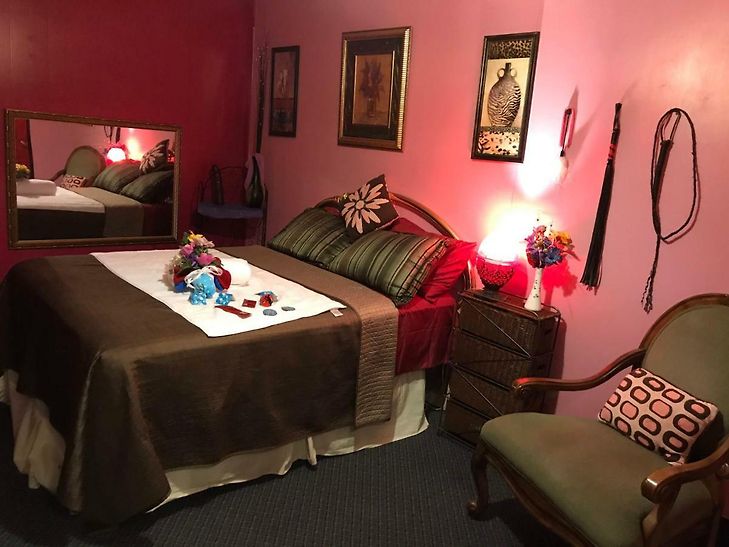
The whips on the wall of a bedroom at today's Rainey's Dance Hall (now Big Four) provide unique decor. Source: booked.net
 
 Rainey's Dance Hall was open for business beginning in the late 1800s. As Big Four, it still operates in Ely, Nevada, but, of course, under new ownership. It has in common with the Desert Club the fact that little remains known of its glory days.

The Pussycat Ranch (aka Pussycat Saloon, aka Pussycat Brothel) once stood on Riverside Street in Winnemucca, but it has since not only close but been demolished. In its flower, the Pussycat boasted a large, ornate bar, among its other diversions.


The Cosmopolitan, presumably, has seen better days. Source: nevadaadventures.com

Located in Belmont, the Cosmopolitan Saloon satisfied the needs of his clientele during the latter half of the 1800s. The July 27, 1874, edition of the Belmont Courier's June 27, 1874, noted that the law provided the means by which to quickly suppress such business enterprises and suggested that local government officials had the moral duty to do so. Such a “hurdy dance house,” the paper proclaimed was “a moral wrong,” if ever there was one, injurious to young and old alike, should they succumb to the establishment's “alluring temptations.”

The Cosmopolitan was a dangerous place to visit because of the gunfire that sometimes occurred on the premises as well, the article noted, although, admittedly, recent shootings had not resulted in any fatalities. Should a death occur as the result of such irresponsible conduct, however, the Courier reckoned that the county was likely to bear a cost of “$3,000 to $10,000 to prosecute the case.”

In commenting on the Courier's article, in “Hurdy houses, hurdy girls flourished in boom towns,” an installment in the Pahrump Valley Times's series of articles concerning Nevada's “history of prostitution,” the author, historian Bob McCracken, points out that “prostitutes were among the first arrivals in a mining boom town” and that they were held in esteem by men, who “generally saw them as tough and resourceful, passionate and fun-loving people with big hearts who provided an essential human service.”


 Belmont, Nevada. Source: Pinterest

Among the other bordellos that the article mentions is the Crook Shop. Regarding this establishment, McCracken reports on the double standard of the times regarding men, women, and prostitution. Men who availed themselves of “hurdy girls” might retain their respectability; the prostitutes, on the other hand, who were guilty of the same risque behavior, were regarded as disgraceful:

“It was noted that a woman who danced in the Crook Shop (a local brothel) was not admitted to a 'respectable party' while the man who danced with the 'hurdy-gurdy girl' suffered no diminished in respectability. Why should that be, the item asked: 'If there is any difference between Tweedle Dee and Tweedle Dum, we confess our ignorance' (Belmont Courier, June 27, 1874).”

  Hurdy gurdy girl. Source: hurdygurdyanthropology.
 

Note: Most historians make a distinction between "hurdy gurdy girls," German frauleins who played the hurdy gurdy and danced with men for a price (usually fifty cents per dance and another fifty cents for the couple's drinks) and "soiled doves" who entertained their clients in a much more "intimate" manner.

Tuesday, December 17, 2019

What's in a Movie Poster? Western Images, Themes, Qualities, Characters, and Values

Copyright 2019 by Gary L. Pullman
 
Western movies tend to do well at the box office, especially when their leading character is a star of the magnitude of John Wayne or Clint Eastwood.

How much do posters and lobby cards designed to promote these films help sell tickets? The answer is anybody's guess, but, apparently, even in the digital age, Hollywood believes that there is magic in such advertisements. Movie posters and lobby cards have long been staples of the promotion of movies of all genres, Westerns included. They remain so today.

Like movie posters that promote other genres, those that advertise Western films can pinpoint some of the features of such fare that screenwriters have found appeal to viewers. The same features, one might suppose, would also appeal to readers of Western novels.

Let's take a look at a Western movie poster, with an eye toward what, specifically, they advertise that's central to this genre.


The poster for Pale Rider, featuring Clint Eastwood, shows

  • a lone gunman fanning his Colt
  • a lone gunman who is dressed well by the standards of his time
  • seven men standing in a line
  • a block of buildings typical of Western towns
  • a caption, in small letters, at the heart of the sun-like circle to the right of Eastwood's head
  • the colors yellow, orange, red-orange, and reddish-brown
What can we infer from the images, design, colors, and text?
 
Typically, the Western hero is a solitary figure who's good with a gun and who is willing to risk his life to defend himself, another person, or his own values. He tends to be larger than life. The poster focuses on Eastwood's character, a lone gunman who is shown as a giant among men; the seven other figures shown in the poster are not only literally beneath him, but they are tiny in comparison, and, while he is shown in full color, they are little more than shadows. Next to him, the other men are insignificant, more like pesky gnats than worthy foes.

Not only is the lone gunman bigger than anyone else, but he is also central: he is shown near the center of the poster's focus. Thanks to his size, his facial features are easily discernible; he has an identity; he is an individual, a person with character. His weathered appearance, leathery skin, and sharp features mark him as an independent, hard-bitten man who's been around and knows the score. In his eyes, we see steely determination; his bared teeth show aggression. He is focused, intent, one with his gun. A man on a mission, he stands and delivers. These are the qualities of personality, the poster suggests, that are important to the audience for this actor's films. Moviegoers (or readers) who enjoy Westerns want a man who, even alone, will take a stand, risk his own life, and combat forces which would defy or destroy the principles he holds dear.

The lone gunman dresses better than many of his day, which suggests that he enjoys financial success. He may make his living by his gun. He may, in other words, be a gunfighter or a mercenary. (Those familiar with the “spaghetti Westerns” in which Eastwood starred will know, of course, that, in Pale Rider, he plays a bounty hunter).

The sun behind him isn't a halo exactly, or, if it is, it doesn't fit him precisely, but the effect is similar; the concentric circles of the high desert sun frame him closely enough to suggest that there may be more to him than meets the eye, even if he himself is not altogether holy.

The poster's colors are bright and vibrant, but the sun's brilliant yellow, by degrees, merges with the brown of the hero's coat and the sky, the element of air merging with the element of earth. Perhaps the lone gunman is a demigod, the Wild West's version of Hercules. Western fans want their heroes to be Heroes, to be writ large, to be of nearly supernatural dimensions.

The fact that the movie is set in the West is presented almost as an afterthought. The stretch of low buildings with false fronts and the line of small figures in Western garb are more like quick sketches that suggest, rather than depict, the setting. It is clear that the film is not so much about the West itself as it is about this one individual, the lone gunman who stands out.

White adds touches of sunlight to the brim of the gunman's hat (which is not a Stetson; this man is a gunman, but he's no cowboy). White also highlights his left cheek, the top of his shirt, the cuffs of his shirt sleeves, and the handle and the cylinder of his second gun, the Colt stuffed in his gun belt, a phallus not quite hidden and ready to hand, doubling his manhood.


In the yellow circle of the sun, the poster's caption, in small letters, whispers part of a verse in the book of Revelations: “. . . and hell followed with him,” suggesting the consequences of the Pale Rider's visit and connecting him to a figure of the Biblical apocalypse: “And I looked, and behold a pale horse: and his name that sat on him was Death, and Hell followed with him.” If there was any doubt as to the lone gunman's identity, the caption spells it out: the Pale Rider is, in fact, Death personified.
 
Without seeing the movie itself, these suggestions are all the poster's viewer has by which to decide whether to see the film. According to Box Office Mojo, Pale Rider grossed over $41 million, a fourth of this amount during its opening. Although other factors contributed to the film's success, it seems that potential viewers liked what the poster showed them. If they were attracted by the themes, the type of hero, and the character traits suggested by this poster, it's likely that they would be drawn to similar themes, heroes, and character traits in Western novels as well.


Friday, November 22, 2019

Nineteenth-Century Guns: What's in a Name (Part 2)

Copyright 2019 by Gary L. Pullman

Several weapons that first appeared during the days of the American Wild West are named for famous people.


Richard Jordan Gatling

Richard J. Gatling (1818-1903), a medical doctor, invented the Gatling gun in 1861 and patented it a year later. He hoped that his spring-loaded, hand-cranked weapon (Handbook of the Gatling Gun, Caliber .30, Models of 1895, 1900, and 1903, Metallic Carriage And Casement Mount, 13), would lead to armies of fewer troops, thereby reducing wartime deaths and casualties (Harold A. Skaarup, Shelldrake: Canadian Artillery Museums and Gun Monuments, 133). It was an early rapid-fire weapon, preceded only by the French mitrailleuse (Skaarup, 133).


French mitrailleuse

Since the gun required the gunner to crank a handle to fire the weapon, it is not an automatic weapon; the first automatic wouldn't be invented until 1884, when the 7.92-millimeter Maxim machine gun, appeared. (Skaarup, 133).


Gatling gun

The Gatling gun, however, was superior to other weapons of its day, because the time that it took to eject a spent cartridge and load the next round of ammunition during “the firing/reloading sequence” allowed the barrel to cool a bit, permitting “higher rates of fire . . . without the barrel['s] overheating” (Skaarp, 133). (Today, the U. S. Army's .50-caliber machine gun fires so many bullets so quickly that the barrel must be replaced at frequent intervals.)

https://www.amazon.com/gp/product/B07THD35QX?ref_=series_rw_dp_labf

Bane Messenger, the protagonist of my Western series, An Adventure of the Old West, uses a Gatling gun twice in Blood Mountain, to even the odds against him.


1873 Winchester Rifle

The Model 1873 Winchester rifle was sold as “The Gun that Won the West,” although, technically, of course, a rifle is not a “gun,” since a rifle is rifled, whereas the bore of a gun is smooth. Originally, the rifle fired a .44-40 centerfire cartridge. The bullet could travel at a velocity of about 1,500 feet-per-second. The rifle also featured “a sliding breech cover . . . that [kept] dirt and snow out of the breech,” and “an integrated safety sear . . . prevented accidental discharge of the rifle when the hammer was cocked” (Martin Pegler, Winchester Lever-Action Rifles).


Buffalo Bill Cody's 1873 Winchester rifle

Various lengths of barrels were available, as were a number of embellishments: “silver or gold plating, engraving, set triggers and special carrying cases” and “an all-in-one reloading tool” (Pegler).

The standard version of the rifle cost $27 ($439 today), the carbine $24 ($390 today), but “these prices were often doubled by the time the guns had shipped west” (Pegler).


Oliver Fisher Winchester

Oliver Winchester and his family became fabulously wealthy. His son, William Wirt Winchester, served as the treasurer of the Winchester Repeating Arms Company. After his demise, William's widow Sarah became convinced that their house was haunted. The ghosts of Native Americans and others who'd been killed by her family's rifle, she believed, were out for revenge. 

To protect herself, psychics told her, she had to continue to add on to the eight-room farmhouse she'd purchased in San Jose, California, after leaving her home in New Haven, Connecticut. The work had to continue non-stop, twenty-four hours a day, year after year—and it did, to the tune of $5 million ($71 million today), until her own death in 1922.


Sarah Winchester

To confuse the spirits, the 24,000-square-foot mansion (as it came to be) incorporated some decidedly strange features. For example, only one bathroom has a “working toilet”; the others were constructed to confuse the ghosts (Gia Lui, “Take a Tour of San Jose's Winchester Mystery House”).


Winchester Mystery House

Sunday, November 3, 2019

Night Riders

Copyright 2019 by Gary L. Pullman

https://www.amazon.com/gp/product/B07THD35QX?ref_=series_rw_dp_labf

Riding a horse at night sounds dangerous—and it can be—but it's not necessarily risky, if riders take precautions.

During cattle drives, cowboys often rode at night, as, on occasions, did posses hot on the trail of suspected outlaws.

In the days of the Wild West, there were no superhighways, streetlamps, or other modern inventions to worry about (night traffic can startle horses, and bright lights can temporarily blind them, neither of which situations is good for the safety of the horse or the rider).

Still, riding at night had distinct disadvantages on the frontier. Despite their good night vision, horses couldn't see every obstacle on the trail. Low branches could knock a rider from his or her mount. The resulting fall could break an arm or a leg (or a neck). Depending on where one rode, there could be close encounters of the worst kind, too, with bears, cougars, or other nighttime predators. In the event that a horse encounters an animal that might be a predator, it is apt to bolt, rather than to stand its ground while it attempts to discern whether the other animal is a threat. For horses, discretion is the better part of valor.

Most often, night riders rode in the company of others, whether fellow cowboys, other members of a posse, comrades in arms, or other members of their outlaw gangs. They'd avoid any gait other than a walk, unless they were sure the path ahead was level and free of obstacles.


Not all night riders were men, and not all of them rode horses by night on the frontier. Women also rode horses at night. One, a sixteen-year-old Connecticut girl, Sybil Ludington, rode forty miles, through the night in April 1777, “to warn her father's troops about a British attack on Danbury,” earning the praise of General George Washington. Thereafter, she became known as “the female Paul Revere.”


As Virginia C. Johnson makes clear in Virginia by Stagecoach, “Old Moll” Tate may not have ridden a horse after sunset, but she drove “the night stage from Abington to Blountville,” Virginia, “for several years” as a means of earning a living for herself and one of her children after losing the rest of her family, including her husband, to a plague (137). She had excellent night vision, which allowed her to avoid a tree that had fallen into the road (137). After mail she was carrying had been stolen, “Old Moll” Tate carried a “dummy” mail bag to “foist on any would-be robbers” (137). An extraordinary woman, she had fourteen given names, having been named after “each of the women who attended her birth and one for each of her aunts”: Mary Malzeeda Susan Elizabeth Cynthia Parnintha Sarah Adeline Rosey Daisy Laura Lucretia Louisa Jane (137).


According to Pinkerton detective Charles (“Charlie”) Siringo's A Cowboy Detective, Butch Cassidy escaped riding bareback one night and, to avoid lawmen, continued to ride at night, sleeping during the day. A posse led by William Beeler, on the trail of outlaw Kid Curry and his gang, “waylaid” Cassidy and his fellow traveler, outlaw “Red” Weaver. The lawmen continued to hunt Curry, as he and his gang “committed bloody crimes” as they rode north, but Cassidy escaped the posse's custody and lived on “nothing . . . but crackers.” It was only after Cassidy received news at one of the gang's “blind post offices,” that he learned the men from whom he was hiding during the day weren't members of Beeler's posse, after all, but his own “friends” (368).

Siringo himself was no stranger to night riding. Advised that a party of three-hundred men planned to “take over” Murray, Idaho, in order to kidnap him, Siringo writes, “I would pretend to retire to my room for the night; . . . then, I would slip down the back stairs and [ride] up the mountainside.” He would remain awake . . . on the mountainside overlooking the town,” his Winchester “ready for action,” until morning, when he “would return to the hotel . . . and slip into [his] room” (184). After providing testimony to a grand jury, Siringo thwarted “Dallas and his gang,” who intended to ambush him, by riding a rented horse twenty miles to Wallace instead of taking the stagecoach, the route of which went through “a dense growth of timber and underbrush,” which would have made ambushing the stage an easy matter (184).


In Pat Garrett: The Story of a Western Lawman, Leon Claire Metz recounts a night ride undertaken by Garrett and his posse. Charlie Thompson, Bill Gatlin (aka Dan Bogan), and Wade Woods were wanted for cattle rustling, and Garrett had obtained warrants for their arrests. The suspects were believed to alter the brands of the cattle they stole using “a versatile brand called the Tabletop.” So effective was the technique in changing marks that the difference was undetectable “unless the animal was killed and skinned and the hide turned inside out so that the old and new brands could be compared” (143).


Learning that the wanted men were hiding out in “a rock house at red River Springs near the Canadian River,” Garrett and his posse, joined by Sheriff James East, rode forth at night, during a fierce snowstorm, which, Garrett believed, was the most effective occasion “to hunt a badman” (143). The posse rode throughout the night, “pausing stiff and nearly frozen at two o'clock in the morning to feed their horses and bolt down a warm meal.”


Bill Gatlin (aka Dan Bogan)

Despite approaching the hideout from a direction that prevented the outlaws from seeing their approach, Garrett and his posse were spotted by Bob Basset, a member of the gang who was collecting firewood. Running back toward the house, Basset warned the other wanted men of the arrival of Garrett and his posse (143). To avoid a shootout, nine of the men inside the house left the domicile, including two of the suspects, Charlie Thompson and Wade Wood, who surrendered, but Garrett made the mistake of allowing Thompson to return to the house to fetch his coat, and Thompson then refused to return, saying he would fight and die beside Gatlin, who remained in the house. However, assuring Thompson of a fair trial, East was able to talk him into surrendering, and the arrests were made, after East entered the house and convinced Gatlin, with whom he had once herded cattle, to also surrender 143).

The outlaws were jailed in Tascosa, but Gatlin and Thompson escaped, using a file “someone [had] slipped them” to cut through their handcuffs (145). For their efforts, Garrett, East, and the rest of the posse retained in custody only two of the four fugitives they'd brought to justice.


Bob Switzer

Plenty of others rode horses at night (or drove stagecoaches after sunset), but none of them were equipped with the supplies recommended by today's experts—largely because most of these supplies didn't exist in the days of the American Wild West. For example, Equisearch: For People Who Love Horses recommends that night riders “carry a flashlight in case of emergencies,” being careful not to spook the horse in using the instrument. For greater visibility, the wearing of “reflective clothing” is also recommended (“Riding Your Horse at Night”). Battery-powered flashlights weren't patented until about 1899, and Bob Switzer didn't invent reflective clothing until the 1930s (he tested his new Day-Glo paint on his wife's wedding dress!), and such attire didn't become popular until World War II, when aircraft carrier crews began to wear it.

Another website, The Spruce Pets, recommends night riders carry not only flashlights and wear reflective clothing, but also equip themselves with headlamps, and wearable LED lights (“Safety Tips for Horseback Trail Riding at Night”). Headlamps did exist in the early 1880s, but they weren't the type of lights riders would want to use. They burned acetylene or oil, and, although the flames produced by such fuels were wind- and rain-resistant, it seems safe to bet they'd frighten horses.

British researcher H. J. Round invented the first light-emitting solid-state diode (LED) in 1907, but the public couldn't buy an LED light until dim red LED lights became “commercially available” during the 1960s, well past the era of the Wild West.

Horse & Rider is even more particular in regard to recommendations for safe night riding. A host of “special gear” is needed, the website's “Trail Riding at Night” article suggests, including “a handheld flashlight” as well as “a first-aid kit, a multipurpose tool, an EasyBoot,” glow sticks, and duct tape.

1888 Johnson & Johnson first-aid kit

We've already addressed the origin of flashlights. Commercially available first-aid kits appeared in 1888 (although riders could certainly assemble their own kits before then, if the thought occurred to them).


Sheffield contrivance

Such multi-purpose tools as the Modell [sic] 1890 “Sheffield contrivances,” as Herman Melville identifies them in chapter 107 of Moby Dick, consisted of pocket knives containing, all in one, “blades of various sizes, . . . screw-drivers, cork-screws, tweezers, awls, pens, rulers, nail-filers, [and] countersinkers,” and the Swiss army pocket knife debuted in 1890, featuring a spear point blade, a reamer, a can-opener, a screwdriver, and water-repellent grips” (The Swiss Army Knife Owner's Manual, September 7, 2011). For Wild West night riders who rode after 1890, these multi-purpose tools could have been carried in the saddlebags.

The EasyBoot was first sold in 1970, and could “be applied to the barefoot hoof. . . and used as a spare or . . . when a barefoot horse needs additional hoof protection,” so, of course, this item was unavailable to the night riders of the Old West.


When Edwin A. Chandross of Brooklyn, New York, in experimenting with luminol in the 1970s, mixed hydrogen peroxide with oxalyl chloride and dye, the mixture “emitted a [feeble] visible light,” but glow sticks were not invented until 1976, when, after a variety of materials and devices were patented, “the first . . . device to resemble glow sticks as we know them today,” the Chemiluminescent Signal Device, was patented by Vincent J. Esposito, Steven M. Little, and John H. Lyons. Clearly the night riders of the latter half of the nineteenth century would not have had access to glow sticks.


Duct tape was invented in 1943, after Vesta Stoudt, a worker at the Green River ordnance Plant in Illinois, wrote a letter to President Franklin Delano Roosevelt, asking him to pursue her idea of replacing the thin tape that sealed packages of cartridges used to launch rifle grenades with a stronger “cloth-based waterproof tape” that would not tear away when soldiers opened the ammunition packages, leaving them “frantically scrambling to claw the boxes open while under enemy fire.” She'd proposed the idea to her superiors at work, but it seemed to have gone nowhere. Roosevelt forwarded her letter to the War Production Board, which contracted the task of producing the tape to Johnson & Johnson. Although duct tape might be highly recommended for night riders' use, those who rode horses at night prior to World War II wouldn't have been able to adopt the suggestion (“The Woman Who Invented Duct Tape”).

https://www.amazon.com/gp/product/B07THD35QX?ref_=series_rw_dp_labf

Of the modern recommendations for items to carry on night rides, the horsemen and horsewomen of the Old West would have been able to take with them headlamps (although they probably wouldn't have wanted to do so, as the flames would have startled their horses), self-assembled first-aid kits, and multi-purpose tools of the type that Melville describes or the earliest Swiss army knife alternative. Mostly, though the night riders of the Old West (and of eras before then) would have had to trust their horses' excellent night vision, the animals' instinct, and their own experience as riders. Examples such as those of Ludington, Tate, Siringo, Garrett, and others suggest that the night riders' trust in their horses' night vision and instinct was well placed.

Saturday, October 19, 2019

Frank and Frank

Copyright 2019 by Gary L. Pullman


First published in 1855, Frank Leslie's Illustrated Newspaper (later Leslie's Weekly) ended its run in 1922. As its title suggests, the periodical provided engravings and Daguerreotypes (and, later, photographs) as illustrations of the news of the day.

According to Joshua Brown, author of The Great Uprising and Pictorial Order in Gilded Age America, the newspaper's illustrated articles concerning the American Civil War, which were often shocking and sensational, catapulted the publication to success (20).


Frank Leslie

In producing the 16-page newspaper, a laborious sort of assembly-line approach was taken to produce each illustration. It took artists and engravers eight hours to produce one completed illustration—and this period of time represented an increase in speed; before the assembly-line process was introduced, producing a single finished illustration took as long as an entire week (Brown, Beyond the Lines: Pictorial Reporting, Everyday Life, and the Crisis of Gilded Age America 33).


However, a “beeswax mold” then had to be the finished picture then had to be made of the page bearing the illustration, after which this mold was immersed “in an electrocharged bath containing copper particles” so that it could be copperplated—a process which took “between thirty and forty-eight hours” (Beyond the Lines 33).

Over time, this process was expedited so that “by the 1880s three sets of Frank Leslie's, comprising forty-eight pages, were being electroplated in three hours” (Beyond the Lines 39).


Critics pointed out that the newspaper's claim that the resulting pictures provided “'eye-witness' recordings of events” was far from the truth, as they tended to be based more on the artists' imagination than on a “direct observation” of the events they supposedly depicted (Beyond the Lines 33).

The printing of the newspaper itself was also a time-consuming enterprise, but, like the production of its illustration, the time required for the printing of the publication also decreased thanks to technological developments and other innovations. For example, the newspaper's purchase of a Taylor Perfecting Press in 1858 allowed 1,200 copies per hour of the newspaper to be printed (Beyond the Lines 40). As a result, Frank Leslie's could report on the current events of the day while they were still current.


To appeal to the public, the newspaper routinely printed lurid stories; as Brown points out, such fare included engravings of details of “notorious crimes, . . . sexually charged cheap amusements and “violent” rough sports” (Beyond the Lines 41).

Indeed, the covers of the newspaper indicate the lurid nature of the publication's contents.

After almost 80 years, Frank Leslie's periodical ceased publication. Leslie died in 1880. As the result of an expensive train trip that he'd taken with his second wife, Miriam, and a bevy of their friends in 1887, which Miriam describes in her book From Gotham to the Golden Gate, an an economic recession, the publication was in poor financial shape (Woman of the Century 459).


Frank Leslie

Upon her husband's death, Miriam changed her name to his (Dictionary of American Biography, Vol. 11, 186), and, as Frank Leslie, ran the business until 1992, when, tiring of the task, she sold the publication “and its German edition for between $300,000 and $4000,000” (Woman of the Century 459).


William ("Willie") Charles Kingsbury Wilde

As a result, “in her early fifties,” she was “extremely rich” (Beyond the Lines 233). She married yet again, to her fourth husband, Oscar Wilde's younger brother William (“Willie”) Charles Kingsbury Wilde, who was seventeen years younger than she (Beyond the Lines 233).


List o f 19th-Century U. S. Western Frontier Forts, Part VIII: Montana

Note : This is the eighth of a series of lists of the  U. S. forts of the Wild West. It is intended for use in research by writers, readers,...