Showing posts with label cattle drive. Show all posts

Wednesday, June 30, 2021

The Wild West's Nevada Bordellos

 Copyright 2021 by Gary L. Pullman


Our review of some of Nevada's Wild West towns along Highway 50 and Interstate 80 reveal some of the motives westward travelers and frontier settlers had in migrating from points east. Watering holes and bodies of water along overland trails (like the existence of the trails themselves); the building of the Transcontinental Railroad; discoveries of silver, gold, lead, and other ores; and politics brought men, women, and children west, where the frontier seemed a land of possibilities and, perhaps, for some, wealth, as well as adventure.

We can pretty well guess why prostitution was widespread throughout the West. There were few women and lots of men. The law of supply and demand made brothels lucrative business ventures—for their owners, at least—and provided employment for women, which was scarce on the frontier. There were, after all, only so much demand for laundresses, schoolmarms, seamstresses, store clerks, waitresses, and the like, and, aside from these occupations, respectable women had few options. Sometimes, a woman became a “soiled dove” simply because she had no other alternative.

 
Today, Donna's Ranch continues to cater to its clientele.Source: Yelp

What else can we discern by investigating some of the brothels known to have existed in Nevada during the nineteenth century? A fairly well documented establishment of this type was Donna's Ranch in Wells. During its Wild West heyday, this bordello, which has been in operation since 1867, had two major types of clients: the men constructing the Central Pacific Railroad and the cowboys who drove herds to the railroad's cattle-boarding locations and sometimes paid for the prostitutes' services with cows in lieu of dollars. Its more recent owners have included heavyweight champion Jack Dempsey (1895-1983).

 The Desert Club's contemporary look. Source: Desert Club Girls

 The Desert Club, a Battle Mountain brothel that first opened its doors in the late 1800s, includes only five rooms. It's back in business, having reopened under new management in 2016, after closing in 1991, having been temporarily transformed into a mining museum during the interim. Unfortunately, nothing much is known about its operations during its frontier days.
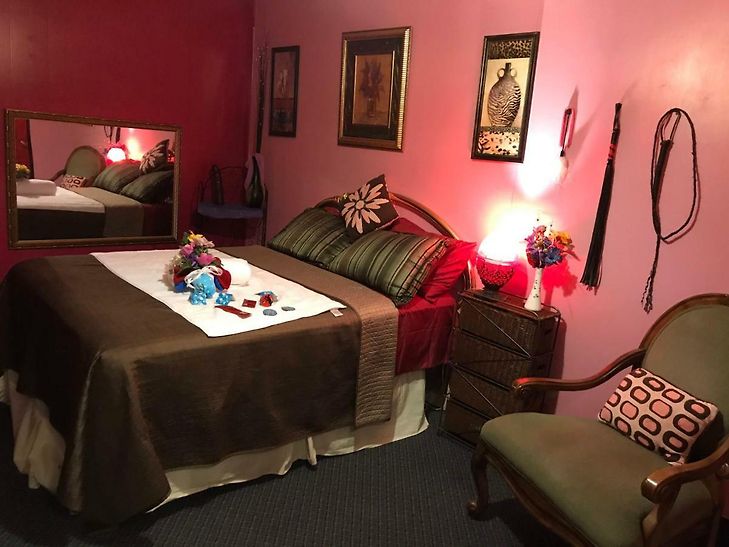
 
The whips on the wall of a bedroom at today's Rainey's Dance Hall (now Big Four) provide unique decor. Source: booked.net
 
 Rainey's Dance Hall was open for business beginning in the late 1800s. As Big Four, it still operates in Ely, Nevada, but, of course, under new ownership. It has in common with the Desert Club the fact that little remains known of its glory days.

The Pussycat Ranch (aka Pussycat Saloon, aka Pussycat Brothel) once stood on Riverside Street in Winnemucca, but it has since not only close but been demolished. In its flower, the Pussycat boasted a large, ornate bar, among its other diversions.


The Cosmopolitan, presumably, has seen better days. Source: nevadaadventures.com

Located in Belmont, the Cosmopolitan Saloon satisfied the needs of his clientele during the latter half of the 1800s. The July 27, 1874, edition of the Belmont Courier's June 27, 1874, noted that the law provided the means by which to quickly suppress such business enterprises and suggested that local government officials had the moral duty to do so. Such a “hurdy dance house,” the paper proclaimed was “a moral wrong,” if ever there was one, injurious to young and old alike, should they succumb to the establishment's “alluring temptations.”

The Cosmopolitan was a dangerous place to visit because of the gunfire that sometimes occurred on the premises as well, the article noted, although, admittedly, recent shootings had not resulted in any fatalities. Should a death occur as the result of such irresponsible conduct, however, the Courier reckoned that the county was likely to bear a cost of “$3,000 to $10,000 to prosecute the case.”

In commenting on the Courier's article, in “Hurdy houses, hurdy girls flourished in boom towns,” an installment in the Pahrump Valley Times's series of articles concerning Nevada's “history of prostitution,” the author, historian Bob McCracken, points out that “prostitutes were among the first arrivals in a mining boom town” and that they were held in esteem by men, who “generally saw them as tough and resourceful, passionate and fun-loving people with big hearts who provided an essential human service.”


 Belmont, Nevada. Source: Pinterest

Among the other bordellos that the article mentions is the Crook Shop. Regarding this establishment, McCracken reports on the double standard of the times regarding men, women, and prostitution. Men who availed themselves of “hurdy girls” might retain their respectability; the prostitutes, on the other hand, who were guilty of the same risque behavior, were regarded as disgraceful:

“It was noted that a woman who danced in the Crook Shop (a local brothel) was not admitted to a 'respectable party' while the man who danced with the 'hurdy-gurdy girl' suffered no diminished in respectability. Why should that be, the item asked: 'If there is any difference between Tweedle Dee and Tweedle Dum, we confess our ignorance' (Belmont Courier, June 27, 1874).”

  Hurdy gurdy girl. Source: hurdygurdyanthropology.
 

Note: Most historians make a distinction between "hurdy gurdy girls," German frauleins who played the hurdy gurdy and danced with men for a price (usually fifty cents per dance and another fifty cents for the couple's drinks) and "soiled doves" who entertained their clients in a much more "intimate" manner.

Tuesday, November 12, 2019

Charles Siringo: The Moral of the Story

Copyright 2019 by Gary L. Pullman

https://www.amazon.com/Cowboy-Detective-Twenty-Two-Famous-Agency/dp/154500188X/ref=sr_1_1?keywords=a+cowboy+detective+siringo&qid=1573582342&sr=8-1

According to Pinkerton detective Charles (“Charlie”) Siringo, a year after Dodge City's incorporation, 81 men had been buried in the town's graveyard. Eighty of them had been killed, only one having experienced “a natural death” (A Cowboy Detective 315).


It was in this wild West town that Siringo first encountered Bat Masterson, the nighttime bartender at the Lone Star dance hall. Siringo, attracted by the hall's good-looking women and the establishment's “Texas flavor,” visited the place with a cowboy friend, “Wess” Adams (315). Wess, complaining of having been insulted by Jim White, a buffalo hunter, enlisted Siringo's assistance (315).


Bat Masterson

In the ensuing barroom fight, Masterson intervened, tossing a handful of “heavy beer glasses” at Siringo, one of which, breaking, drew blood (135). A dozen men were involved in the fracas; Masterson didn't differentiate between brawlers and bystanders, but struck anyone in range of the ice mallet he'd taken from its place behind the bar (135).


Jim White

Some of the fighters clubbed others with their pistols. When Siringo saw White “lying on the floor apparently dead, with blood flowing from wounds in the head,” and witnessed Adams being stabbed “in the back,” he beat a hasty retreat, Adams in tow, to their horses, hitched out front, and threatened a police officer, Joe Mason, who barred their way, before riding out of town (136-137).

Siringo and Adams took refuge in a stock yard “shanty.” Examining Adams's knife wound, Siringo saw that it was, indeed, “serious”:

. . . The knife had been thrust in and then brought around in a semi-circle in the shape of a large horseshoe. The open part of the shoe was where the flesh was not cut, and the other part of the wound [was where] the flesh stood out several inches from the body. The clothing was saturated with blood (317).


Charles Siringo

There was nothing to do but ride back into Dodge. Suspecting that the police might be waiting to ambush him, should he return to town, Siringo took a different route back to Dodge, where he bought supplies at the local drug store: “needles and thread, sticking plaster, and a candle” (318).

Returning to the shanty by the same route he'd ridden back to town, Siringo tried, unsuccessfully, to stitch his friend's wound, but found that “the horseshoe[-] shaped protruding flesh could not be pushed back into place on a level with the rest of the body” (318).

Siringo had no alternative but to apply the sticking plaster, before the men rode eighteen miles “to the Bates & Beals cattle camp,” as Adams became progressively weaker “from loss of blood” (318).

Later, Siringo learned that White, “the boss of a large gang of buffalo hunters,” had survived; he ultimately “recovered” from his “many wounds” and the multiple cracks in his skull (319). Siringo also learned, years later, upon meeting Masterson, that he'd been right to take a different route back into Dodge than the one he and Adams had taken out of town, as Masterson “and a gang of officers” had, indeed, been lying in wait to ambush him, had he ridden back to Dodge by the same path he'd left town. “Armed with rifles and shotguns,” the posse had “stood guard till morning,” intent upon making “angels” of the suspects “if [they] returned” (318).


Siringo ends his account of “how near” he'd come “to being put out of business by Bat Masterson” (315) by drawing a moral for his story: “This little scrape illustrates what fools cowboys were after long drives over the rail” (319).

Sunday, November 3, 2019

Night Riders

Copyright 2019 by Gary L. Pullman

https://www.amazon.com/gp/product/B07THD35QX?ref_=series_rw_dp_labf

Riding a horse at night sounds dangerous—and it can be—but it's not necessarily risky, if riders take precautions.

During cattle drives, cowboys often rode at night, as, on occasions, did posses hot on the trail of suspected outlaws.

In the days of the Wild West, there were no superhighways, streetlamps, or other modern inventions to worry about (night traffic can startle horses, and bright lights can temporarily blind them, neither of which situations is good for the safety of the horse or the rider).

Still, riding at night had distinct disadvantages on the frontier. Despite their good night vision, horses couldn't see every obstacle on the trail. Low branches could knock a rider from his or her mount. The resulting fall could break an arm or a leg (or a neck). Depending on where one rode, there could be close encounters of the worst kind, too, with bears, cougars, or other nighttime predators. In the event that a horse encounters an animal that might be a predator, it is apt to bolt, rather than to stand its ground while it attempts to discern whether the other animal is a threat. For horses, discretion is the better part of valor.

Most often, night riders rode in the company of others, whether fellow cowboys, other members of a posse, comrades in arms, or other members of their outlaw gangs. They'd avoid any gait other than a walk, unless they were sure the path ahead was level and free of obstacles.


Not all night riders were men, and not all of them rode horses by night on the frontier. Women also rode horses at night. One, a sixteen-year-old Connecticut girl, Sybil Ludington, rode forty miles, through the night in April 1777, “to warn her father's troops about a British attack on Danbury,” earning the praise of General George Washington. Thereafter, she became known as “the female Paul Revere.”


As Virginia C. Johnson makes clear in Virginia by Stagecoach, “Old Moll” Tate may not have ridden a horse after sunset, but she drove “the night stage from Abington to Blountville,” Virginia, “for several years” as a means of earning a living for herself and one of her children after losing the rest of her family, including her husband, to a plague (137). She had excellent night vision, which allowed her to avoid a tree that had fallen into the road (137). After mail she was carrying had been stolen, “Old Moll” Tate carried a “dummy” mail bag to “foist on any would-be robbers” (137). An extraordinary woman, she had fourteen given names, having been named after “each of the women who attended her birth and one for each of her aunts”: Mary Malzeeda Susan Elizabeth Cynthia Parnintha Sarah Adeline Rosey Daisy Laura Lucretia Louisa Jane (137).


According to Pinkerton detective Charles (“Charlie”) Siringo's A Cowboy Detective, Butch Cassidy escaped riding bareback one night and, to avoid lawmen, continued to ride at night, sleeping during the day. A posse led by William Beeler, on the trail of outlaw Kid Curry and his gang, “waylaid” Cassidy and his fellow traveler, outlaw “Red” Weaver. The lawmen continued to hunt Curry, as he and his gang “committed bloody crimes” as they rode north, but Cassidy escaped the posse's custody and lived on “nothing . . . but crackers.” It was only after Cassidy received news at one of the gang's “blind post offices,” that he learned the men from whom he was hiding during the day weren't members of Beeler's posse, after all, but his own “friends” (368).

Siringo himself was no stranger to night riding. Advised that a party of three-hundred men planned to “take over” Murray, Idaho, in order to kidnap him, Siringo writes, “I would pretend to retire to my room for the night; . . . then, I would slip down the back stairs and [ride] up the mountainside.” He would remain awake . . . on the mountainside overlooking the town,” his Winchester “ready for action,” until morning, when he “would return to the hotel . . . and slip into [his] room” (184). After providing testimony to a grand jury, Siringo thwarted “Dallas and his gang,” who intended to ambush him, by riding a rented horse twenty miles to Wallace instead of taking the stagecoach, the route of which went through “a dense growth of timber and underbrush,” which would have made ambushing the stage an easy matter (184).


In Pat Garrett: The Story of a Western Lawman, Leon Claire Metz recounts a night ride undertaken by Garrett and his posse. Charlie Thompson, Bill Gatlin (aka Dan Bogan), and Wade Woods were wanted for cattle rustling, and Garrett had obtained warrants for their arrests. The suspects were believed to alter the brands of the cattle they stole using “a versatile brand called the Tabletop.” So effective was the technique in changing marks that the difference was undetectable “unless the animal was killed and skinned and the hide turned inside out so that the old and new brands could be compared” (143).


Learning that the wanted men were hiding out in “a rock house at red River Springs near the Canadian River,” Garrett and his posse, joined by Sheriff James East, rode forth at night, during a fierce snowstorm, which, Garrett believed, was the most effective occasion “to hunt a badman” (143). The posse rode throughout the night, “pausing stiff and nearly frozen at two o'clock in the morning to feed their horses and bolt down a warm meal.”


Bill Gatlin (aka Dan Bogan)

Despite approaching the hideout from a direction that prevented the outlaws from seeing their approach, Garrett and his posse were spotted by Bob Basset, a member of the gang who was collecting firewood. Running back toward the house, Basset warned the other wanted men of the arrival of Garrett and his posse (143). To avoid a shootout, nine of the men inside the house left the domicile, including two of the suspects, Charlie Thompson and Wade Wood, who surrendered, but Garrett made the mistake of allowing Thompson to return to the house to fetch his coat, and Thompson then refused to return, saying he would fight and die beside Gatlin, who remained in the house. However, assuring Thompson of a fair trial, East was able to talk him into surrendering, and the arrests were made, after East entered the house and convinced Gatlin, with whom he had once herded cattle, to also surrender 143).

The outlaws were jailed in Tascosa, but Gatlin and Thompson escaped, using a file “someone [had] slipped them” to cut through their handcuffs (145). For their efforts, Garrett, East, and the rest of the posse retained in custody only two of the four fugitives they'd brought to justice.


Bob Switzer

Plenty of others rode horses at night (or drove stagecoaches after sunset), but none of them were equipped with the supplies recommended by today's experts—largely because most of these supplies didn't exist in the days of the American Wild West. For example, Equisearch: For People Who Love Horses recommends that night riders “carry a flashlight in case of emergencies,” being careful not to spook the horse in using the instrument. For greater visibility, the wearing of “reflective clothing” is also recommended (“Riding Your Horse at Night”). Battery-powered flashlights weren't patented until about 1899, and Bob Switzer didn't invent reflective clothing until the 1930s (he tested his new Day-Glo paint on his wife's wedding dress!), and such attire didn't become popular until World War II, when aircraft carrier crews began to wear it.

Another website, The Spruce Pets, recommends night riders carry not only flashlights and wear reflective clothing, but also equip themselves with headlamps, and wearable LED lights (“Safety Tips for Horseback Trail Riding at Night”). Headlamps did exist in the early 1880s, but they weren't the type of lights riders would want to use. They burned acetylene or oil, and, although the flames produced by such fuels were wind- and rain-resistant, it seems safe to bet they'd frighten horses.

British researcher H. J. Round invented the first light-emitting solid-state diode (LED) in 1907, but the public couldn't buy an LED light until dim red LED lights became “commercially available” during the 1960s, well past the era of the Wild West.

Horse & Rider is even more particular in regard to recommendations for safe night riding. A host of “special gear” is needed, the website's “Trail Riding at Night” article suggests, including “a handheld flashlight” as well as “a first-aid kit, a multipurpose tool, an EasyBoot,” glow sticks, and duct tape.

1888 Johnson & Johnson first-aid kit

We've already addressed the origin of flashlights. Commercially available first-aid kits appeared in 1888 (although riders could certainly assemble their own kits before then, if the thought occurred to them).


Sheffield contrivance

Such multi-purpose tools as the Modell [sic] 1890 “Sheffield contrivances,” as Herman Melville identifies them in chapter 107 of Moby Dick, consisted of pocket knives containing, all in one, “blades of various sizes, . . . screw-drivers, cork-screws, tweezers, awls, pens, rulers, nail-filers, [and] countersinkers,” and the Swiss army pocket knife debuted in 1890, featuring a spear point blade, a reamer, a can-opener, a screwdriver, and water-repellent grips” (The Swiss Army Knife Owner's Manual, September 7, 2011). For Wild West night riders who rode after 1890, these multi-purpose tools could have been carried in the saddlebags.

The EasyBoot was first sold in 1970, and could “be applied to the barefoot hoof. . . and used as a spare or . . . when a barefoot horse needs additional hoof protection,” so, of course, this item was unavailable to the night riders of the Old West.


When Edwin A. Chandross of Brooklyn, New York, in experimenting with luminol in the 1970s, mixed hydrogen peroxide with oxalyl chloride and dye, the mixture “emitted a [feeble] visible light,” but glow sticks were not invented until 1976, when, after a variety of materials and devices were patented, “the first . . . device to resemble glow sticks as we know them today,” the Chemiluminescent Signal Device, was patented by Vincent J. Esposito, Steven M. Little, and John H. Lyons. Clearly the night riders of the latter half of the nineteenth century would not have had access to glow sticks.


Duct tape was invented in 1943, after Vesta Stoudt, a worker at the Green River ordnance Plant in Illinois, wrote a letter to President Franklin Delano Roosevelt, asking him to pursue her idea of replacing the thin tape that sealed packages of cartridges used to launch rifle grenades with a stronger “cloth-based waterproof tape” that would not tear away when soldiers opened the ammunition packages, leaving them “frantically scrambling to claw the boxes open while under enemy fire.” She'd proposed the idea to her superiors at work, but it seemed to have gone nowhere. Roosevelt forwarded her letter to the War Production Board, which contracted the task of producing the tape to Johnson & Johnson. Although duct tape might be highly recommended for night riders' use, those who rode horses at night prior to World War II wouldn't have been able to adopt the suggestion (“The Woman Who Invented Duct Tape”).

https://www.amazon.com/gp/product/B07THD35QX?ref_=series_rw_dp_labf

Of the modern recommendations for items to carry on night rides, the horsemen and horsewomen of the Old West would have been able to take with them headlamps (although they probably wouldn't have wanted to do so, as the flames would have startled their horses), self-assembled first-aid kits, and multi-purpose tools of the type that Melville describes or the earliest Swiss army knife alternative. Mostly, though the night riders of the Old West (and of eras before then) would have had to trust their horses' excellent night vision, the animals' instinct, and their own experience as riders. Examples such as those of Ludington, Tate, Siringo, Garrett, and others suggest that the night riders' trust in their horses' night vision and instinct was well placed.

Wednesday, October 30, 2019

Wild West Coffee

Copyright 2019 by Gary L. Pullman


Photo courtesy of Folger's Coffee

Readers and writers of Western fiction are always interested in the verisimilitude that historically accurate references provide. When it comes to coffee, quite a bit of which cowboys and other men of the West drank on a regular basis, it was, more often than not, Folger's in their cups.

The fact that such men enjoyed a morning cup of joe is reflected in the fact that they made room for sacks of coffee beans aboard their wagons, the additional weight be damned.


Photo courtesy of White Buffalo Trading Co.

The beans were green, though, so they had be roasted over an open fire or atop a stove before they were fit to use—after they were ground. Since boiling the grounds didn't guarantee there'd be no grounds in the resulting beverage, the coffee was poured into a saucer, blown upon to cool it, and then slurped to filter out any stray grounds that might remain.


Photo courtesy of Folger's Coffee

As this process suggests, it took time to brew up a decent cup of coffee. James Athern Folger would make the process easier, buying out the partners in Pioneer Mills and renaming it the James A. Folger Company. When he died in 1889, his oldest son, James A. Folger II (1835-1889), took over as the company's president, and expanded the business. In 1963, the company was sold to Procter & Gamble. Today, the coffee is a member of “the J. M. Smucker Company's family of brands.”


Photo courtesy of Find-a-Grave

John Arbuckle's coffee was also a Wild West winner. By using “an egg and sugar glaze” that contained “Irish moss,” he “sealed in the flavor”of unground roasted green beans, selling them in “one-pound bags” as Arbuckle's Ariosa Coffee.


Photo courtesy of on target shooters nz

Arbuckle also began to include such offerings as “coupons . . . scissors . . . . [and] peppermint candy.” On cattle drives, cooks bartered the candy for the service of a cow hand who'd agree to turn the coffee grinder's crank.

Later, he ground the beans as well, saving his customers the time and trouble of grinding them themselves.

By the time he died, in 1912, Arbuckle had become a millionaire several times over, thanks to his coffee.

Thursday, October 10, 2019

Authentic Cowgirls of the Wild West

Copyright 2019 by Gary L. Pullman

Not much is often written about the authentic cowgirls of the American West. However, a few authors' works contribute to this interesting topic.


According to one such work, Joyce Gibson Roach's 1990 The Cowgirls, the Civil War transformed the retiring, well-mannered homemaker of the aristocratic South into a hardy pioneer woman who took an active part in her family's “survival” on the frontier.


“The cowgirl was no Guinevere,” Roach observes. “She did not stay at home weaving the events of her life into a tapestry and awaiting the hero's return” (xix). Nor were the displaced women who wandered west all from high society or from the South, for that matter: “Rich or poor, refined or rough, high born and low found that the frontier experience was a great leveller [sic]” (xix).


As in the antebellum South, women on the frontier were often called upon to do work usually reserved for men. In the absence, temporary or permanent, of their husbands, women “had to take charge of a cattle ranch” (xix), and desperate circumstances sometimes produced innovative and unusual solutions. For example, “a crippled husband caused a Montana woman to drive a team for the local stage line, in addition to managing the ranch” (ix).

The demands of ranching, driving a stagecoach, or other duties afforded cowgirls some privileges their sisters back east didn't have; cowgirls were free to “dress as they pleased” (xx), and many likely wore “britches” under their skirts (xx). Some rode horses and learned to use the weapons they carried on their persons for self-defense, including “guns . . . ropes, knives, [and] whips” (xx).

Roach's brief anecdotes about authentic cowgirls of the Old West provide her readers with an idea of these stalwart women, the lives they lived, and the adventures they experienced.

Minta Homsley

During the “early 1870s," Roach writes, while her husband was away from home, Mrs. Minta Homsley received a telegram indicating that a cattle buyer wanted an immediate delivery of their ranch's steers. She saw that the cattle were shipped; as a result, she “got top price." Two days later the bottom dropped out of the market” (8).

Lizzie Johnson Williams


Using a pen name, schoolmarm Lizzie Johnson Williams supplemented her income by writing articles for Frank Leslie's Illustrated Newspaper (later called Frank Leslie's Magazine), earning enough money to purchase “$2,500 worth of stock in” a cattle company (9).


She started branding her own cattle, expanding her herd by hiring hands to capture the many unbranded cattle that wandered among South Texas “thickets” (9).

Before marrying, at age 36, Lizzie insisted that she and her future spouse, Hezekiah, would each take charge only of his or her own business dealings, and she and her fiance signed an agreement stipulating that Lizzie's personal property would remain hers alone after their marriage, as would “future profits made by her.”

Lizzie also instructed their ranch's foreman to “put the best steers in her herd” and to steal “unbranded calves” from Hezekiah's cattle and “mark them with her brand” (9).


After marrying, Lizzie drove her own herd of cattle up the Chisholm Trail, while Hezekiah drove a second herd along the same trail (9).

When her husband “went broke” through a bad investment, she loaned him $50,000 “to re-establish his business,” but made him "pay back the money” once he was on his feet again.

Despite her scheming ways, Lizzie “was fond of” Hezekiah, and, when he died, she bought a $600 coffin for him, writing on the bill she paid, “I loved this old buzzard this much” (9).

Saturday, September 7, 2019

Using Resources to Research and Better appreciate the Old West

Copyright 2019 by Gary L. Pullman

 When we think of the towns of the Old West, only a few names are apt to come to mind: Abilene, Kansas, Coffeyville, Kansas, Dodge City, Kansas, Deadwood, South Dakota, Tombstone, Arizona, and—uh?

Of course, these towns are largely associated with bigger-than-life figures: Wild Bill Hickok (Abilene, Kansas, and Deadwood, South Dakota); the Dalton gang (Coffeyville, Kansas); Wyatt Earp, Bat Masterson, and Doc Holliday (Dodge City, Kansas, and Tombstone, Arizona).


There are other ways to identify—and to think about—the towns of the Old West, though. A map of the route of the transcontinental railroad, like maps of other Wild West occasions and enterprises, reveals the names of a lot of towns (some of which, such as Laramie, Wyoming, and North Platte, Nebraska, developed alongside the railroad).

 Note: Reading about such towns is interesting in itself for Wild West buffs, the writers among whom may develop plots and plot twists, and situations; meet and invent characters; find or create settings; discover conflicts; encounter true-life incidents and scenarios; and obtain facts by which to make stories more interesting, realistic, and authentic.
 
 Black dots = gold mines; red dots = mining towns
Click the image to enlarge it.

A map showing gold or silver mines will usually also show the boom towns that grew up nearby, many of them during the years of the Old West; some are Sutter's Mill, California; Central City, Colorado, Leadville, Colorado, and Silverton, Colorado; Silver City, New Mexico; and Virginia City, Nevada.

 Note: Reading about these mines and boom towns is, again, both intriguing in itself and, for Western writers, offers a wealth of potential material and a mountain of facts.


 Click the image to enlarge it.
 Source: Pinterest

 Maps of cattle trails show the towns (and Army posts) through which the trails ran and towns nearby, including (in Texas) San Antonio, Austin, Fort graham, Fort Worth, and Doan's Crossing and (in Kansas) Wichita, Caldwell, Newton, Ellsworth, Abilene, and Dodge City (Chisholm Trail); (in Texas) Fort Belknap, Concho, and Fort Concho, (in Colorado) Pueblo, and (in New Mexico) El Paso, Tularosa, and Fort Sumner; and (in Texas) Bandera, and (in Nebraska) Ogallala (Western Trail).

 Note: Not only do the towns, terrain features, and other points of interest in specific maps relate to particular aspects of the western experience—in this case, mining—but they also provide the other benefits already mentioned in previous notes.


A good road atlas, such as Rand McNally publishes, is also an excellent way to locate settings for Westerns or for readers and writers to identify sites that may be of interest to fans of the genre.
 
For example, Interstate 80 pretty much follows the route of the transcontinental railroad, and U. S. Highway 50 connects towns to which the Southern Pacific Railroad was linked by trunk lines: Austin, Eureka, and (later) Ely.

In Colorado (and elsewhere), several present-day cities along U. S. Highway 50 existed during the days of the Old West, including Grand Junction (incorporated 1882), Delta (incorporated 1882), Montrose (incorporated 1882), Gunnison (incorporated 1880), Maysville (early 1880s), Salida (incorporated 1891), Canon City (incorporated 1872), Pueblo (incorporated 1885), Rocky Ford (incorporated 1887), La Junta (incorporated 1881), Las Animas (incorporated 1886), Fort Lyon, Lamar (incorporated 1886), and Granada (incorporated 1887); plenty of other nearby towns also existed during the heyday of the Wild West.
On the Rand McNally atlas pages for Colorado, red squares along the highway identify points of interest, many of which pertain to the Old West: Ute Indian Museum near Montrose; The Angel of Shavano near Monarch; Koshare Indian Museum and Kiva near La Junta; Bent's Old Fort National Historical Site, Fort Carson Museum, Boggsville, and Fort Lyon National Cemetery between la Junta and Las Animas; and Big Timbers Museum near Lamar.

On the Rand McNally atlas pages for Colorado, red squares along the highway identify points of interest, many of which pertain to the Old West: Ute Indian Museum near Montrose; The Angel of Shavano near Monarch; Koshare Indian Museum and Kiva near La Junta; Bent's Old Fort National Historical Site, Fort Carson Museum, Boggsville, and Fort Lyon National Cemetery between la Junta and Las Animas; and Big Timbers Museum near Lamar.

Click the image to enlarge it.

 
 A map of the Pony Express route, from St. Joseph, Missouri, west to Sacramento, California, identifies numerous towns, cities, rocks, bridges, creeks, rivers, forts, mountain passes, mesas, and other points of interest in the Old West, including

 (in Kansas) Elwood, Kennekuk, Kickapoo, Granada, Log Chain, Seneca, Guittard's, Marysville, and Hollenberg;

 (in Nebraska) Rock Creek, Big Sandy, Thompson's, Kiowa, Liberty Farm, Thirty-Two-Mile Creek, Lone Tree, Summit, Hooks, Fort Kearny, Platte Station, Craig's, Plum Creek, Willow Spring, Midway, Gilman's, Sam Mettache's, Cottonwood, Cold Spring, Fremont Spring, O'Fallon's, Alkali, Beauvai's, Diamond Spring, Lodge Pole, Thirty-Mile Ridge, Midway (yes, a second one!), Mud Springs, Courthouse Rock, Junction, Chimney Rock, Ficklin's, Fort Mitchell, Horse Creek;

 (in Colorado) South Platte and Julesberg;

 (in Wyoming) Spring Station, Beauvai's (yes, a second one!), Fort Laramie, Cottonwood, Horseshoe, Elkhorn, La Bonte, La Prelle, Box Elder, Deer Creek, Platte Bridge, Red Buttes, Willow Spring (yes, a second one!), Sweetwater, Independence Rock, Devil's Gate, Split Rock, Three Crossings, Saint Mary's, Rock Creek, South Pass, Pacific Spring, Dry Sandy, Big Sandy, Big Bend, Ham's Fork (Granger), Church Buttes, Millersville, Fort Bridger, Maddy, Quaking Aspen, and Bear River;

 (in Utah) Needle Rocks, Echo, Hanging Rock, Weber, Henefer, Dixie, Snyder's, Mountain Dell, Salt Lake City, Traveler's Rest, Rockwell's, Joe Duquut, Crittenden's Pass, Faust's, P. T. Lookout, Simpson's Spring, River Bed, Dug Way, Black Rock, Fish Spring, Boyd's, Willow Spring (yes, another one!), Canyon, and Deep Creek;

 (in Nevada) Eight-Mile or Prairie Gate, Antelope Spring, Spring Valley, Schell Creek, Egall, Butte, Mountain Spring, Ruby Valley, Jacob's Well, Diamond Spring, Sulphur Spring, Robert's Creek, Camp Station, Dry Creek, Cape Horn, Simpson's Park, Reese River, Mount Airy, Castle Rock, Edward's Creek, Cold Spring, Middle Creek, Fairview, Mountain Well, Still Water, Old River, Busby's, Nevada, Dessert Wells, Dayton, Carson, Genoa; and

 (in California) Friday's, Yank's, Strawberry, Webster's, Moss, Sportsman's Hall, Placerville, Folsom, Mills, and Sacramento.

 Note: The points along the Pony Express map identify more than towns and cities; terrain features, way stations, important travel information, such as the locations of passes, springs, and rivers, are identified; landmarks are provided; and, it seems, the locations of private persons' property are supplied. Such elements suggest that the route was more than merely a trail for Pony Express riders; it was something similar to a road atlas, offering not only points of interest, but also information about travel, the availability of water, danger spots, and more. The Pony Express rider, for example, would know that a dry spring lay ahead, that once he reached Quaking Aspen, he didn't have to ride much farther until he'd enter Utah or, if he were in need—perhaps a band of Indians were in hot pursuit, he'd know that, just past Mountain Dell, he'd reach Salt Lake City, where, hopefully, assistance would be available to him. Such information could prove both vital and comforting on a route that was 1,900 miles long!

Wikipedia offers a ton of helpful information to jump start a writer's or a reader's research. (Of course, Wikipedia should be only a starting point, and any information it provides should be verified; often, Wikipedia's own footnotes provide sources that allow just such verification.) For example, the article on “Boot Hill” includes a section, “List of places with Boot Hill cemeteries.” There are forty of them! By perusing the articles associated with the places on the list, one can acquire interesting, relevant information in a matter of minutes, from the convenience and comfort of one's own home or office. The first place on this list, Alma, New Mexico, for example, provides this tidbit—useful for readers and writers alike (the footnotes and hyperlinks are not included here):

 Sergeant James C. Cooney laid out a town on site of Alma in the early 1870s, but left it undeveloped. The town was bought by a Captain Birney, who named it "Alma" for his mother. In 1882 the U.S. Post Office opened in Alma, lasting until 1931.

 The town was home of Butch Cassidy and the Sundance Kid's infamous Wild Bunch gang for a short period. They worked at the nearby WS ranch. Reportedly, the foreman and ranch manager were very happy with the Wild Bunch's work since the rustling stopped while they were employed at the ranch. Tom Ketchum, Harvey Logan and William Antrim, Billy the Kid's stepfather, also lived in Alma at some point. Artist Olaf Wieghorst once worked on the Cunningham Ranch near Alma.

 Charlie Siringo wrote that Butch Cassidy "ran a saloon there under the name of Jim Lowe."

 Alma is the site of a Boot Hill cemetery, which is located about two miles north of the town.

Whether a reader or a writer of Wild West adventures uses these and other resources to research the Old West, he or she is likely to enrich his or her knowledge, understanding, and appreciation of this unique time period in American history, which, in turn, should allow him or her to read with greater discernment and discrimination—and with greater enjoyment!—or to write with more accuracy, verisimilitude, and, indeed, greater elan. It is by knowing our past that we become able to learn from it—and to celebrate it, in fiction and in life.

List o f 19th-Century U. S. Western Frontier Forts, Part VIII: Montana

Note : This is the eighth of a series of lists of the  U. S. forts of the Wild West. It is intended for use in research by writers, readers,...