Showing posts with label frontier. Show all posts

Saturday, June 26, 2021

Western Towns Along Nevada's Highway 50

 Copyright 2021 by Gary L. Pullman


Source: Wikipedia

Nevada, has a lot more to do with the Wild West than might be apparent to those unfamiliar with the history of “The Silver State.” The impetuses that led to the founding of its towns, large and small, often indicate their role in the settlement of that part of the great American West that lies in and about the Great Basin and its immediate environs.

Using Highway 50, “The Loneliest Road in America,” as a handy route across the state, and raveling from east to west, we chart the towns that were settled during the nineteenth and early twentieth centuries, appreciating, in the process, how each contributed to the civilization of the Western frontier.
 

Source: Harry Shipler

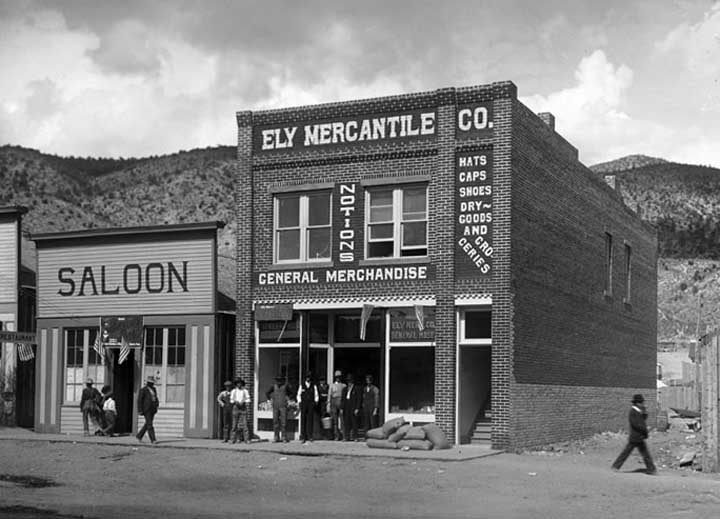
Ely, the seat of White Pine County, was founded in 1906 as a stagecoach station on the Pony Express and Ventral Overland Route. Later, with the discovery of copper in the area, which supplemented earlier gold discoveries, Ely became a mining town subject to the ups and downs of similar boom towns.

Western points of interest in Ely include the Nevada Northern Railway Museum and the East Ely Depot.


Source: Online Nevada

Settled in 1864, the mining town of Eureka, a source of silver and lead, proved to be the second-most productive in the state, with only the famed Comstock Lode producing more ore. Unfortunately, Eureka's mines were played out by 1878, although “The Friendliest Town on the Loneliest Road in America” survives.


The California Gold Rush is responsible for the settlement of Fallon, which became the final stop of men whose intention of joining the Forty-Niners in their search for California's gold but, instead, called it quits after crossing the Carson River. The settlement was named after local rancher Michael Fallon and his wife Eliza.


Wild horses near Stagecoach, Nevada. Source: YouTube.

As its name suggests, Stagecoach began as a station along the Overland Stagecoach route, which also served as a Pony Express station. Before 1857, when the Overland Stagecoach company was founded, U. S. mail was delivered to the West by way of steamers routed through Panama.


Source: Flickr

Of those towns on our list so far, Dayton is, in some ways, probably one of the most historic. Its original name, Ponderers Rest, recalls the pondering of travelers who rested here as they watered their animals and decided whether to follow the river southward or continue their journey to the west.

The population soared after gold was discovered at nearby Gold Creek, a Carson River tributary. To avoid California's tax, Chinese miners immigrated from the Golden State to the Silver State, and, when the Comstock Lode was discovered in 1859 and many miners traveled to Gold Hill and Virginia City to seek their fortunes, the number of Chinese workers in Dayton became great enough a year later that the settlement was renamed China Town.

It wasn't until 1861 that it was officially named Dayton, after John Day, a local surveyor who later became the Surveyor General of the United States. Thereafter, Dayton capitalized on its proximity to the Carson River by becoming the Comstock's major milling center, experiencing rapid growth. One of the “Great Fires” that occurred during the years 1866 and 1870 burned down much of the town, but Dayton survived, reduced both in size and importance, after the construction of the Carson & Colorado Railroad in 1881.

The Dayton Courthouse and the Union Hotel are among Dayton's places of interest to Western fans.
 

Source: Wikipedia

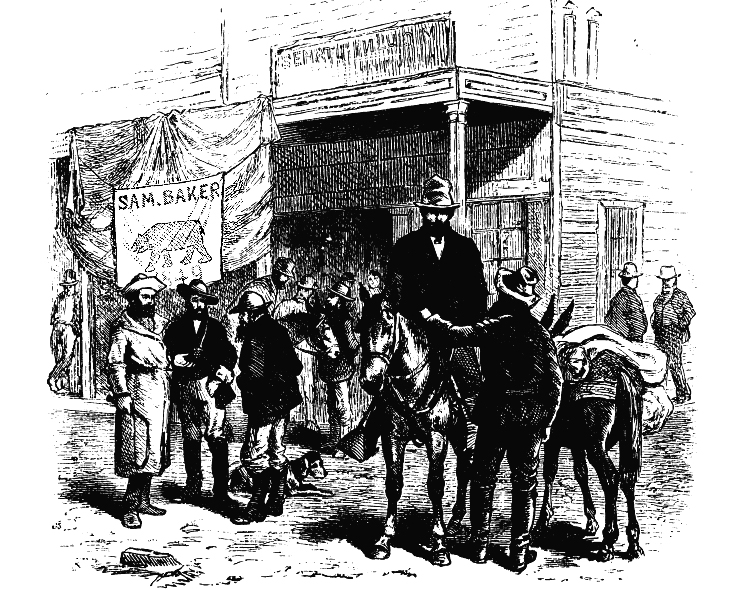
Finally, our trip west on Highway 50 brings us to Carson City. Named, in 1843, by John C. Fremont in honor of his scout Kit Carson, Carson City had its start as a Utah Territory trading post along the Carson Branch of the California Trail and was governed by Salt Lake City officials. The discovery of the Comstock Lode increased Carson City's population dramatically, and it became the seat of Ormsby County. Its Warm Springs Hotel, which has served as the territorial legislature's meeting hall, was converted into the region's first prison and remains part of this institution even today.


Nevada became a state in 1864, and Carson City became its capital. Its economic base switched from mining to commerce and railroad construction, in which Chinese workers played an enormous role. Although the building of the Central Pacific Railroad through the Donner Pass reduced Carson City's size and status, it remained an important frontier city into the twentieth century.


There are several places of interest for Western devotees, including several museums, the Stewart Indian School, the Sears-Ferris House, the Silver Saddle Ranch, the Mexican Dam, Prison Hill, and Lake Tahoe.


Mining, stagecoach lines, the Pony Express, politics, and railroads helped to settle the Western towns of Nevada, just as they helped to bring civilization to many other states of America's Wild West.


Next up: Western towns along Nevada's Interstate 80.


Sunday, August 30, 2020

Humorous Columns of Frontier Newspapers: Part I

Copyright 2020 by Gary L.Pullman


In a time such as our own, when newspapers are quickly becoming a thing of the past, it is difficult, perhaps, to imagine how readers, in the past, looked forward to the delivery of their daily chronicles.

The newspaper brought the world into their homes, where the news of the day—stories of election fraud, of gunfights, or stagecoach and train robberies, of hangings, of gold strikescould be read in armchairs by the fireside or over bacon and eggs at breakfast tables.

Stories of travel and adventure, of newfangled inventions, of battle and of war in the planet's far-flung countries could be read and debated in pool halls and barbershops and saloons.

The newspaper opened parochial, small-town life on the frontier to the world at large. The stories, often reported in a dramatic tone, were calculated to provoke, to excite, to anger, and to amaze.

Journalism was emotional; unless a newspaper article did as good a job at arousing its readers' passions as it did in relating the facts, a story hadn't successfully performed its task. (In truth, sensationalism was often more important than objectivity, just as feeling was more significant than facts.)


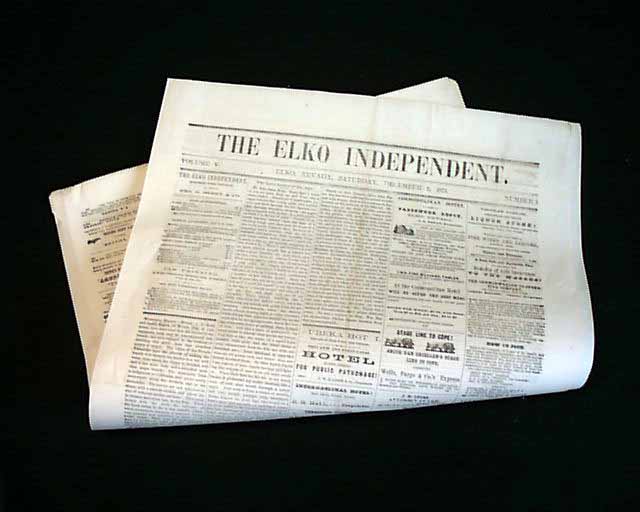
In their efforts to amuse and to be many, if not all, things to all readers, frontier newspapers also often contained humorous columns. Indeed, these periodicals included even analyses of the nature and methodology of humor, as in the “Wit and Humor” article published in the November 2, 1889, edition of Elko, Nevada's Daily Independent, which states that, although “laughter may be either genial or malignant, . . . it is allied rather to egoism and contempt than to affection and devotedness, the chief source of the ludicrous being the degradation of some person or thing which we have been accustomed to associate with power, dignity, or gravity.”

Although this is but one of several competing theories of what tickles the funny bone and why, it certainly prescribes, for reader and humorist alike, the main types of humor, their common wellsprings and method, and even the typical targets of the humorist. But our author, who prefers the protection provided by anonymity, further enlightens his readers as to the differences between wit and humor.


Sydney Smith

Originally, the writer instructs, “wit” referred to “intelligence,” but has since itself “become so degraded that paronomasia [the newspaper writers of yore were often intimately familiar with the lexicon] it is considered a species of wit.” The rest of the column continues to differentiate between humor and wit, backing its claims with allusions to the English wit Sydney Smith, the essayist William Hazlitt, the lexicographer Noah Webster, and the satirist Thomas Carlyle and ending with an example of each category.


As an instance of humor, the author cites Miguel de Cervantes's Don Quixote: the would-be knight  exemplifies humor, the columnist says, when he explains to his page, “The reason, Sancho, why thou feelest that pain all down thy back is that the stick which gave it thee was of length to that extent.”

As an exhibit of wit, the writer repeats the anecdote of a mute whose master reproached him for laughing at a funeral” by observing, “You rascal, you, I have been raising your wages for these two years past on condition that you should appear more sorrowful, and the higher wages you receive the happier you look.”

The article, both educational and amusing, is a good mix, and a good example, of the humor and wit its author defines, in all places, on the page of a newspaper published in one of the towns of the American Wild West!

Friday, July 17, 2020

The A. B. Seelye Company: A Story of Notions, Lotions, Potions, and Riches

Copyright 2020 by Gary L. Pullman


As Ann Anderson points out in Snake Oil, Hustlers and Hambones: The Anerican Medical Show, the entertainment that these carnival-style performances provided (between snake oil salesmen's product pitches) was “perfectly suited to isolated rural audiences” who enjoyed simple amusements (163). Performers included “blackface” comedians, musicians, mind readers, ventriloquists, magicians, and others (82).


Both comedies, such as the movie Poppy (1937), starring W. C. Fields, and a Walt Disney production, Alice's Medicine Show (1927). starring Lois Hardwick, and Westerns, including Little Big Man (1970), starring Dustin Hoffman and Faye Dunaway, and The Outlaw Josey Wales (1976) starring Clint Eastwood.


Some members of show audiences were easily convinced, or duped into believing, that the salesmen offered the elixirs of life. Others were skeptical (as were the physicians of the day). In Western films, though, medicine shows, as might be expected, were usually played strictly for laughs.
The very phrase “snake oil” suggests chicanery. In Europe during the 1800s, rattlesnake “oil” was regarded as a cure for arthritis and rheumatism. Whether or not this is true hasn't been proved, but the question, with regard to the “medicines” said to have been derived from vipers, including rattlesnakes, is moot, since, as Laurence M. Klauber points out, in volume two, of his Rattlesnakes, it's unlikely that snake oil ever actually contained snake oil (or any parts of these vipers).

Snake oil products are also known as “patent medicines.” The National Museum of American History explains why:


Patent medicines are named after the “letters patent” granted by the English crown. The first “letters patent” given to an inventor of a secret remedy was issued during the late 17th century. The patent granted the medicine maker a monopoly over his particular formula. The term “patent medicine” came to describe all pre-packaged medicines sold “over-the-counter” without a doctor’s prescription. In the United States very few preparations were ever actually patented.


The label on the front of a bottle of Seelye's Wasa-Tusa, a medicine “For Man and Beast, Internal and External,” lists its ingredients as “63% non-beverage alcohol, 10 minims [of] sulphuric ether and 7 minims of chloroform per ounce [of] alcohol derivative.”

Like most patent medicines, it's touted as effective in the treatment of a host of maladies: “Muscular Soreness, Bruises, Strains, Sprains, Simple Headache, Simple Neuralgias, Toothache, Simple Earaches, minor Irritations of the Throat, and where a counter-irritant would be used.”

A few drops taken “internally,” with water or milk, likewise remedies “Colic and Cramps due to Gas.” The product is also “Useful for Wire Cuts, Swellings, Etc., and on Animals” and works as effectively to alleviate “Colic in Horses” as it does to relieve the same malady in humans.

Wasa-Tusa cures so many conditions and diseases that it's hard to see why anyone would ever need to buy another medicine after purchasing The A. B. Seelye Company's nostrum. Considering all the ailments from which the product provides relief, if not, indeed, a cure, it is certainly worth its $1.25 retail price.


One of the most interesting facts about Alfred Barns Seelye (December 20, 1870 - February 14, 1948) is that he took the theatrics out of snake oil sales, treating the production, marketing, and distribution of his patent medicines as a business. In addition, as we shall see, he found innovative ways to entertain his customers and potential customers. If, after the passing of the medicine show, due to its ever-increasing extravagance and attendant expenses, Seelye would bring the show to the clientele--or a semblance of it, at least. As a result, he was immensely successful for years, his customer base and profits increasing dramatically.

Seelye studied both medicine at one college and literature at another, without graduating from either. In 1890, after moving from Illinois, where he'd grown up, to the famous cowtown, Abilene, Kansas, of which Wild Bill Hickock had once been marshal, Seelye set up a laboratory and began making Wasa-Tusa, Fro-Zona, and about a hundred other concoctions.

His success was tremendous, his company growing to the point that, at the pinnacle of his success, he employed over three hundred traveling salesmen, among other workers. He had to move his operations into a larger building, which also housed his Seelye Theater, which sat an audience of eight hundred.
He married Jeanette Taylor in 1893, and the couple increased Abilene's population by two, their daughters Mary Eleanor and Helen Ruth.

Founded in 1890, in Abilene, Kansas, Seelye's company was incorporated nine years later. By 1905, its snake oil sales had made Seelye a wealthy man, indeed.

It's not hard to understand why. The company offers something for everyone—and for every ailment.


A three-ounce jar of its Fro-Zona Company ointment is a superb after-shave, its menthol, camphor, and oils (peppermint, eucalyptus, and pine), and, of course, its petroleum, constituting a “soothing preparation” for everyday use. It cools “prickly heat, sunburn, insect stings, chafing, frost bites [sic], head colds, chapped skin, nasal irritation, superficial burns, and simple headaches.”

It can be rubbed “between the eyes,” daubed up the nostrils, or dabbed “behind the ears,” preferably before “retiring at night.” Apparently, it also works on toys: the front of the product's label shows a physician making a house call to examine a little girl's doll, as he holds a jar of the panacea.

The fact that Fro-Zona is a patent medicine is indicated on the bottle by a stamped notice of the balm's registry with the U. S. Patent Office.


In promoting his medicines, Seelye is sure to offer his customers more than their money's worth. A 1903 promotional “almanac” is also a “health guide,” and the combination almanac-health guide is also a cook book—three useful publications in one. In short, the booklet contains, “besides the weather forecasts, some excellent Cooking Receipts [sic] . . . and general information, as well as a history of the Seelye Medicines and their method of cure.”

In addition, it's chock full of advertisements for his lotions, potions, and nostrums. The fifty-two-page publication promotes “Ner-Vena, Wasa-Tusa, Magic Cough and Consumption Cure, Seelye's Wintergreen Ointment, Wintergreen Soap, A. B. Seelye's Happy Life Pills, Seelye's Universal Stock and Poultry Powder, Horse Liniment, Seelye's Hair Tonic and Restorative, and other remedies.”

The brochure's “Introduction” boasts of the company's success. Business was “excellent” in 1902, and sales in 1903 promise to be no less flourishing, as the company marks its “13th year” of continual growth,” satisfied customers singing the medicines' praises as products that not only “cure folks” but also “prolong life.” The booklet is quite a bargain for free (although, should readers care to do so, they're more than welcome to send in their testimonials concerning the benefits of the company's cures).


The brochure contains many delightful, if not always informative, illustrations as well. One, labeled “The Human Body,” shows the figure of a man, lines connecting the animals of the zodiac to the various organs of the human anatomy over which these signs are said to govern: Gemini, the arms; Leo, the heart; Taurus, the neck; and so on.

The booklet contains all manner of trivia and esoteric information. In addition to the astrological associations with human anatomy, a list of religious holidays and their respective dates appears, beneath which the year's “Morning and Evening Stars” are identified.

As might be expected, advertisements and testimonials make up a substantial part of the publication, appearing either as full-page texts or as sidebars, complete with a photograph of the gentleman or lady who offers an endorsement of a particular product.


Mrs. Julia Weathers, for example, of Sedgwick, Kansas, who once suffered, it seems, from “weak nerves,” contends that “Dr. Seelye's Ner-Vena is the greatest medicine” for treating this condition that she has ever seen. “Dizzy spells” had afflicted her, causing her to “stay in bed half a day at a time,” before “three bottles” of Seelye's “remarkable remedy” remedied her condition, curing her. And that's not all! She adds, Ner-Vena also benefited her heart in some way. (She doesn't say how, exactly.) Whatever the wonderful nostrum did to help her heart, though, prompted her to declare, in no uncertain terms, “Ner-Vena was indeed a God send to me.”

These features weren't live acts, of course. There were no magicians and clowns, no ventriloquists or men on stilts, but there were interesting articles, loads of trivia, intriguing illustrations, esoteric lore, and, of course, apparently heartfelt thanks, product recommendations, and personal testimonials from satisfied customers. On the frontier, especially in rural areas far from the nearest town, the arrival of Seelye's combination almanac-health guide-cook book must have been welcome, indeed. Its pages provided escape from boredom and drudgery while acquainting its readers with the wonderful nostrums that could cure nearly any ailment known to medicine, and, best of all, it was delivered free to one's doorstep, upon request.

A help wanted advertisement in the May 15, 1902 issue of the Abilene Weekly Reflector also suggests that the company was doing well. Despite having forty employees, the company was seeking ten to twelve more salesmen and had hired the Abilene Carriage Company to build “ten new wagons” to carry products directly to the customers who ordered them.

Despite the announcement's headline, “Good Chance for Hustlers,” it seems that the newspaper found the company to be a good place to work: “Dickinson county young men need not hesitate to engage with the A. B. Seelye Medicine company as they are reliable and do well by their salesmen.”


Yes, whatever the effectiveness of its many “medicines,” The A. B. Seelye Company was good to its founder. With the fortune he earned, he built the fabulous 11,000-square-foot, twenty-five-room Seelye Mansion in Abilene, Kansas.


A beautiful home in the Georgian style, this magnificent mansion, built in 1905 for $55,000, boasts Edison light fixtures, a Tiffany fireplace, eleven bedrooms, a ballroom, a music room featuring “gold French furniture and a grand Steinway piano,” and a bowling alley. The house was also home, at one time, to Seelye's laboratory (where, it seems likely, plenty more nostrums were concocted),Seelye was even more extravagant in purchasing the mansion's elegant furniture. He bought most of it at the 1904 St. Louis World's Fair, paying more for it than he paid to build the house!


The bowling alley, which “was ordered at the Chicago World's Fair,” was constructed by the American Box Ball Company, Indianapolis, Indiana. It not only automatically returns the ball, but features an unusual feature: the pull of a lever resets the “drop-style pins.”

As a youngster, Dwight D. Eisenhower delivered ice to the mansion; later, of course, the boy would become Supreme Commander of the Allied forces during World War II and the president of the United States, but, for the Seelye daughters, Helen and Marion, who lived in the house following their father's demise, Ike would remain “a man from the wrong side of the tracks.”

Dwight D. Eisenhower and Frank Lloyd Wright

Another famous person associated with the Seelye Mansion is architect Frank Lloyd Wright, who “suggested renovated the interior” of the home in the 1920s.


Seelye's Wasa-Tusa, his Fro-Zona Company ointment, his Magic Cough and Consumption Cure, his Wintergreen Ointment, his Wintergreen Soap, his Happy Life Pills, his Universal Stock and Poultry Powder, his Horse Liniment, his Hair Tonic and Restorative, and all his other preposterous products—and his innovative and tireless efforts in promoting them—made the purveyor of dubious notions, lotions, and potions a remarkably wealthy man who lived out his life in luxury, perhaps tinkering with formulae and concocting new “medicines” right up to the end of his days.


Thursday, November 7, 2019

Past Glimpses of the American Wild West

Copyright 2019 by Gary L. Pullman

https://wyominghistory.blogspot.com/2017/12/on-this-day-in-wyoming-history-now.html

 The format of Patrick T. Holscher's book On This Day in Wyoming History encourages his reports of historical facts as though they were tidbits of trivia. As a result, his account of Wyoming's history, day by day, is an easy, entertaining read; occasionally, it also surprises.

For example, did you know that, on January 5, 1883, Cheyenne was first “lighted by electric lights” (5) Neither did I. I'd have thought the date would have been much later—and I'd have been wrong. (Electric streetlights would follow on January 15 of the same year [16].)

Likewise, I had no idea that a play had been produced “based on Owen Wister's novel The Virginian,” but this very drama opened on Broadway in 1904, two years after Wister's novel was published. What, one might wonder, has the opening of the play in New York have to do with Wyoming? Simple: “The book, hence the play, is set entirely in Wyoming” (5).

https://wizzley.com/speaking-ill-of-the-dead/

As the title of Jodie Foley and Jon Axline book suggests, the authors serve up a decidedly different dish in their In Speaking Ill of the Dead: Jerks in Montana's History. Who among us has never had the misfortune of knowing a jerk or two? (Indeed, which of us, on occasion, hasn't been a jerk?)

Montana's had its fair share. Two of them, Boone Helm and John Johnston, better known, in some circles, as “Liver-Eatin' Johnston,” were known for the proclivity for consuming human flesh. Boone was, indeed, a cannibal, the authors report, whereas “Johnston was a cannibal by reputation only” (62).

It's difficult to discern which was the “jerk” in the strange story the authors tell about Bear's Rib and Sir St. George Gore, an English baronet who journeyed to the United States to hunt the country's abundant wildlife.

When Gore and his party of thirteen men trespassed on the sacred lands of the Sioux, Bear Rib's war party surrounded the interlopers. Instead of killing Gore and his men on the spot, Bear Rib let them leave along the same path they'd followed onto the Sioux's lands, but first made them surrender “their weapons, their equipment, their horses, their clothing, and their foodstuffs” (28).

For five weeks, the naked men lived on such delicacies as “roots, berries, lizards, insects, birds' eggs, and small game,” without benefit of a cooking fire, and cut “their feet on prickly pear cactus.” They also alternately froze or “toasted.” Finally, after traveling in this fashion for nearly three hundred miles, Gore and his entourage encountered “a hunting band of friendly Hidatsa tribesmen” who, taking pity upon the bedraggled party, fed them before leading “them to their camp near Fort Berthold on the Missouri,” whereupon the baronet and his men, once again clothed, resumed their Wild West adventures (29).


Buffalo Bill Cody hired some of the more illustrious men and women of the Wild West, including Sitting Bull, Annie Oakley, and, at one time, Wild Bill Hickok. As Buffalo Bill himself (William F. Cody) points out in his book The Wild West in England, Buffalo Bill's Wild West was not a haphazard show; its “standard program” featured such fare as “racing between cowboys, Mexican vaqueros, and Indians and horsemanship demonstrations, such as the roping and riding of bucking horses, and a Virginia reel on horseback,” and “marksmanship exhibitions . . . made stars of Annie Oakley” and others (xvi).


In 1887, Buffalo Bill took his show to England, where he and his troupe toured for a year, giving a command performance for Queen Victoria. “During its six months' run in London,” the entertainers performed “fourteen times a week” for audiences of more than twenty thousand each. Besides the queen, other “distinguished” guests included future prime minister William Gladstone and Edward, Prince of Wales (xxiii).

Friday, November 1, 2019

Jim Levy (Leavy): At The End of a Trail of Violence

Copyright 2019 by Gary L. Pullman


Pioche, Nevada, 1885

Abilene. Cripple Creek. Deadwood. Dodge City. Tombstone. There are towns with more famous names than that of Pioche, Nevada, but historians have verified that Pioche was as rough and tough as any other town in America's Wild West.

Although Pioche's Jim Levy (also spelled Leavy) wasn't as famous as Wild Bill Hickok, Wyatt Earp, Bat Masterson, or Doc Holliday, he did develop a reputation as a man who was skilled with a six-gun and someone it was dangerous to cross, and Wyatt Earp and Bat Masterson considered him a skilled gunfighter.

He started his career as a gunfighter in hope of inheriting $5,000. In a gunfight with fellow miner Mike Casey, Thomas Gosson (also spelled Gasson) was fatally wounded. His dying proclamation was to will $5,000 to anybody who killed Casey.


Pioche, Nevada

In the 1871 gunfight that occurred between Casey and Levy, in front of Freudenthals' General Store, Levy wounded his adversary, putting Casey out of his misery by pistol-whipping him, an act that earned Levy both a pistol shot to the jaw from one of the dead man's friends and the money Gossan had bequeathed to Casey's killer.

In Pioche, in January 1873, Levy was also involved in another duel to the death, this time against Thomas Ryan. Due to a lack of evidence needed to prosecute Levy for murder, the gunfighter was released. Sometime during the next two years, he left Pioche.


On March 9, 1877, in Cheyenne, Wyoming, Levy became involved in yet another gunfight, this time against Charlie Harrison. Like Levy, Harrison had a history of violence, having killed several of foes. Insults Harrison made about the Irish during a card game in which Levy was also a player infuriated the Nevada gunfighter, and the men agreed to settle their score outside. They later faced off in front of Frenchy's Saloon.

Although Harrison got off the first shot—or the first few shots—his aim was inaccurate. Levy's was not, and he shot Harrison in the chest. To finish the job, Levy approached his fallen foe and shot him again. Witnesses took umbrage at this second, needless exhibition of Levy's skill, but he was never prosecuted for killing Harrison.


Tucson, Arizona

In Tucson, Arizona, Levy came to the end of his trail. This time, his dispute was with John Murphy, who was dealing cards in a faro game at the Fashion Saloon. The men agreed to settle their differences in a gunfight the next morning. 

Instead, Murphy and his friends, Bill Moyer and Dave Gibson, encountering Levy just after midnight as he approached the Palace Saloon's front door, opened fire on Levy, assuming the gunfighter was armed.

Levy believed the shots had been fired from within the saloon and fled outside—a mistake that cost him his life, when he ran straight into his enemies' gunfire. Although Murphy, Moyer, and Gibson were arrested and held in jail for killing an unarmed man, they escaped, and Murphy and Gibson evaded capture. Moyer was arrested and sentenced to life in prison.


Thursday, October 10, 2019

Authentic Cowgirls of the Wild West

Copyright 2019 by Gary L. Pullman

Not much is often written about the authentic cowgirls of the American West. However, a few authors' works contribute to this interesting topic.


According to one such work, Joyce Gibson Roach's 1990 The Cowgirls, the Civil War transformed the retiring, well-mannered homemaker of the aristocratic South into a hardy pioneer woman who took an active part in her family's “survival” on the frontier.


“The cowgirl was no Guinevere,” Roach observes. “She did not stay at home weaving the events of her life into a tapestry and awaiting the hero's return” (xix). Nor were the displaced women who wandered west all from high society or from the South, for that matter: “Rich or poor, refined or rough, high born and low found that the frontier experience was a great leveller [sic]” (xix).


As in the antebellum South, women on the frontier were often called upon to do work usually reserved for men. In the absence, temporary or permanent, of their husbands, women “had to take charge of a cattle ranch” (xix), and desperate circumstances sometimes produced innovative and unusual solutions. For example, “a crippled husband caused a Montana woman to drive a team for the local stage line, in addition to managing the ranch” (ix).

The demands of ranching, driving a stagecoach, or other duties afforded cowgirls some privileges their sisters back east didn't have; cowgirls were free to “dress as they pleased” (xx), and many likely wore “britches” under their skirts (xx). Some rode horses and learned to use the weapons they carried on their persons for self-defense, including “guns . . . ropes, knives, [and] whips” (xx).

Roach's brief anecdotes about authentic cowgirls of the Old West provide her readers with an idea of these stalwart women, the lives they lived, and the adventures they experienced.

Minta Homsley

During the “early 1870s," Roach writes, while her husband was away from home, Mrs. Minta Homsley received a telegram indicating that a cattle buyer wanted an immediate delivery of their ranch's steers. She saw that the cattle were shipped; as a result, she “got top price." Two days later the bottom dropped out of the market” (8).

Lizzie Johnson Williams


Using a pen name, schoolmarm Lizzie Johnson Williams supplemented her income by writing articles for Frank Leslie's Illustrated Newspaper (later called Frank Leslie's Magazine), earning enough money to purchase “$2,500 worth of stock in” a cattle company (9).


She started branding her own cattle, expanding her herd by hiring hands to capture the many unbranded cattle that wandered among South Texas “thickets” (9).

Before marrying, at age 36, Lizzie insisted that she and her future spouse, Hezekiah, would each take charge only of his or her own business dealings, and she and her fiance signed an agreement stipulating that Lizzie's personal property would remain hers alone after their marriage, as would “future profits made by her.”

Lizzie also instructed their ranch's foreman to “put the best steers in her herd” and to steal “unbranded calves” from Hezekiah's cattle and “mark them with her brand” (9).


After marrying, Lizzie drove her own herd of cattle up the Chisholm Trail, while Hezekiah drove a second herd along the same trail (9).

When her husband “went broke” through a bad investment, she loaned him $50,000 “to re-establish his business,” but made him "pay back the money” once he was on his feet again.

Despite her scheming ways, Lizzie “was fond of” Hezekiah, and, when he died, she bought a $600 coffin for him, writing on the bill she paid, “I loved this old buzzard this much” (9).

Friday, September 6, 2019

Wild West Humorists Lincoln Loved

Copyright 2019 by Gary L. Pullman

 
It's hard to say whether the Wild West brought out the humor in some men or whether the humor in these men found gold in the shenanigans of those whom they met on the American frontier, but one thing is clear: the Old West produced a number of Wild West humorists, one of whom President Abraham Lincoln (no slouch as a humorist himself) considered his favorite writer.

NOTE: Click the red links (below) to access websites on which you can read these authors' works free online.

Samuel Langhorne Clemens (Mark Twain) (1835-1910)

 
 Although Samuel Langhorne Clemens, or Mark Twain, as he is better known, is the most famous author among the Wild West humorists, he wasn't Lincoln's favorite writer.

In many ways, however, Clemens embodied the Wild West.

His years as a riverboat pilot gave him much of the material for Life on the Mississippi.

His stagecoach trip west and his experiences there, prospecting for silver and gold and writing for The Territorial Enterprise newspaper, supplied him with material for Roughing It (1872).

Recently, the University of California at Berkeley recovered 65,000 words (about one fourth) of the columns Clemens wrote for the Enterprise in 1865-1866 (he worked for the newspaper for three years, from 1862-1865) and plans to publish this correspondence.

Among Clemens's output that was never missing are such articles as the “Petrified Man” hoax, “A Bloody Massacre near Carson” (also known as the “Empire City Massacre Hoax”), and “A Scene at Rawhide Ranch.”

It was one of his short stories, however, that brought Clemens to national attention: “The Celebrated Jumping Frog of Calaveras County” (1865).

David Ross Locke (Petroleum V. Nasby) (1833-1888)


 David Ross Locke delighted readers with the ironic, intentionally semi-literate letters he wrote under the pen name Petroleum V. Nasby in support of the Union during the Civil War. After the war ended, he targeted Reconstruction with his wry sense of humor.

Before beginning his career in journalism, Lock (like Clemens) served as a printer's devil, or apprentice. After seven years in this capacity, Locke became an itinerant journalist, before purchasing The Jefferson newspaper, of Findlay, Ohio.

It was as owner of this newspaper that he began to write his Nasby letters, adopting a persona described by John M. Harrison, author of The Man Who Made Nasby, as “a supreme opportunist, bigoted, work-shy, often half-drunk, and willing to say or do anything to get a [cushy] Postmaster's job” (85).

A Democrat who opposed the Civil War, Nasby was drafted into the Union Army. He deserted and joined the Confederates' (fictitious) Pelican Brigade, but soon deserted it as well, finding it not to his liking. A civilian again, he devoted his life to pursuing the elusive position of Postmaster. Meanwhile, Nasby worked as a preacher who used Bible verses to show that God had ordained slavery.

Lincoln greatly enjoyed Locke's Nasby letters, quoting from them frequently, and, writes Alexander K. McClure, in Abe Lincoln's Yarns and Stories, the president reportedly declared, “I intend to tell him if he will communicate his talent to me, I will swap places with him.”

Robert Henry Newell (Orpheus C. Kerr) (1836-1901)


 The Civil War was also a topic of humor for Robert Henry Newell, the editor of the New York Sunday Mercury, who wrote as Orpheus C. Kerr (a play on words suggesting that he was an “Office Seeker,” by which he implied his fictional stand-in was a lazy man who'd like to secure a political appointment to an office requiring minimal work at high pay).

As the literary editor of the New York Sunday Mercury, Newell penned widely popular articles lampooning society and aspects of the Civil War.

Lincoln was one of Newell's fans. When the president asked General Montgomery C. Miegs whether he'd read The Orpheus C. Kerr Papers and the general said no, Lincoln contended that “anyone who has not read them is a heathen” (Benjamin P. Thomas, Lincoln's Humor: An Analysis, 3.)

By the way, Newell was married to the famous actress, painter, and poet Ada Issacs Menken, whose performance in Mazeppa scandalized New York and London audiences!
 

 Charles Farrar Browne (Artemus Ward) (1834-1867)


A member of the audience during one of Browne's performances another Wild West humorist, Francis Brett Hart, or Bret Harte, as he was known professionally, observed that Browne, in his portrayal of Ward, perfectly showcased American frontier “humor that belongs to the country of boundless prairies, limitless rivers, and stupendous cataracts—that fun which overlies the surface of our national life, which is met in the stage, rail-car, canal and flat-boat, which bursts out over camp-fires and around bar-room stoves.”


“Artemis Ward” met Clemens when he and “Mark Twain” performed in Virginia City, Nevada, and the two humorists became lifelong friends.

 
Browne also proved enormously popular when he toured England as a lecturer and contributed humorous pieces to the British humor magazine Punch.

Although Lincoln enjoyed the writings of both Locke and Kerr, the chief executive absolutely loved Browne's humor. Not Nasby, nor Kerr, nor even Clemens, but Browne, has the honor of being President Lincoln's favorite author.

Indeed, as Benjamin Tarnof relates in The Bohemians: Mark Twain and the San Francisco Writers Who Reinvented American Literature, before Lincoln shared “The Gettysburg Address” with his cabinet, he regaled them with a reading of Browne's latest essay, “Outrage in Utiky,” which was also known as High-Handed Outrage at Utica.
  
Other Wild West Humorists

Other Wild West humorists you may enjoy include Francis Brett Hart (Bret Harte) (1836-1902), William Wright (Dan DeQuille) (1829-1898), and Seba Smith (Major Jack Downing) (1792-1868).

List o f 19th-Century U. S. Western Frontier Forts, Part VIII: Montana

Note : This is the eighth of a series of lists of the  U. S. forts of the Wild West. It is intended for use in research by writers, readers,...