Showing posts with label American West. Show all posts

Sunday, June 27, 2021

Western Towns Along Nevada's Interstate 80

 Copyright 2021 by Gary L. Pullman


Although Nevada isn't always the first state that pops into the thoughts of Western readers, its history, like that of other states west of the Mississippi, is replete with a colorful past directly related to the settlement of this vast frontier.


Source: Wikipedia

Traveling from east to west along Interstate 80, we encounter Wells, Deeth, Halleck, Elko, Golconda, Winnemucca, Oreana, Lovelock, Reno, and Verdi, many of which appear as settings in On the Track of Vengeance, the fourth book of my series An Adventure of the Old West.

 Source: Wikipedia
 
 Source: Amazon
 

Wells was settled in the 1850s, when it was known as Humboldt Wells, taking its name from the nearby river and springs of the same name and, possibly, from its position at the head of the Humboldt Trail. Situated along the future routes of the Transcontinental Railroad, as a rest stop for railroad passengers, the site caught fire toward the close of the nineteenth century. Seeking assistance, the message "Wells is burning" was telegraphed, which event led to the shortening of the name to simply "Wells."

Source: Pinterest

The telegraph followed the Transcontinental Railroad. In 1869, a branch line station including telegraph service was built near Deeth, Nevada, a rural area through which the Central Pacific Railroad ran. Six years later, a post office was constructed to serve local ranches and farms, and a town began to take shape. Mining also attracted newcomers, and the fledgling community, named for a local pioneer, soon boasted a Mormon chapel, stables for horses, merchants' stores, a blacksmith, and, of course, the inevitable saloons. In fact, Deeth became a cattle shipping point and a trading center for ranchers in the vicinity of the town.

Source: Wikipedia
 

Established in 1867, Camp Halleck, named in honor of U. S. Army Major General Henry Wager Halleck, protected the California Trail and Central Pacific Railroad workers until 1879. Two years after the camp opened, the town of Halleck was built as a shipping point for supplies bound for the military post.

Among the town's buildings were two hotels and a saloon, the patrons of which were often soldiers stationed at the nearby military installation. In 1874, both a store and a school opened, the latter continuing to educate the townspeople's children until the 1950s. The camp developed into Fort Halleck, but its abandonment in 1886 led to the town's decline.

 Source: Elko Daily Free Press 

The construction of the Transcontinental Railroad across Nevada also led to the 1868 settlement of Elko at the east end of the California Trail. After the railroad's construction, Elko persisted as a shipping center for ranching, mining, rail freight, and sundry other supplies.

 Sourve: Wikipedia

Named after Golkonda, the diamond mining district in India, Nevada's Golconda, founded in 1869, grew up around mines that produced copper, silver, gold, and lead. Home to French, Portuguese, Paiute, and Chinese residents, the town, by the first decade of the twentieth century, boasted a train depot, a few hotels, a school, various business establishments, newspapers, and two bordellos. However, after the ores were exhausted, the town declined.


 Chief Winnemucca

Source: Pinterest

For Western fans, Winnemucca has several claims to fame. It is named after nineteenth-century Chief Winnemucca, of the North Paiute tribe, whose members occupied a nearby camp. The town was situated along the Central Pacific Railroad's portion of the Transcontinental Railroad. On September 19, 1900, Butch Cassidy's gang robbed the First National Bank of Winnemucca of $32,640. The town is also home to the Buckaroo Hall of Fame and Heritage Museum.

In both the late nineteenth century and the early twentieth century, Chinese railroad workers numbered about four hundred and lived in a portion of the city known as Chinatown, which featured the Joss House on Baud Street, a visitor to which was future Chinese President Sun Yat-Sen, who was touring the United States to raise funds to help finance the Xinhai Revolution. As Tombstone's Doc Holliday might have said, Winnemucca was "very cosmopolitan," indeed.

Source: Wikipedia

Nevada mines produced so much ore of various kinds that mills were erected to process the materials. One such operation, the Montezuma Smelting Works, built in Oreana in 1857, not only smelted ores from the Arabia and Trinity mining districts, but was also the first lead smelter to ship lead commercially; others shipped their output only locally. From the 1870s through the first two-and-a-half decades of the twentieth century, Orena Station was also a stop on the Central Pacific Railroad, serving as a supply depot for Rochester mines.


Source: nevadaweb.com

 Situated halfway along the Humboldt Trail, Lovelock, or "Big Meadows," as it was originally known, was a bustling mecca of activity in 1849, with as many as two-hundred-and-fifty wagons present at times, as wagon trains came and went throughout the day and livestock, including cattle and mules, grazed in nearby fields in which settlers harvested rye. 

However, it was the silver and gold mining and the Central Pacific Railroad in particular, that gave the town a solid foundation. Now the seat of Pershing County, the town was named in honor of English settler George Lovelock's family. In addition to three newspapers, Lovelock included the Big Meadows Hotel, a train station, a school, several churches, and a thriving business district.


Source: Amazon

Gold mining plays a large part in Blood Mountain, the third action-packed novel in my series An Adventure of the Old West, when former bounty hunter and sheriff Bane Messenger discovers a gold mine on property that he and his wife Pamela just purchased, as a result encountering unscrupulous men who will do anything to get their hands on his precious ore.


Source: Wikipedia

Travel along the California Trail, the discovery of gold near Virginia City, and, most of all, the discovery of silver in 1859 at the Comstock Lode brought thousands of prospectors and miners West, many of whom sought their fortunes in and near Reno, which was founded in 1868 and incorporated in 1903.

The city was named for Major General Jesse L. Reno, a veteran of the Mexican-American War and the Civil War, a "soldier's soldier" who often fought side-by-side with his troops. Even today, Nevada remains the world's third-largest gold producer, after South Africa and Australia.

In 1868, Verdi, originally O'Neil's Crossing, was renamed by Charles Crocker, the founder of the Central Pacific Railroad. The original name of the town had honored the man who'd built a bridge there in 1860. The name change was as much a matter or chance as it was of intention, havi g resulted from Crocker's having pulled a slip of paper bearing the famous Italian opera singer's name from a hat.


 Source: Elko daily Free Press

The gateway to the Verdi Range in California, the town of Verdi was the approximate location of a train robbery in 1870. On November 4 of that year, five men blocked the track near a lumber camp in the vicinity of Verdi, causing the train, which was traveling from San Francisco to Virginia City, to stop. The robbers made off with about $40,000 of the $60,000 of gold and silver the train was carrying. The same train was robbed a second time near either Pequop or Moor, Nevada (reports differ), and the robbers escaped with about $3,000.

Tuesday, September 1, 2020

Humorous Columns of Frontier Newspapers: Part 3

Copyright 2020 by Gary L. Pullman
 
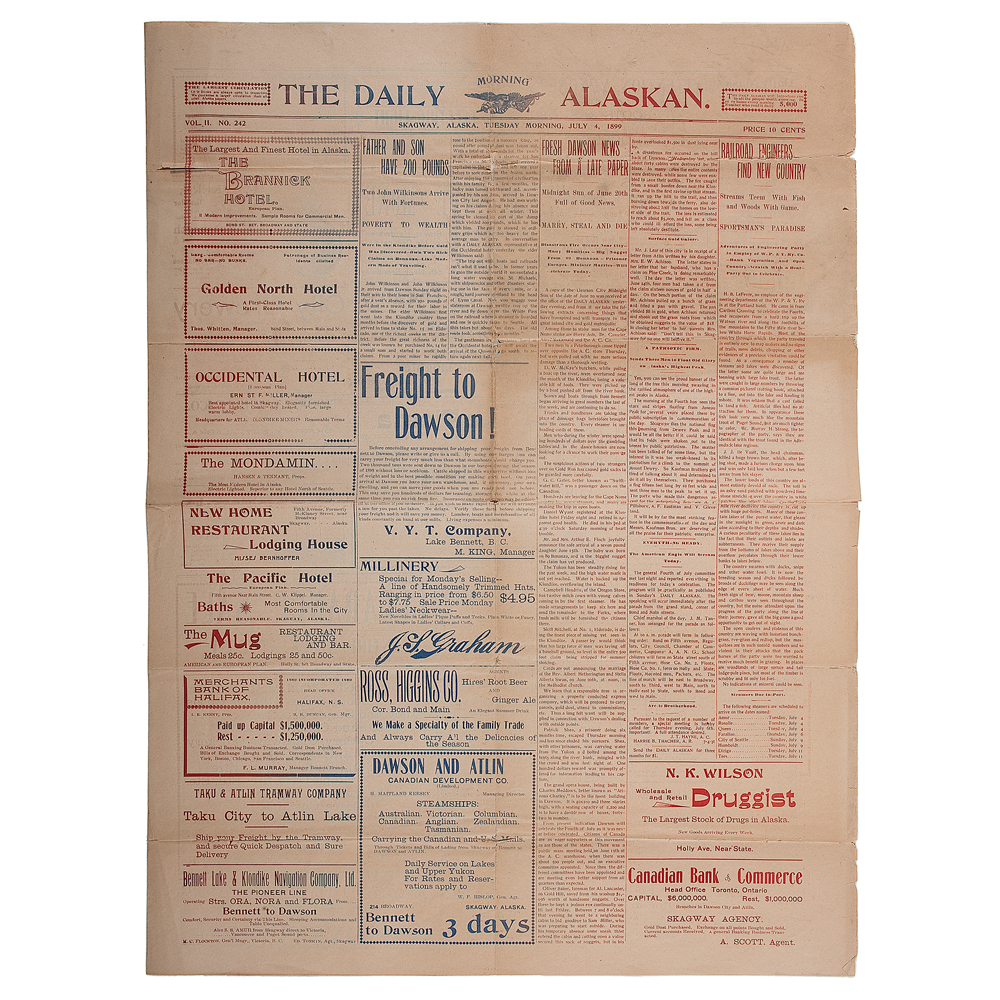
Wild West newspapers, it seems, were fond of philosophizing about the causes and effects of humor, but they also offered samples of the merchandise.

Sometimes, the samples themselves rely upon reasoning—or, rather, errors in the exercise of that faculty. The January 19, 1900, edition of The Daily Morning Alaskan column “Humor of the Hour” offers its readers these choice morsels, borrowed form their original sources.


The first anecdote is based upon jumping to a conclusion; the second involves a mistaken inference; and the third relies upon the fallacy of begging the question (and early twentieth-century sexism).

Untitled

Of course she was indignant when it dawned on her that some one was trying to flirt with her. Yet there was no denying the man behind her had kept steadily after her since she had left the street car.

And old enough to be in better business,” she said to herself indignantly. “I'll cross the street just to make sure whether he is really following.”

She crossed the street, and so did he. Then she turned on him.

Sir,” she said, “why do you persist in following me?”

He started, as if disturbed in the midst of some abstruse mental calculation, and for a minute seemed to be bewildered. Then he bowed courteously and said:

Madam, why do you persist in preceding me?”

Two doors farther on, he turned in, producing a latchkey as he did so and showing in other ways that he had reached his destination. She turned back and went around the block rather than pass that house, and her face was still red when she reached home. —Chicago Post


Making It Right

Madam,” said the leader of The Best Citizens' league, I have come to inform you that we just lynched your husband by mistake.

The bereaved woman covered her face with her hands and began to moan.

There, there,” the best citizen went on, “don't cry. We expect to get the right man before night.” —Chicago News


Couldn't Believe It

Do you see that girl with the fluffy brown hair over there?”

The one with the pink roses in her bodice?”

Yes. She knows French, German, Latin and Greek, besides English, and she graduated a few weeks ago.”

Pshaw, that can't be right! There must be some mistake. Why, that girl is actually beautiful!” (Title of source is illegible.)


Thursday, May 14, 2020

The Wild West's Famous, Infamous, and Fictitious Associations with Nevada

Copyright 2020 by Gary L. Pullman


Click the map to enlarge it.

Despite its rich association with the Wild West, Nevada isn't often the setting of Western novels or films, perhaps because its settlement and development were late.


Click the map to enlarge it.


The Transcontinental Railroad at Donner's Pass. Click the illustration to enlarge it.

Indeed, its final dimensions and borders weren't established until two years after the conclusion of the Civil War, although Nevada Territory became the nation's thirty-sixth state in 1864.


Click the map to enlarge it.

Mining was a key factor in the state's development, causing boom towns to spring up overnight, especially in the western part of Nevada. The building of the Transcontinental Railroad, which occurred between 1863 and 1869, also contributed to Nevada's growth and development, as the Central Pacific Railroad crossed into the state in 1868; by the end of the next year, the railroad had crossed the state completely.


Goldfield, Nevada historical marker. Click the marker to enlarge it.

Manhattan, Golconda, Battle Mountain, Tonopah, Goldfield, Virginia City, and Pioche (one of the toughest towns in the West) are among the towns that owe their existence or expansion to mining, and Reno, Lovelock, Winnemucca, Battle Mountain, Beowawe, Elko, Halleck, and others were founded or benefited from railroad construction.


Mark Twain and his Enterprise desk. Click the picture to enlarge it.

In addition to Mark Twain, who wrote for the Territorial Enterprise newspaper while he lived in Virginia City, other names, famous and notorious, associated with Nevada are the ill-fated Donner party, the outlaw leader Butch Cassidy, and the legendary lawman Wyatt Earp and his nearly-as-famous brother Virgil.


The Donner Party. Click the drawing to enlarge it.

Almost eighteen-hundred miles lie between Independence, Missouri, the starting point of the original members of the ill-fated Donner Party, and their destination, California. The party entered Nevada on September 10, 1847, and crossed the Ruby Mountains, reaching the Humboldt River sixteen days later. Legends of America describes this part of the party's journey:

The Donner Party soon reached the junction with the California Trail, about seven miles west of present-day Elko, Nevada[,] and spent the next two weeks traveling along the Humboldt River. As the disillusionment of the party increased, tempers began to flare in the group.

On October 5 at Iron Point, two wagons became entangled and John Snyder, a teamster of one of the wagons began to whip his oxen. Infuriated by the teamster’s treatment of the oxen, James Reed ordered the man to stop and when he wouldn’t, Reed grabbed his knife and stabbed the teamster in the stomach, killing him. The Donner Party wasted no time in administering their own justice. Though member, Lewis Keseberg, favored hanging for James Reed, the group, instead, voted to banish him. Leaving his family, Reed was last seen riding off to the west with a man named Walter Herron.

The Donner Party continued to travel along the Humboldt River with their remaining draft animals exhausted. To spare the animals, everyone who could, walked. Two days after the Snyder killing, on October 7th, Lewis Keseberg turned out a Belgian man named Hardcoop, who had been traveling with him. The old man, who could not keep up with the rest of the party with his severely swollen feet, began to knock on other wagon doors, but no one would let him in. He was last seen sitting under a large sagebrush, completely exhausted, unable to walk, worn out, and was left there to die.

The terrible ordeals of the caravan continued to mount when on October 12th, their oxen were attacked by Paiute Indians, killing 21 one of them with poison-tipped arrows, further depleting their draft animals.

Continuing to encounter multiple obstacles, on October 16th, they reached the gateway to the Sierra Nevada on the Truckee River (present-day Reno) almost completely depleted of food supplies.


Butch Cassidy. Click the photograph to enlarge it.

The association of Robert LeRoy Parker, better known as Butch Cassidy, the leader of the Wild Bunch, with the Silver State is no less deplorable.

As reported in The Ely Times, on September 19, 1900, Cassidy's gang robbed the First National Bank of Winnemucca. The outlaws got away with $32,640 in gold coins.


Etta Place and the Sundance Kid. Click the photograph to enlarge it.

It's an interesting story. Unfortunately, there's not much truth to it: According to a Nevadagram article, “Butch Cassidy didn’t send that picture and the evidence is clear that he was never in Winnemucca in his life.” Although both the Nevadagram article and the The Ely Times article concede that the bank was robbed, both deny that Cassidy was directly involved, if he was involved at all.


Wyatt Earp. Click the photograph to enlarge it.


Virgil Earp. Click the photograph to enlarge it.


Wyatt Earp and his brother Virgil followed opportunity, traveling from one boom town to the next, often in the company of a female companion. Wyatt relocated from the Kansas cattle town of Dodge City to the silver mining town of Tombstone, Arizona, the site of the famous Shootout at the OK Corral. After visiting the gold mines of the Yukon, he operated a saloon in Nevada before, eventually, retiring in California.

In Tonopah, Wyatt established a saloon, The Northern, with his common-law second wife, Josephine Marcus, the successor to Earps' first common-law wife Mattie Blaylock. He also hauled “ore and supplies” for the Tonopah Mining Company and did a stint as a deputy U.S. marshal. 

Virgil, who'd been with Wyatt in the shootout in Tombstone, died in Tonopah. Outlaws and ruffians had attempted to end Virgil's life numerous times before, but pneumonia claimed him.


The Northern Saloon.  Click the photograph to enlarge it.

* * *
To the exploits of the Donner Party, Wyatt Earp, Virgil Earp, and Butch Cassidy, we can add those of Nevadan Bane Messenger, the protagonist of the novels in my series An Adventure of the Old West. By turns, a Union veteran of the Civil War, a bounty hunter, a sheriff, and a U. S. marshal recruited by President Chester A. Arthur himself, and a friend and confidant of Allan Pinkerton, Bane's exploits are every bit as adventurous as those of any other Western hero, living or dead, historical or fictional.

https://www.amazon.com/Good-Gun-Gary-L-Pullman/dp/1719801754


Monday, December 2, 2019

Wild Bill Hickok's Wild Bear Story

Copyright 2019 by Gary L. Pullman


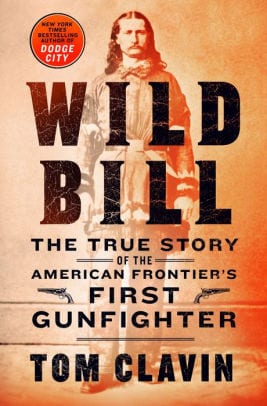
In Wild Bill, his biography of Wild Bill Hickok, Tom Clavin relates an anecdote about Hickok's alleged encounter with a cinnamon bear.


Wild Bill Hickok

According to Clavin, the story probably happened, although “a few researchers have disputed that the encounter” between Hickok and the bear “ever took place” (38).

It seems that the gunfighter was working as a teamster when “he found a bear blocking the road,” whereupon he climbed off his wagon “and shot her in the head.” The gunshot didn't do anything but anger the mother bear, causing her to attack, "crushing Hickok against her” (38).


He responded by shooting her in the paw, after which the bear locked onto his left arm and began to bite; Hickok jerked his Bowie knife from his belt and slashed "the bear's throat” (38).

Somehow, Hickok managed to drive his “freight wagon to the next town,” despite his extraordinary pain, and the local sawbones treated his patient “for broken bones in Hickok's chest, shoulder, and arm” (38).


Clavin mentions a film that features a bear attack: The Revenant, starring Leonardo DiCaprio (37). (Another movie, set in Canada, that features a horrific bear attack is Backcountry.)


Friday, November 22, 2019

Nineteenth-Century Guns: What's in a Name (Part 2)

Copyright 2019 by Gary L. Pullman

Several weapons that first appeared during the days of the American Wild West are named for famous people.


Richard Jordan Gatling

Richard J. Gatling (1818-1903), a medical doctor, invented the Gatling gun in 1861 and patented it a year later. He hoped that his spring-loaded, hand-cranked weapon (Handbook of the Gatling Gun, Caliber .30, Models of 1895, 1900, and 1903, Metallic Carriage And Casement Mount, 13), would lead to armies of fewer troops, thereby reducing wartime deaths and casualties (Harold A. Skaarup, Shelldrake: Canadian Artillery Museums and Gun Monuments, 133). It was an early rapid-fire weapon, preceded only by the French mitrailleuse (Skaarup, 133).


French mitrailleuse

Since the gun required the gunner to crank a handle to fire the weapon, it is not an automatic weapon; the first automatic wouldn't be invented until 1884, when the 7.92-millimeter Maxim machine gun, appeared. (Skaarup, 133).


Gatling gun

The Gatling gun, however, was superior to other weapons of its day, because the time that it took to eject a spent cartridge and load the next round of ammunition during “the firing/reloading sequence” allowed the barrel to cool a bit, permitting “higher rates of fire . . . without the barrel['s] overheating” (Skaarp, 133). (Today, the U. S. Army's .50-caliber machine gun fires so many bullets so quickly that the barrel must be replaced at frequent intervals.)

https://www.amazon.com/gp/product/B07THD35QX?ref_=series_rw_dp_labf

Bane Messenger, the protagonist of my Western series, An Adventure of the Old West, uses a Gatling gun twice in Blood Mountain, to even the odds against him.


1873 Winchester Rifle

The Model 1873 Winchester rifle was sold as “The Gun that Won the West,” although, technically, of course, a rifle is not a “gun,” since a rifle is rifled, whereas the bore of a gun is smooth. Originally, the rifle fired a .44-40 centerfire cartridge. The bullet could travel at a velocity of about 1,500 feet-per-second. The rifle also featured “a sliding breech cover . . . that [kept] dirt and snow out of the breech,” and “an integrated safety sear . . . prevented accidental discharge of the rifle when the hammer was cocked” (Martin Pegler, Winchester Lever-Action Rifles).


Buffalo Bill Cody's 1873 Winchester rifle

Various lengths of barrels were available, as were a number of embellishments: “silver or gold plating, engraving, set triggers and special carrying cases” and “an all-in-one reloading tool” (Pegler).

The standard version of the rifle cost $27 ($439 today), the carbine $24 ($390 today), but “these prices were often doubled by the time the guns had shipped west” (Pegler).


Oliver Fisher Winchester

Oliver Winchester and his family became fabulously wealthy. His son, William Wirt Winchester, served as the treasurer of the Winchester Repeating Arms Company. After his demise, William's widow Sarah became convinced that their house was haunted. The ghosts of Native Americans and others who'd been killed by her family's rifle, she believed, were out for revenge. 

To protect herself, psychics told her, she had to continue to add on to the eight-room farmhouse she'd purchased in San Jose, California, after leaving her home in New Haven, Connecticut. The work had to continue non-stop, twenty-four hours a day, year after year—and it did, to the tune of $5 million ($71 million today), until her own death in 1922.


Sarah Winchester

To confuse the spirits, the 24,000-square-foot mansion (as it came to be) incorporated some decidedly strange features. For example, only one bathroom has a “working toilet”; the others were constructed to confuse the ghosts (Gia Lui, “Take a Tour of San Jose's Winchester Mystery House”).


Winchester Mystery House

Wednesday, November 20, 2019

Nineteenth-Century Guns: What's in a Name (Part 1)

Copyright 2019 by Gary L. Pullman

Several weapons that first appeared during the days of the American Wild West are named for famous people.


The Armstrong breech-loading gun was named after its English designer Sir William Armstrong (1810-1900). In 1854, Armstrong sold the Secretary of State for War on making a rifled breech-loading three-pounder for testing purposes. Later models fired ammunition of higher calibers, including the largest among them, a 100-pounder. Although the guns were more expensive, they were also safer, but, ultimately, their design was found to be too complicated, and loading them was a time-consuming process involving several discrete steps. The Ordnance Selection Committee reported its conclusions:

The many-grooved system of rifling with its lead-coated projectiles and complicated breech-loading arrangements is far inferior for the general purpose of war to the muzzle-loading system and has the disadvantage of being more expensive in both original cost and ammunition. Muzzle-loading guns are far superior to breech-loaders in simplicity of construction and efficiency in this respect for active service; they can be loaded and worked with perfect ease and abundant rapidity.

As a result, the military resumed its use of muzzle-loading guns.


Sir William Armstrong

Armstrong, a man of many talents and abilities, is considered the father of modern artillery. A well-respected inventor and philanthropist,” he was knighted, and Queen Victoria later elevated him to the peerage as a baron (Robert P. Dod, The Peerage, Baronetage and Knightage of Great Britain and Ireland 93). In addition to the breech-loading gun named for himself, Armstrong also developed the hydraulic accumulator.


Samuel Colt

Samuel Colt began making weapons in the 1830s, securing a British patent for an improved revolver design in 1836. According to True West, the weapon that Wyatt Earp used during the 1881 Shootout at the OK Corral in Tombstone, Arizona, Earp “probably” used a Colt single-action revolver with a ten-inch barrel. A Tactical Life article indicates that Bat Masterson “ordered a total of eight single-action revolvers from Colt’s,” the “most notable” of which was a customized “nickel plated short .45 calibre” (source's italics):


Bat Masterson

. . . make it very Easy on the trigger and have the front Sight a little higher and thicker than the ordinary pistol of this Kind. Put on a gutta percha handle and send it as soon as possible, have the barrel about the same length that the ejector rod is (source's italics).


Wild Bill Hickok

The favorite sidearms” of Wild Bill Hickok, who earned his living as a lawman a bit earlier than Earp and Masterson, were a pair of “a pair of elegantly engraved, ivory-handled 1851 Navy Colt cap and ball .36 caliber revolvers [source's bold]. . . [the cylinders of which were] engraved with a naval battle scene between Texas and Mexico” (“Wild Bill's Colts”).

Employed by his father, Colt worked on several ideas for inventions, one of which was the first pistol he'd ever created. Unfortunately, when the weapon was fired, it blew up (R. L. Wilson, Colt: An American Legend 8). The rifle on which he was working at the same time fared better (Colt: An American Legend 8). Leaving his father's employ, he traveled across the United States and Canada, demonstrating the effects of nitrous oxide, calling himself the Celebrated Dr. Coult of New York, London, and Calcutta” (Gardner Soule, The Story of Sam Colt's Equalizer” in Popular Science. 179 (6): 89. 8).


After focusing on a handgun with one barrel, rather than multiple barrels, he managed to find a financial backer and was able to secure a patent in 1836 for the first model of his Colt revolver (Soule, 89). Eventually, with modifications and refinements, his revolver would become one of the most popular handguns in the Wild West.


In 1852, Henry Deringer gave the world the small handgun with a large bore that is named (but misspelled) for him. Muzzle loaded, the percussion-cap pistol fired one shot. Usually sold in pairs for $15 to $25 for both, these weapons were known in the Wild West as “boot pistols” (Gettysburg Museum), “Vest Pocket Pistols,” or “sleeve guns

Thursday, November 7, 2019

Past Glimpses of the American Wild West

Copyright 2019 by Gary L. Pullman

https://wyominghistory.blogspot.com/2017/12/on-this-day-in-wyoming-history-now.html

 The format of Patrick T. Holscher's book On This Day in Wyoming History encourages his reports of historical facts as though they were tidbits of trivia. As a result, his account of Wyoming's history, day by day, is an easy, entertaining read; occasionally, it also surprises.

For example, did you know that, on January 5, 1883, Cheyenne was first “lighted by electric lights” (5) Neither did I. I'd have thought the date would have been much later—and I'd have been wrong. (Electric streetlights would follow on January 15 of the same year [16].)

Likewise, I had no idea that a play had been produced “based on Owen Wister's novel The Virginian,” but this very drama opened on Broadway in 1904, two years after Wister's novel was published. What, one might wonder, has the opening of the play in New York have to do with Wyoming? Simple: “The book, hence the play, is set entirely in Wyoming” (5).

https://wizzley.com/speaking-ill-of-the-dead/

As the title of Jodie Foley and Jon Axline book suggests, the authors serve up a decidedly different dish in their In Speaking Ill of the Dead: Jerks in Montana's History. Who among us has never had the misfortune of knowing a jerk or two? (Indeed, which of us, on occasion, hasn't been a jerk?)

Montana's had its fair share. Two of them, Boone Helm and John Johnston, better known, in some circles, as “Liver-Eatin' Johnston,” were known for the proclivity for consuming human flesh. Boone was, indeed, a cannibal, the authors report, whereas “Johnston was a cannibal by reputation only” (62).

It's difficult to discern which was the “jerk” in the strange story the authors tell about Bear's Rib and Sir St. George Gore, an English baronet who journeyed to the United States to hunt the country's abundant wildlife.

When Gore and his party of thirteen men trespassed on the sacred lands of the Sioux, Bear Rib's war party surrounded the interlopers. Instead of killing Gore and his men on the spot, Bear Rib let them leave along the same path they'd followed onto the Sioux's lands, but first made them surrender “their weapons, their equipment, their horses, their clothing, and their foodstuffs” (28).

For five weeks, the naked men lived on such delicacies as “roots, berries, lizards, insects, birds' eggs, and small game,” without benefit of a cooking fire, and cut “their feet on prickly pear cactus.” They also alternately froze or “toasted.” Finally, after traveling in this fashion for nearly three hundred miles, Gore and his entourage encountered “a hunting band of friendly Hidatsa tribesmen” who, taking pity upon the bedraggled party, fed them before leading “them to their camp near Fort Berthold on the Missouri,” whereupon the baronet and his men, once again clothed, resumed their Wild West adventures (29).


Buffalo Bill Cody hired some of the more illustrious men and women of the Wild West, including Sitting Bull, Annie Oakley, and, at one time, Wild Bill Hickok. As Buffalo Bill himself (William F. Cody) points out in his book The Wild West in England, Buffalo Bill's Wild West was not a haphazard show; its “standard program” featured such fare as “racing between cowboys, Mexican vaqueros, and Indians and horsemanship demonstrations, such as the roping and riding of bucking horses, and a Virginia reel on horseback,” and “marksmanship exhibitions . . . made stars of Annie Oakley” and others (xvi).


In 1887, Buffalo Bill took his show to England, where he and his troupe toured for a year, giving a command performance for Queen Victoria. “During its six months' run in London,” the entertainers performed “fourteen times a week” for audiences of more than twenty thousand each. Besides the queen, other “distinguished” guests included future prime minister William Gladstone and Edward, Prince of Wales (xxiii).

Sunday, November 3, 2019

Night Riders

Copyright 2019 by Gary L. Pullman

https://www.amazon.com/gp/product/B07THD35QX?ref_=series_rw_dp_labf

Riding a horse at night sounds dangerous—and it can be—but it's not necessarily risky, if riders take precautions.

During cattle drives, cowboys often rode at night, as, on occasions, did posses hot on the trail of suspected outlaws.

In the days of the Wild West, there were no superhighways, streetlamps, or other modern inventions to worry about (night traffic can startle horses, and bright lights can temporarily blind them, neither of which situations is good for the safety of the horse or the rider).

Still, riding at night had distinct disadvantages on the frontier. Despite their good night vision, horses couldn't see every obstacle on the trail. Low branches could knock a rider from his or her mount. The resulting fall could break an arm or a leg (or a neck). Depending on where one rode, there could be close encounters of the worst kind, too, with bears, cougars, or other nighttime predators. In the event that a horse encounters an animal that might be a predator, it is apt to bolt, rather than to stand its ground while it attempts to discern whether the other animal is a threat. For horses, discretion is the better part of valor.

Most often, night riders rode in the company of others, whether fellow cowboys, other members of a posse, comrades in arms, or other members of their outlaw gangs. They'd avoid any gait other than a walk, unless they were sure the path ahead was level and free of obstacles.


Not all night riders were men, and not all of them rode horses by night on the frontier. Women also rode horses at night. One, a sixteen-year-old Connecticut girl, Sybil Ludington, rode forty miles, through the night in April 1777, “to warn her father's troops about a British attack on Danbury,” earning the praise of General George Washington. Thereafter, she became known as “the female Paul Revere.”


As Virginia C. Johnson makes clear in Virginia by Stagecoach, “Old Moll” Tate may not have ridden a horse after sunset, but she drove “the night stage from Abington to Blountville,” Virginia, “for several years” as a means of earning a living for herself and one of her children after losing the rest of her family, including her husband, to a plague (137). She had excellent night vision, which allowed her to avoid a tree that had fallen into the road (137). After mail she was carrying had been stolen, “Old Moll” Tate carried a “dummy” mail bag to “foist on any would-be robbers” (137). An extraordinary woman, she had fourteen given names, having been named after “each of the women who attended her birth and one for each of her aunts”: Mary Malzeeda Susan Elizabeth Cynthia Parnintha Sarah Adeline Rosey Daisy Laura Lucretia Louisa Jane (137).


According to Pinkerton detective Charles (“Charlie”) Siringo's A Cowboy Detective, Butch Cassidy escaped riding bareback one night and, to avoid lawmen, continued to ride at night, sleeping during the day. A posse led by William Beeler, on the trail of outlaw Kid Curry and his gang, “waylaid” Cassidy and his fellow traveler, outlaw “Red” Weaver. The lawmen continued to hunt Curry, as he and his gang “committed bloody crimes” as they rode north, but Cassidy escaped the posse's custody and lived on “nothing . . . but crackers.” It was only after Cassidy received news at one of the gang's “blind post offices,” that he learned the men from whom he was hiding during the day weren't members of Beeler's posse, after all, but his own “friends” (368).

Siringo himself was no stranger to night riding. Advised that a party of three-hundred men planned to “take over” Murray, Idaho, in order to kidnap him, Siringo writes, “I would pretend to retire to my room for the night; . . . then, I would slip down the back stairs and [ride] up the mountainside.” He would remain awake . . . on the mountainside overlooking the town,” his Winchester “ready for action,” until morning, when he “would return to the hotel . . . and slip into [his] room” (184). After providing testimony to a grand jury, Siringo thwarted “Dallas and his gang,” who intended to ambush him, by riding a rented horse twenty miles to Wallace instead of taking the stagecoach, the route of which went through “a dense growth of timber and underbrush,” which would have made ambushing the stage an easy matter (184).


In Pat Garrett: The Story of a Western Lawman, Leon Claire Metz recounts a night ride undertaken by Garrett and his posse. Charlie Thompson, Bill Gatlin (aka Dan Bogan), and Wade Woods were wanted for cattle rustling, and Garrett had obtained warrants for their arrests. The suspects were believed to alter the brands of the cattle they stole using “a versatile brand called the Tabletop.” So effective was the technique in changing marks that the difference was undetectable “unless the animal was killed and skinned and the hide turned inside out so that the old and new brands could be compared” (143).


Learning that the wanted men were hiding out in “a rock house at red River Springs near the Canadian River,” Garrett and his posse, joined by Sheriff James East, rode forth at night, during a fierce snowstorm, which, Garrett believed, was the most effective occasion “to hunt a badman” (143). The posse rode throughout the night, “pausing stiff and nearly frozen at two o'clock in the morning to feed their horses and bolt down a warm meal.”


Bill Gatlin (aka Dan Bogan)

Despite approaching the hideout from a direction that prevented the outlaws from seeing their approach, Garrett and his posse were spotted by Bob Basset, a member of the gang who was collecting firewood. Running back toward the house, Basset warned the other wanted men of the arrival of Garrett and his posse (143). To avoid a shootout, nine of the men inside the house left the domicile, including two of the suspects, Charlie Thompson and Wade Wood, who surrendered, but Garrett made the mistake of allowing Thompson to return to the house to fetch his coat, and Thompson then refused to return, saying he would fight and die beside Gatlin, who remained in the house. However, assuring Thompson of a fair trial, East was able to talk him into surrendering, and the arrests were made, after East entered the house and convinced Gatlin, with whom he had once herded cattle, to also surrender 143).

The outlaws were jailed in Tascosa, but Gatlin and Thompson escaped, using a file “someone [had] slipped them” to cut through their handcuffs (145). For their efforts, Garrett, East, and the rest of the posse retained in custody only two of the four fugitives they'd brought to justice.


Bob Switzer

Plenty of others rode horses at night (or drove stagecoaches after sunset), but none of them were equipped with the supplies recommended by today's experts—largely because most of these supplies didn't exist in the days of the American Wild West. For example, Equisearch: For People Who Love Horses recommends that night riders “carry a flashlight in case of emergencies,” being careful not to spook the horse in using the instrument. For greater visibility, the wearing of “reflective clothing” is also recommended (“Riding Your Horse at Night”). Battery-powered flashlights weren't patented until about 1899, and Bob Switzer didn't invent reflective clothing until the 1930s (he tested his new Day-Glo paint on his wife's wedding dress!), and such attire didn't become popular until World War II, when aircraft carrier crews began to wear it.

Another website, The Spruce Pets, recommends night riders carry not only flashlights and wear reflective clothing, but also equip themselves with headlamps, and wearable LED lights (“Safety Tips for Horseback Trail Riding at Night”). Headlamps did exist in the early 1880s, but they weren't the type of lights riders would want to use. They burned acetylene or oil, and, although the flames produced by such fuels were wind- and rain-resistant, it seems safe to bet they'd frighten horses.

British researcher H. J. Round invented the first light-emitting solid-state diode (LED) in 1907, but the public couldn't buy an LED light until dim red LED lights became “commercially available” during the 1960s, well past the era of the Wild West.

Horse & Rider is even more particular in regard to recommendations for safe night riding. A host of “special gear” is needed, the website's “Trail Riding at Night” article suggests, including “a handheld flashlight” as well as “a first-aid kit, a multipurpose tool, an EasyBoot,” glow sticks, and duct tape.

1888 Johnson & Johnson first-aid kit

We've already addressed the origin of flashlights. Commercially available first-aid kits appeared in 1888 (although riders could certainly assemble their own kits before then, if the thought occurred to them).


Sheffield contrivance

Such multi-purpose tools as the Modell [sic] 1890 “Sheffield contrivances,” as Herman Melville identifies them in chapter 107 of Moby Dick, consisted of pocket knives containing, all in one, “blades of various sizes, . . . screw-drivers, cork-screws, tweezers, awls, pens, rulers, nail-filers, [and] countersinkers,” and the Swiss army pocket knife debuted in 1890, featuring a spear point blade, a reamer, a can-opener, a screwdriver, and water-repellent grips” (The Swiss Army Knife Owner's Manual, September 7, 2011). For Wild West night riders who rode after 1890, these multi-purpose tools could have been carried in the saddlebags.

The EasyBoot was first sold in 1970, and could “be applied to the barefoot hoof. . . and used as a spare or . . . when a barefoot horse needs additional hoof protection,” so, of course, this item was unavailable to the night riders of the Old West.


When Edwin A. Chandross of Brooklyn, New York, in experimenting with luminol in the 1970s, mixed hydrogen peroxide with oxalyl chloride and dye, the mixture “emitted a [feeble] visible light,” but glow sticks were not invented until 1976, when, after a variety of materials and devices were patented, “the first . . . device to resemble glow sticks as we know them today,” the Chemiluminescent Signal Device, was patented by Vincent J. Esposito, Steven M. Little, and John H. Lyons. Clearly the night riders of the latter half of the nineteenth century would not have had access to glow sticks.


Duct tape was invented in 1943, after Vesta Stoudt, a worker at the Green River ordnance Plant in Illinois, wrote a letter to President Franklin Delano Roosevelt, asking him to pursue her idea of replacing the thin tape that sealed packages of cartridges used to launch rifle grenades with a stronger “cloth-based waterproof tape” that would not tear away when soldiers opened the ammunition packages, leaving them “frantically scrambling to claw the boxes open while under enemy fire.” She'd proposed the idea to her superiors at work, but it seemed to have gone nowhere. Roosevelt forwarded her letter to the War Production Board, which contracted the task of producing the tape to Johnson & Johnson. Although duct tape might be highly recommended for night riders' use, those who rode horses at night prior to World War II wouldn't have been able to adopt the suggestion (“The Woman Who Invented Duct Tape”).

https://www.amazon.com/gp/product/B07THD35QX?ref_=series_rw_dp_labf

Of the modern recommendations for items to carry on night rides, the horsemen and horsewomen of the Old West would have been able to take with them headlamps (although they probably wouldn't have wanted to do so, as the flames would have startled their horses), self-assembled first-aid kits, and multi-purpose tools of the type that Melville describes or the earliest Swiss army knife alternative. Mostly, though the night riders of the Old West (and of eras before then) would have had to trust their horses' excellent night vision, the animals' instinct, and their own experience as riders. Examples such as those of Ludington, Tate, Siringo, Garrett, and others suggest that the night riders' trust in their horses' night vision and instinct was well placed.

List o f 19th-Century U. S. Western Frontier Forts, Part VIII: Montana

Note : This is the eighth of a series of lists of the  U. S. forts of the Wild West. It is intended for use in research by writers, readers,...