Showing posts with label Nevada. Show all posts

Wednesday, June 30, 2021

The Wild West's Nevada Bordellos

 Copyright 2021 by Gary L. Pullman


Our review of some of Nevada's Wild West towns along Highway 50 and Interstate 80 reveal some of the motives westward travelers and frontier settlers had in migrating from points east. Watering holes and bodies of water along overland trails (like the existence of the trails themselves); the building of the Transcontinental Railroad; discoveries of silver, gold, lead, and other ores; and politics brought men, women, and children west, where the frontier seemed a land of possibilities and, perhaps, for some, wealth, as well as adventure.

We can pretty well guess why prostitution was widespread throughout the West. There were few women and lots of men. The law of supply and demand made brothels lucrative business ventures—for their owners, at least—and provided employment for women, which was scarce on the frontier. There were, after all, only so much demand for laundresses, schoolmarms, seamstresses, store clerks, waitresses, and the like, and, aside from these occupations, respectable women had few options. Sometimes, a woman became a “soiled dove” simply because she had no other alternative.

 
Today, Donna's Ranch continues to cater to its clientele.Source: Yelp

What else can we discern by investigating some of the brothels known to have existed in Nevada during the nineteenth century? A fairly well documented establishment of this type was Donna's Ranch in Wells. During its Wild West heyday, this bordello, which has been in operation since 1867, had two major types of clients: the men constructing the Central Pacific Railroad and the cowboys who drove herds to the railroad's cattle-boarding locations and sometimes paid for the prostitutes' services with cows in lieu of dollars. Its more recent owners have included heavyweight champion Jack Dempsey (1895-1983).

 The Desert Club's contemporary look. Source: Desert Club Girls

 The Desert Club, a Battle Mountain brothel that first opened its doors in the late 1800s, includes only five rooms. It's back in business, having reopened under new management in 2016, after closing in 1991, having been temporarily transformed into a mining museum during the interim. Unfortunately, nothing much is known about its operations during its frontier days.
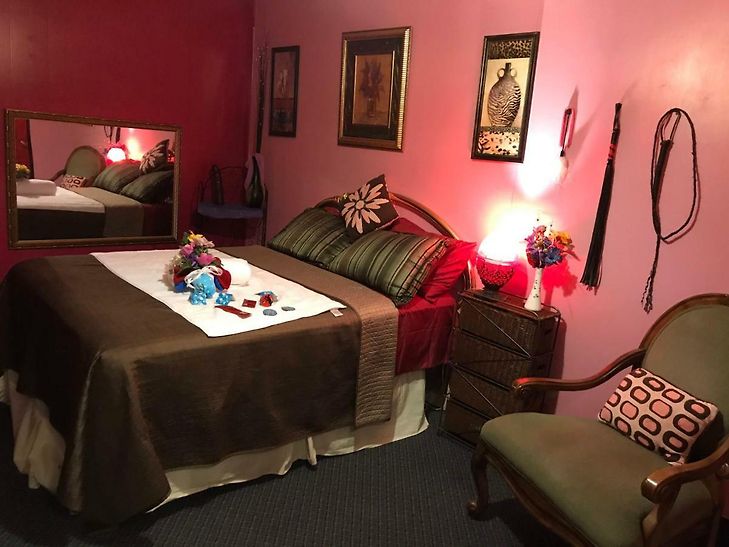
 
The whips on the wall of a bedroom at today's Rainey's Dance Hall (now Big Four) provide unique decor. Source: booked.net
 
 Rainey's Dance Hall was open for business beginning in the late 1800s. As Big Four, it still operates in Ely, Nevada, but, of course, under new ownership. It has in common with the Desert Club the fact that little remains known of its glory days.

The Pussycat Ranch (aka Pussycat Saloon, aka Pussycat Brothel) once stood on Riverside Street in Winnemucca, but it has since not only close but been demolished. In its flower, the Pussycat boasted a large, ornate bar, among its other diversions.


The Cosmopolitan, presumably, has seen better days. Source: nevadaadventures.com

Located in Belmont, the Cosmopolitan Saloon satisfied the needs of his clientele during the latter half of the 1800s. The July 27, 1874, edition of the Belmont Courier's June 27, 1874, noted that the law provided the means by which to quickly suppress such business enterprises and suggested that local government officials had the moral duty to do so. Such a “hurdy dance house,” the paper proclaimed was “a moral wrong,” if ever there was one, injurious to young and old alike, should they succumb to the establishment's “alluring temptations.”

The Cosmopolitan was a dangerous place to visit because of the gunfire that sometimes occurred on the premises as well, the article noted, although, admittedly, recent shootings had not resulted in any fatalities. Should a death occur as the result of such irresponsible conduct, however, the Courier reckoned that the county was likely to bear a cost of “$3,000 to $10,000 to prosecute the case.”

In commenting on the Courier's article, in “Hurdy houses, hurdy girls flourished in boom towns,” an installment in the Pahrump Valley Times's series of articles concerning Nevada's “history of prostitution,” the author, historian Bob McCracken, points out that “prostitutes were among the first arrivals in a mining boom town” and that they were held in esteem by men, who “generally saw them as tough and resourceful, passionate and fun-loving people with big hearts who provided an essential human service.”


 Belmont, Nevada. Source: Pinterest

Among the other bordellos that the article mentions is the Crook Shop. Regarding this establishment, McCracken reports on the double standard of the times regarding men, women, and prostitution. Men who availed themselves of “hurdy girls” might retain their respectability; the prostitutes, on the other hand, who were guilty of the same risque behavior, were regarded as disgraceful:

“It was noted that a woman who danced in the Crook Shop (a local brothel) was not admitted to a 'respectable party' while the man who danced with the 'hurdy-gurdy girl' suffered no diminished in respectability. Why should that be, the item asked: 'If there is any difference between Tweedle Dee and Tweedle Dum, we confess our ignorance' (Belmont Courier, June 27, 1874).”

  Hurdy gurdy girl. Source: hurdygurdyanthropology.
 

Note: Most historians make a distinction between "hurdy gurdy girls," German frauleins who played the hurdy gurdy and danced with men for a price (usually fifty cents per dance and another fifty cents for the couple's drinks) and "soiled doves" who entertained their clients in a much more "intimate" manner.

Sunday, June 27, 2021

Western Towns Along Nevada's Interstate 80

 Copyright 2021 by Gary L. Pullman


Although Nevada isn't always the first state that pops into the thoughts of Western readers, its history, like that of other states west of the Mississippi, is replete with a colorful past directly related to the settlement of this vast frontier.


Source: Wikipedia

Traveling from east to west along Interstate 80, we encounter Wells, Deeth, Halleck, Elko, Golconda, Winnemucca, Oreana, Lovelock, Reno, and Verdi, many of which appear as settings in On the Track of Vengeance, the fourth book of my series An Adventure of the Old West.

 Source: Wikipedia
 
 Source: Amazon
 

Wells was settled in the 1850s, when it was known as Humboldt Wells, taking its name from the nearby river and springs of the same name and, possibly, from its position at the head of the Humboldt Trail. Situated along the future routes of the Transcontinental Railroad, as a rest stop for railroad passengers, the site caught fire toward the close of the nineteenth century. Seeking assistance, the message "Wells is burning" was telegraphed, which event led to the shortening of the name to simply "Wells."

Source: Pinterest

The telegraph followed the Transcontinental Railroad. In 1869, a branch line station including telegraph service was built near Deeth, Nevada, a rural area through which the Central Pacific Railroad ran. Six years later, a post office was constructed to serve local ranches and farms, and a town began to take shape. Mining also attracted newcomers, and the fledgling community, named for a local pioneer, soon boasted a Mormon chapel, stables for horses, merchants' stores, a blacksmith, and, of course, the inevitable saloons. In fact, Deeth became a cattle shipping point and a trading center for ranchers in the vicinity of the town.

Source: Wikipedia
 

Established in 1867, Camp Halleck, named in honor of U. S. Army Major General Henry Wager Halleck, protected the California Trail and Central Pacific Railroad workers until 1879. Two years after the camp opened, the town of Halleck was built as a shipping point for supplies bound for the military post.

Among the town's buildings were two hotels and a saloon, the patrons of which were often soldiers stationed at the nearby military installation. In 1874, both a store and a school opened, the latter continuing to educate the townspeople's children until the 1950s. The camp developed into Fort Halleck, but its abandonment in 1886 led to the town's decline.

 Source: Elko Daily Free Press 

The construction of the Transcontinental Railroad across Nevada also led to the 1868 settlement of Elko at the east end of the California Trail. After the railroad's construction, Elko persisted as a shipping center for ranching, mining, rail freight, and sundry other supplies.

 Sourve: Wikipedia

Named after Golkonda, the diamond mining district in India, Nevada's Golconda, founded in 1869, grew up around mines that produced copper, silver, gold, and lead. Home to French, Portuguese, Paiute, and Chinese residents, the town, by the first decade of the twentieth century, boasted a train depot, a few hotels, a school, various business establishments, newspapers, and two bordellos. However, after the ores were exhausted, the town declined.


 Chief Winnemucca

Source: Pinterest

For Western fans, Winnemucca has several claims to fame. It is named after nineteenth-century Chief Winnemucca, of the North Paiute tribe, whose members occupied a nearby camp. The town was situated along the Central Pacific Railroad's portion of the Transcontinental Railroad. On September 19, 1900, Butch Cassidy's gang robbed the First National Bank of Winnemucca of $32,640. The town is also home to the Buckaroo Hall of Fame and Heritage Museum.

In both the late nineteenth century and the early twentieth century, Chinese railroad workers numbered about four hundred and lived in a portion of the city known as Chinatown, which featured the Joss House on Baud Street, a visitor to which was future Chinese President Sun Yat-Sen, who was touring the United States to raise funds to help finance the Xinhai Revolution. As Tombstone's Doc Holliday might have said, Winnemucca was "very cosmopolitan," indeed.

Source: Wikipedia

Nevada mines produced so much ore of various kinds that mills were erected to process the materials. One such operation, the Montezuma Smelting Works, built in Oreana in 1857, not only smelted ores from the Arabia and Trinity mining districts, but was also the first lead smelter to ship lead commercially; others shipped their output only locally. From the 1870s through the first two-and-a-half decades of the twentieth century, Orena Station was also a stop on the Central Pacific Railroad, serving as a supply depot for Rochester mines.


Source: nevadaweb.com

 Situated halfway along the Humboldt Trail, Lovelock, or "Big Meadows," as it was originally known, was a bustling mecca of activity in 1849, with as many as two-hundred-and-fifty wagons present at times, as wagon trains came and went throughout the day and livestock, including cattle and mules, grazed in nearby fields in which settlers harvested rye. 

However, it was the silver and gold mining and the Central Pacific Railroad in particular, that gave the town a solid foundation. Now the seat of Pershing County, the town was named in honor of English settler George Lovelock's family. In addition to three newspapers, Lovelock included the Big Meadows Hotel, a train station, a school, several churches, and a thriving business district.


Source: Amazon

Gold mining plays a large part in Blood Mountain, the third action-packed novel in my series An Adventure of the Old West, when former bounty hunter and sheriff Bane Messenger discovers a gold mine on property that he and his wife Pamela just purchased, as a result encountering unscrupulous men who will do anything to get their hands on his precious ore.


Source: Wikipedia

Travel along the California Trail, the discovery of gold near Virginia City, and, most of all, the discovery of silver in 1859 at the Comstock Lode brought thousands of prospectors and miners West, many of whom sought their fortunes in and near Reno, which was founded in 1868 and incorporated in 1903.

The city was named for Major General Jesse L. Reno, a veteran of the Mexican-American War and the Civil War, a "soldier's soldier" who often fought side-by-side with his troops. Even today, Nevada remains the world's third-largest gold producer, after South Africa and Australia.

In 1868, Verdi, originally O'Neil's Crossing, was renamed by Charles Crocker, the founder of the Central Pacific Railroad. The original name of the town had honored the man who'd built a bridge there in 1860. The name change was as much a matter or chance as it was of intention, havi g resulted from Crocker's having pulled a slip of paper bearing the famous Italian opera singer's name from a hat.


 Source: Elko daily Free Press

The gateway to the Verdi Range in California, the town of Verdi was the approximate location of a train robbery in 1870. On November 4 of that year, five men blocked the track near a lumber camp in the vicinity of Verdi, causing the train, which was traveling from San Francisco to Virginia City, to stop. The robbers made off with about $40,000 of the $60,000 of gold and silver the train was carrying. The same train was robbed a second time near either Pequop or Moor, Nevada (reports differ), and the robbers escaped with about $3,000.

Saturday, June 26, 2021

Western Towns Along Nevada's Highway 50

 Copyright 2021 by Gary L. Pullman


Source: Wikipedia

Nevada, has a lot more to do with the Wild West than might be apparent to those unfamiliar with the history of “The Silver State.” The impetuses that led to the founding of its towns, large and small, often indicate their role in the settlement of that part of the great American West that lies in and about the Great Basin and its immediate environs.

Using Highway 50, “The Loneliest Road in America,” as a handy route across the state, and raveling from east to west, we chart the towns that were settled during the nineteenth and early twentieth centuries, appreciating, in the process, how each contributed to the civilization of the Western frontier.


Source: Harry Shipler

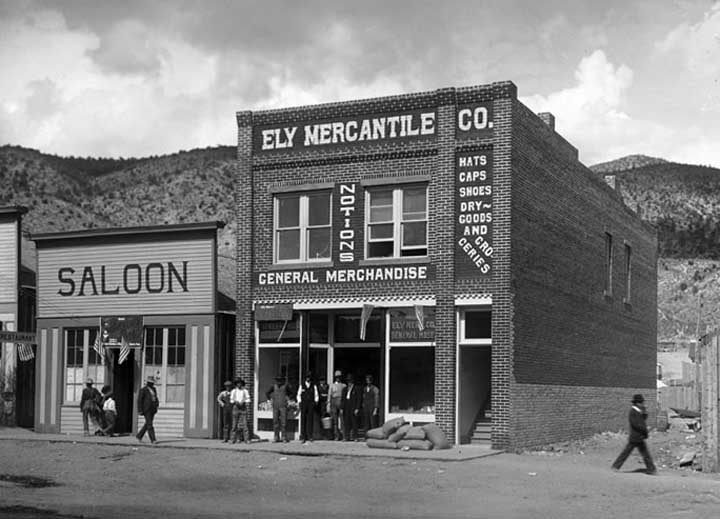
Ely, the seat of White Pine County, was founded in 1906 as a stagecoach station on the Pony Express and Ventral Overland Route. Later, with the discovery of copper in the area, which supplemented earlier gold discoveries, Ely became a mining town subject to the ups and downs of similar boom towns.

Western points of interest in Ely include the Nevada Northern Railway Museum and the East Ely Depot.


Source: Online Nevada

Settled in 1864, the mining town of Eureka, a source of silver and lead, proved to be the second-most productive in the state, with only the famed Comstock Lode producing more ore. Unfortunately, Eureka's mines were played out by 1878, although “The Friendliest Town on the Loneliest Road in America” survives.


The California Gold Rush is responsible for the settlement of Fallon, which became the final stop of men whose intention of joining the Forty-Niners in their search for California's gold but, instead, called it quits after crossing the Carson River. The settlement was named after local rancher Michael Fallon and his wife Eliza.


Wild horses near Stagecoach, Nevada. Source: YouTube.

As its name suggests, Stagecoach began as a station along the Overland Stagecoach route, which also served as a Pony Express station. Before 1857, when the Overland Stagecoach company was founded, U. S. mail was delivered to the West by way of steamers routed through Panama.


Source: Flickr

Of those towns on our list so far, Dayton is, in some ways, probably one of the most historic. Its original name, Ponderers Rest, recalls the pondering of travelers who rested here as they watered their animals and decided whether to follow the river southward or continue their journey to the west.

The population soared after gold was discovered at nearby Gold Creek, a Carson River tributary. To avoid California's tax, Chinese miners immigrated from the Golden State to the Silver State, and, when the Comstock Lode was discovered in 1859 and many miners traveled to Gold Hill and Virginia City to seek their fortunes, the number of Chinese workers in Dayton became great enough a year later that the settlement was renamed China Town.

It wasn't until 1861 that it was officially named Dayton, after John Day, a local surveyor who later became the Surveyor General of the United States. Thereafter, Dayton capitalized on its proximity to the Carson River by becoming the Comstock's major milling center, experiencing rapid growth. One of the “Great Fires” that occurred during the years 1866 and 1870 burned down much of the town, but Dayton survived, reduced both in size and importance, after the construction of the Carson & Colorado Railroad in 1881.

The Dayton Courthouse and the Union Hotel are among Dayton's places of interest to Western fans.


Source: Wikipedia

Finally, our trip west on Highway 50 brings us to Carson City. Named, in 1843, by John C. Fremont in honor of his scout Kit Carson, Carson City had its start as a Utah Territory trading post along the Carson Branch of the California Trail and was governed by Salt Lake City officials. The discovery of the Comstock Lode increased Carson City's population dramatically, and it became the seat of Ormsby County. Its Warm Springs Hotel, which has served as the territorial legislature's meeting hall, was converted into the region's first prison and remains part of this institution even today.


Nevada became a state in 1864, and Carson City became its capital. Its economic base switched from mining to commerce and railroad construction, in which Chinese workers played an enormous role. Although the building of the Central Pacific Railroad through the Donner Pass reduced Carson City's size and status, it remained an important frontier city into the twentieth century.


There are several places of interest for Western devotees, including several museums, the Stewart Indian School, the Sears-Ferris House, the Silver Saddle Ranch, the Mexican Dam, Prison Hill, and Lake Tahoe.


Mining, stagecoach lines, the Pony Express, politics, and railroads helped to settle the Western towns of Nevada, just as they helped to bring civilization to many other states of America's Wild West.


Next up: Western towns along Nevada's Interstate 80.


Sunday, August 30, 2020

Humorous Columns of Frontier Newspapers: Part I

Copyright 2020 by Gary L.Pullman


In a time such as our own, when newspapers are quickly becoming a thing of the past, it is difficult, perhaps, to imagine how readers, in the past, looked forward to the delivery of their daily chronicles.

The newspaper brought the world into their homes, where the news of the day—stories of election fraud, of gunfights, or stagecoach and train robberies, of hangings, of gold strikescould be read in armchairs by the fireside or over bacon and eggs at breakfast tables.

Stories of travel and adventure, of newfangled inventions, of battle and of war in the planet's far-flung countries could be read and debated in pool halls and barbershops and saloons.

The newspaper opened parochial, small-town life on the frontier to the world at large. The stories, often reported in a dramatic tone, were calculated to provoke, to excite, to anger, and to amaze.

Journalism was emotional; unless a newspaper article did as good a job at arousing its readers' passions as it did in relating the facts, a story hadn't successfully performed its task. (In truth, sensationalism was often more important than objectivity, just as feeling was more significant than facts.)


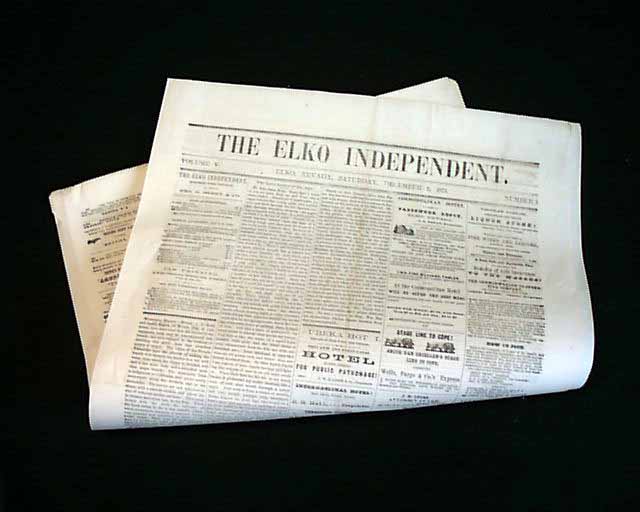
In their efforts to amuse and to be many, if not all, things to all readers, frontier newspapers also often contained humorous columns. Indeed, these periodicals included even analyses of the nature and methodology of humor, as in the “Wit and Humor” article published in the November 2, 1889, edition of Elko, Nevada's Daily Independent, which states that, although “laughter may be either genial or malignant, . . . it is allied rather to egoism and contempt than to affection and devotedness, the chief source of the ludicrous being the degradation of some person or thing which we have been accustomed to associate with power, dignity, or gravity.”

Although this is but one of several competing theories of what tickles the funny bone and why, it certainly prescribes, for reader and humorist alike, the main types of humor, their common wellsprings and method, and even the typical targets of the humorist. But our author, who prefers the protection provided by anonymity, further enlightens his readers as to the differences between wit and humor.


Sydney Smith

Originally, the writer instructs, “wit” referred to “intelligence,” but has since itself “become so degraded that paronomasia [the newspaper writers of yore were often intimately familiar with the lexicon] it is considered a species of wit.” The rest of the column continues to differentiate between humor and wit, backing its claims with allusions to the English wit Sydney Smith, the essayist William Hazlitt, the lexicographer Noah Webster, and the satirist Thomas Carlyle and ending with an example of each category.


As an instance of humor, the author cites Miguel de Cervantes's Don Quixote: the would-be knight  exemplifies humor, the columnist says, when he explains to his page, “The reason, Sancho, why thou feelest that pain all down thy back is that the stick which gave it thee was of length to that extent.”

As an exhibit of wit, the writer repeats the anecdote of a mute whose master reproached him for laughing at a funeral” by observing, “You rascal, you, I have been raising your wages for these two years past on condition that you should appear more sorrowful, and the higher wages you receive the happier you look.”

The article, both educational and amusing, is a good mix, and a good example, of the humor and wit its author defines, in all places, on the page of a newspaper published in one of the towns of the American Wild West!

Thursday, May 14, 2020

The Wild West's Famous, Infamous, and Fictitious Associations with Nevada

Copyright 2020 by Gary L. Pullman


Click the map to enlarge it.

Despite its rich association with the Wild West, Nevada isn't often the setting of Western novels or films, perhaps because its settlement and development were late.


Click the map to enlarge it.


The Transcontinental Railroad at Donner's Pass. Click the illustration to enlarge it.

Indeed, its final dimensions and borders weren't established until two years after the conclusion of the Civil War, although Nevada Territory became the nation's thirty-sixth state in 1864.


Click the map to enlarge it.

Mining was a key factor in the state's development, causing boom towns to spring up overnight, especially in the western part of Nevada. The building of the Transcontinental Railroad, which occurred between 1863 and 1869, also contributed to Nevada's growth and development, as the Central Pacific Railroad crossed into the state in 1868; by the end of the next year, the railroad had crossed the state completely.


Goldfield, Nevada historical marker. Click the marker to enlarge it.

Manhattan, Golconda, Battle Mountain, Tonopah, Goldfield, Virginia City, and Pioche (one of the toughest towns in the West) are among the towns that owe their existence or expansion to mining, and Reno, Lovelock, Winnemucca, Battle Mountain, Beowawe, Elko, Halleck, and others were founded or benefited from railroad construction.


Mark Twain and his Enterprise desk. Click the picture to enlarge it.

In addition to Mark Twain, who wrote for the Territorial Enterprise newspaper while he lived in Virginia City, other names, famous and notorious, associated with Nevada are the ill-fated Donner party, the outlaw leader Butch Cassidy, and the legendary lawman Wyatt Earp and his nearly-as-famous brother Virgil.


The Donner Party. Click the drawing to enlarge it.

Almost eighteen-hundred miles lie between Independence, Missouri, the starting point of the original members of the ill-fated Donner Party, and their destination, California. The party entered Nevada on September 10, 1847, and crossed the Ruby Mountains, reaching the Humboldt River sixteen days later. Legends of America describes this part of the party's journey:

The Donner Party soon reached the junction with the California Trail, about seven miles west of present-day Elko, Nevada[,] and spent the next two weeks traveling along the Humboldt River. As the disillusionment of the party increased, tempers began to flare in the group.

On October 5 at Iron Point, two wagons became entangled and John Snyder, a teamster of one of the wagons began to whip his oxen. Infuriated by the teamster’s treatment of the oxen, James Reed ordered the man to stop and when he wouldn’t, Reed grabbed his knife and stabbed the teamster in the stomach, killing him. The Donner Party wasted no time in administering their own justice. Though member, Lewis Keseberg, favored hanging for James Reed, the group, instead, voted to banish him. Leaving his family, Reed was last seen riding off to the west with a man named Walter Herron.

The Donner Party continued to travel along the Humboldt River with their remaining draft animals exhausted. To spare the animals, everyone who could, walked. Two days after the Snyder killing, on October 7th, Lewis Keseberg turned out a Belgian man named Hardcoop, who had been traveling with him. The old man, who could not keep up with the rest of the party with his severely swollen feet, began to knock on other wagon doors, but no one would let him in. He was last seen sitting under a large sagebrush, completely exhausted, unable to walk, worn out, and was left there to die.

The terrible ordeals of the caravan continued to mount when on October 12th, their oxen were attacked by Paiute Indians, killing 21 one of them with poison-tipped arrows, further depleting their draft animals.

Continuing to encounter multiple obstacles, on October 16th, they reached the gateway to the Sierra Nevada on the Truckee River (present-day Reno) almost completely depleted of food supplies.


Butch Cassidy. Click the photograph to enlarge it.

The association of Robert LeRoy Parker, better known as Butch Cassidy, the leader of the Wild Bunch, with the Silver State is no less deplorable.

As reported in The Ely Times, on September 19, 1900, Cassidy's gang robbed the First National Bank of Winnemucca. The outlaws got away with $32,640 in gold coins.


Etta Place and the Sundance Kid. Click the photograph to enlarge it.

It's an interesting story. Unfortunately, there's not much truth to it: According to a Nevadagram article, “Butch Cassidy didn’t send that picture and the evidence is clear that he was never in Winnemucca in his life.” Although both the Nevadagram article and the The Ely Times article concede that the bank was robbed, both deny that Cassidy was directly involved, if he was involved at all.


Wyatt Earp. Click the photograph to enlarge it.


Virgil Earp. Click the photograph to enlarge it.


Wyatt Earp and his brother Virgil followed opportunity, traveling from one boom town to the next, often in the company of a female companion. Wyatt relocated from the Kansas cattle town of Dodge City to the silver mining town of Tombstone, Arizona, the site of the famous Shootout at the OK Corral. After visiting the gold mines of the Yukon, he operated a saloon in Nevada before, eventually, retiring in California.

In Tonopah, Wyatt established a saloon, The Northern, with his common-law second wife, Josephine Marcus, the successor to Earps' first common-law wife Mattie Blaylock. He also hauled “ore and supplies” for the Tonopah Mining Company and did a stint as a deputy U.S. marshal. 

Virgil, who'd been with Wyatt in the shootout in Tombstone, died in Tonopah. Outlaws and ruffians had attempted to end Virgil's life numerous times before, but pneumonia claimed him.


The Northern Saloon.  Click the photograph to enlarge it.

* * *
To the exploits of the Donner Party, Wyatt Earp, Virgil Earp, and Butch Cassidy, we can add those of Nevadan Bane Messenger, the protagonist of the novels in my series An Adventure of the Old West. By turns, a Union veteran of the Civil War, a bounty hunter, a sheriff, and a U. S. marshal recruited by President Chester A. Arthur himself, and a friend and confidant of Allan Pinkerton, Bane's exploits are every bit as adventurous as those of any other Western hero, living or dead, historical or fictional.

https://www.amazon.com/Good-Gun-Gary-L-Pullman/dp/1719801754


Friday, November 1, 2019

Jim Levy (Leavy): At The End of a Trail of Violence

Copyright 2019 by Gary L. Pullman


Pioche, Nevada, 1885

Abilene. Cripple Creek. Deadwood. Dodge City. Tombstone. There are towns with more famous names than that of Pioche, Nevada, but historians have verified that Pioche was as rough and tough as any other town in America's Wild West.

Although Pioche's Jim Levy (also spelled Leavy) wasn't as famous as Wild Bill Hickok, Wyatt Earp, Bat Masterson, or Doc Holliday, he did develop a reputation as a man who was skilled with a six-gun and someone it was dangerous to cross, and Wyatt Earp and Bat Masterson considered him a skilled gunfighter.

He started his career as a gunfighter in hope of inheriting $5,000. In a gunfight with fellow miner Mike Casey, Thomas Gosson (also spelled Gasson) was fatally wounded. His dying proclamation was to will $5,000 to anybody who killed Casey.


Pioche, Nevada

In the 1871 gunfight that occurred between Casey and Levy, in front of Freudenthals' General Store, Levy wounded his adversary, putting Casey out of his misery by pistol-whipping him, an act that earned Levy both a pistol shot to the jaw from one of the dead man's friends and the money Gossan had bequeathed to Casey's killer.

In Pioche, in January 1873, Levy was also involved in another duel to the death, this time against Thomas Ryan. Due to a lack of evidence needed to prosecute Levy for murder, the gunfighter was released. Sometime during the next two years, he left Pioche.


On March 9, 1877, in Cheyenne, Wyoming, Levy became involved in yet another gunfight, this time against Charlie Harrison. Like Levy, Harrison had a history of violence, having killed several of foes. Insults Harrison made about the Irish during a card game in which Levy was also a player infuriated the Nevada gunfighter, and the men agreed to settle their score outside. They later faced off in front of Frenchy's Saloon.

Although Harrison got off the first shot—or the first few shots—his aim was inaccurate. Levy's was not, and he shot Harrison in the chest. To finish the job, Levy approached his fallen foe and shot him again. Witnesses took umbrage at this second, needless exhibition of Levy's skill, but he was never prosecuted for killing Harrison.


Tucson, Arizona

In Tucson, Arizona, Levy came to the end of his trail. This time, his dispute was with John Murphy, who was dealing cards in a faro game at the Fashion Saloon. The men agreed to settle their differences in a gunfight the next morning. 

Instead, Murphy and his friends, Bill Moyer and Dave Gibson, encountering Levy just after midnight as he approached the Palace Saloon's front door, opened fire on Levy, assuming the gunfighter was armed.

Levy believed the shots had been fired from within the saloon and fled outside—a mistake that cost him his life, when he ran straight into his enemies' gunfire. Although Murphy, Moyer, and Gibson were arrested and held in jail for killing an unarmed man, they escaped, and Murphy and Gibson evaded capture. Moyer was arrested and sentenced to life in prison.


List o f 19th-Century U. S. Western Frontier Forts, Part VIII: Montana

Note : This is the eighth of a series of lists of the  U. S. forts of the Wild West. It is intended for use in research by writers, readers,...