Saturday, August 1, 2020

Charles M. Russell's Portrait of the American West

Copyright 2020 by Gary L. Pullman
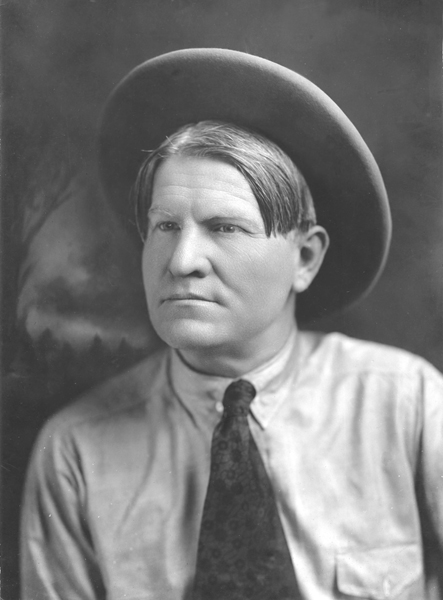


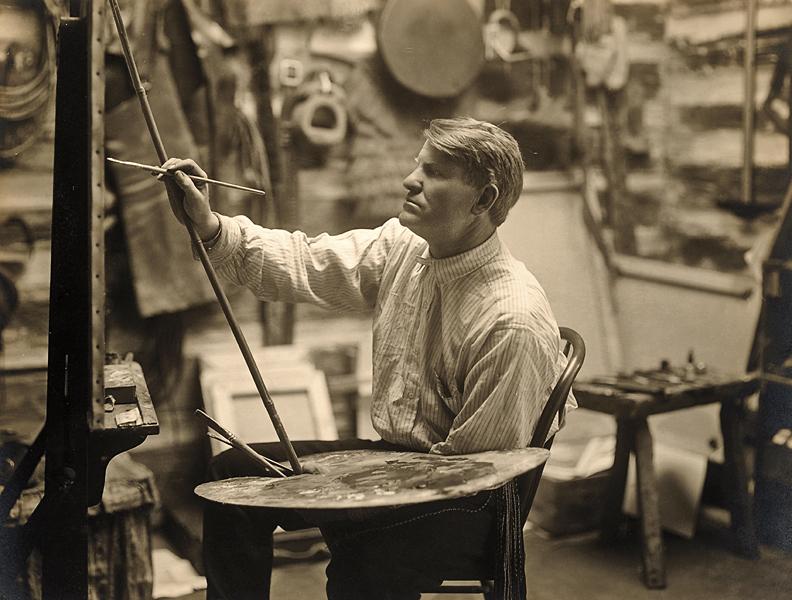
Born in Oak Hill, Missouri, near St. Louis, a year before the end of the American Civil War, Charles M. Russell became an early devotee of the American West, working first as a shepherd and then as a cowboy on Montana ranches. After marrying Nancy Cooper, in 1896, Russell began his career as a full-time artist, “painting and sculpting” inside his “log cabin studio next to their home” in Great Falls, where he died in 1926, leaving a legacy of work chronicling and commemorating the time and place he'd loved all the days of his life.


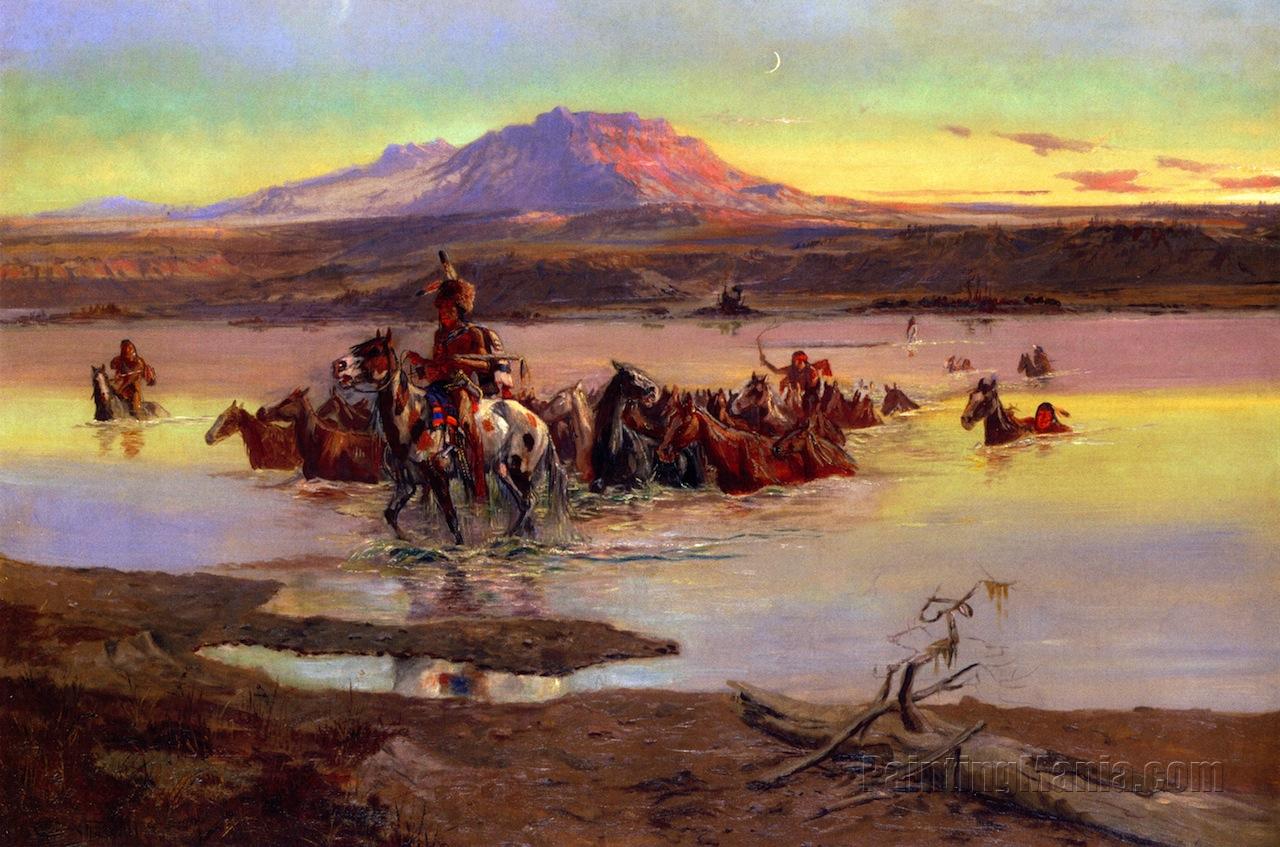
In over two thousand paintings, Russell captures the spirit and adventure of the Wild West. His work depicts roundups, bronco busting, the fording of rivers, cowboys' encounters with wild animals, buffalo hunts, camping, gambling, scouting, gold mining, hunting, and much more.


Many of his paintings are also devoted to the nomadic life of Native Americans, as they hunt buffalo, fight cavalry soldiers, attack frontiersmen, travel from campsite to campsite, grieve fallen warriors, greet the famous explorers Lewis and Clark, encounter other tribes, worship, communicate by smoke signals, and perform other tasks of daily life.
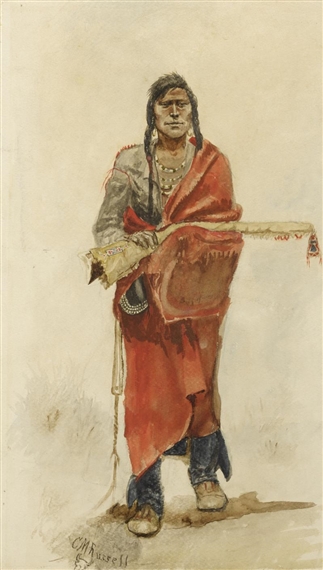

Several tribes are portrayed, including the Piegan, Crow, Sioux, Blackfoot, Chinook, Navajo, Shoshone, Cree, Mandan, and Kootenai. By today's standards, Russell's portraits of Native Americans are, at times, politically incorrect. In his art, which depicts its subjects' encounters with both other tribes than their own and with white men, whom they see variously as traders, fighters, settlers, and invaders, battles, bloodletting, and death are likely to follow.
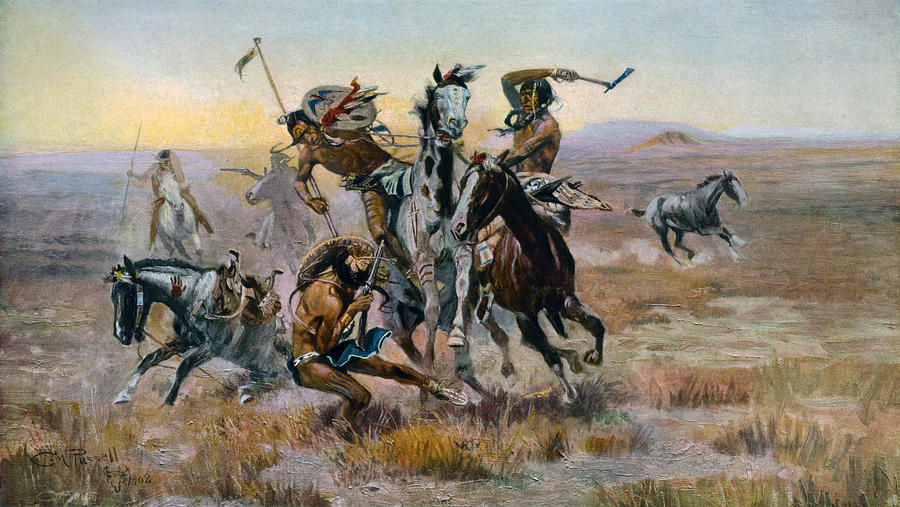

More than a few of the paintings are dedicated to displays of Native Americans at war, both with each other and with whites. as the works' titles suggest: Scouting the Enemy, On the Warpath, The Battle Between the Blackfeet and the Piegans, War Council, The Making of a Warrior, Planning the Attack, The Attack, Indian War Party, Sun River War Party, Battle of Belly River, Mandan Warrior, Return of the Warriors, Cree War Party, The War Party, and WAR.


When Native Americans are not waging war, they are often engaged in other hostile acts, against other tribes or against white men, as they are in such paintings as Sioux Torturing a Blackfoot Brave, Planning the Attack on the Wagon Train, The Horse Thieves, Blackfeet Burning Crow Buffalo Range, and Crow Sheep Stealer.
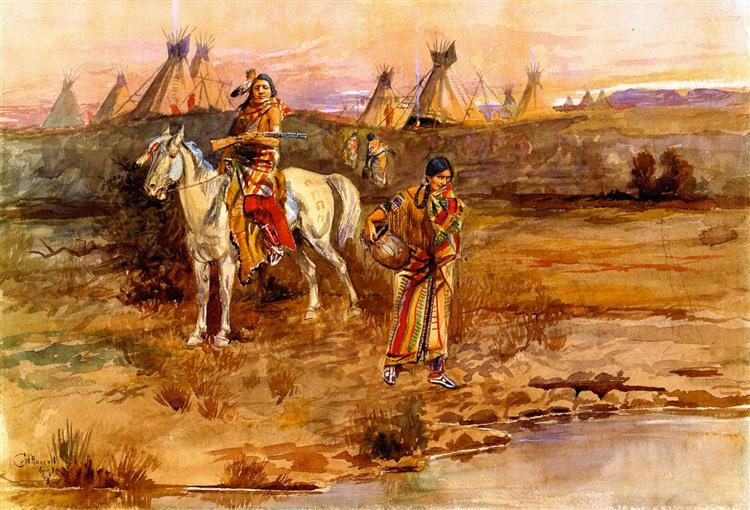

Not all of Russell's paintings depict Native Americans as uncivilized, battle-driven killers, thieves, and arsonists, of course. A couple show individuals as “noble” and “romantic” figures. In a number of works, Russell's Native American subjects are even portrayed in a seemingly lighthearted or humorous fashion (A Piegan Flirtation, Indian Beauty Parlor, Waiting and Mad), a reverent manner (Invocation to the Sun, Sun Worship in Montana), or a diplomatic pose (Lewis and Clark Meeting Indians at Ross' Hole, Lewis and Clark Reach Shoshone Camp Led by Sacajawea the Bird Woman, Indians Discovering Lewis and Clark, Lewis and Clark Meeting the Mandan Indians).


One can't help but to notice, however, that in the diplomatic series involving the meetings between Lewis and Clark and various tribes, the white explorers receive top billing in the titles, and it is usually they, not the Native Americans, who are assigned the active role; it is they who meet; even when Sacajawea leads, her name appears after theirs, and they are assigned the primary active role: they “reach” the Shoshone's camp. It is almost as an afterthought that their guide's action, in leading them, is mentioned. Clearly, in Russell's view of the American West, whites are the protagonists. His Native Americans are the villains or supporting characters or, in some cases, even window dressing.
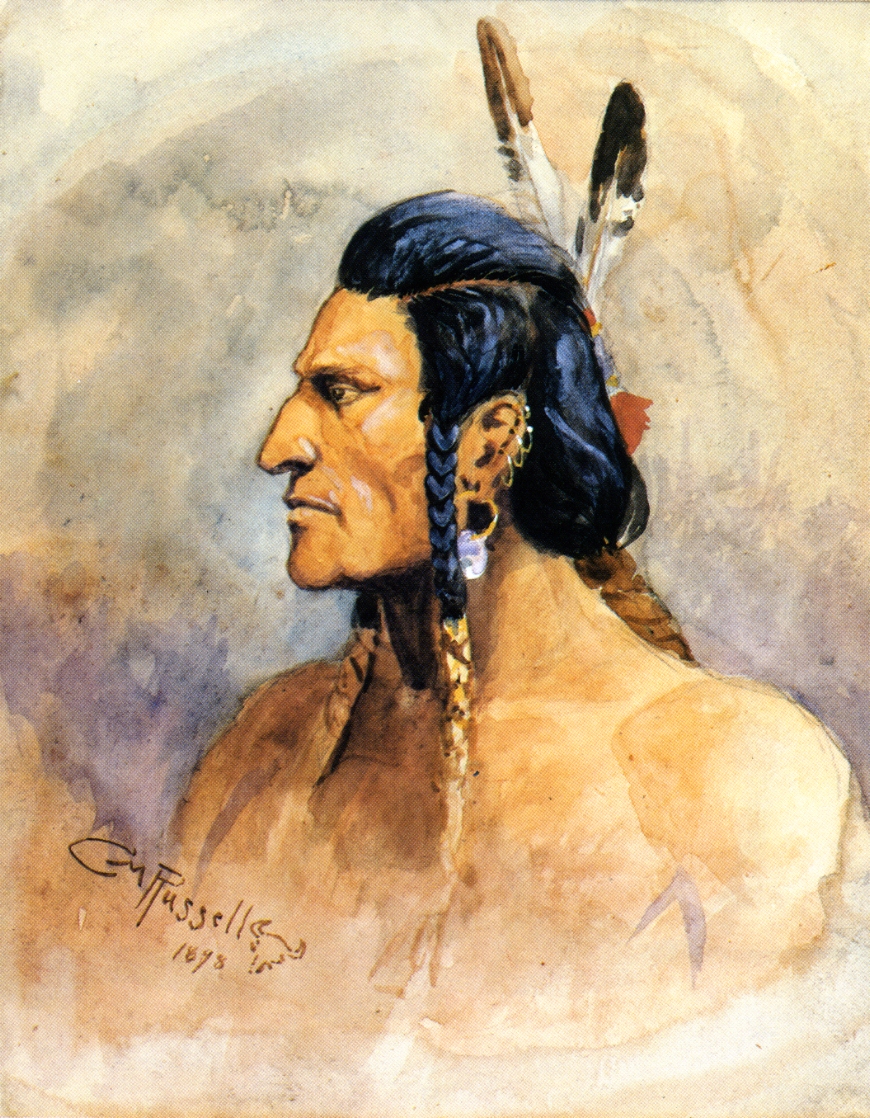

Russell's work tends to show Native Americans as treacherous and militant or, in the comparatively rare moments in which they are not burning a field, torturing an enemy, plotting battles, or waging war, as comical, paganistic (animistic), or helpful to the active, purposeful white men they serve. There is only one other major category of Native American on display in the artist's gallery of “Indians”: the stereotypical representative, usually in portraiture, of Indian Brave, Indian Buck, Indian Squaw, and [Portrait of an] Indian.


Although Russell is largely positive in his portrayal of white men as the heroic tamers of the Wild West, he also lampoons them on occasion and shows them in a bad light at times. In one painting, a cowboy tries to “bargain” with a Native Indian “for an Indian girl.”


In another work, Whooping It Up, a band of cowboys, apparently drunk, gallop down the main street, past a saloon, shooting their revolvers at the sky and frightening a Chinese pedestrian, who drops a basket of laundry, scattering chickens, while a dog runs in the opposite direction and, across the street, men look on from the boardwalk in front of a saloon, while Asian women in front of Hop Lee's Laundry stare in fear. The white men's behavior is reckless and dangerous, but no one seems ready to intercept or challenge them.
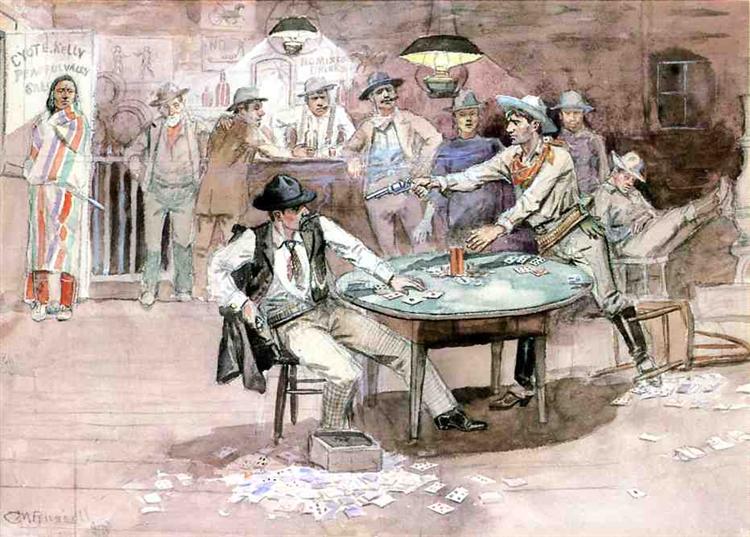

In the ironically titled Peaceful Valley Saloon, gamblers are about to duel at their table, possibly to settle a charge of cheating at cards; one hold his extended weapon, while his adversary begins to draw his own six-shooter from his holster. None of the other patrons of the saloon, including the bartender, appears concerned, suggesting they have seen such behavior before. Adding to the irony is the Native American who looks on, rifle in hand, a stoic expression on his face, since, often, in Russell's' work, Native Americans are depicted as hostile and violent.
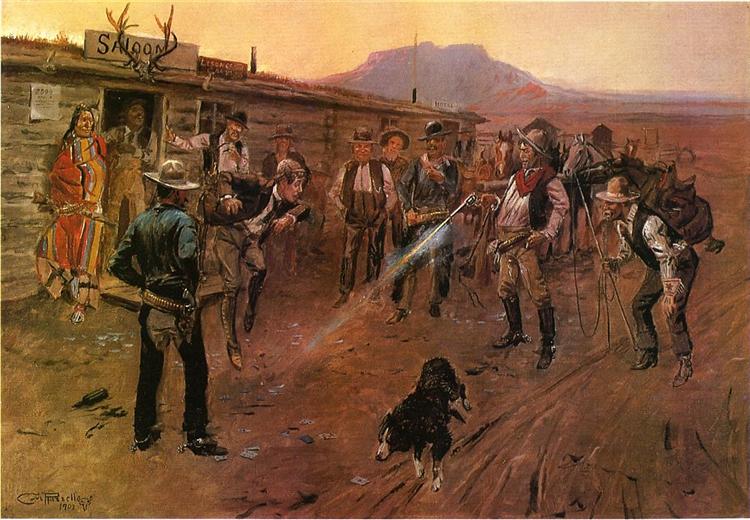

In The Tenderfoot, a cowboy makes a new arrival to the West, who is still dressed in the fashion of the East, “dance” by shooting his pistol at the dude's feet, much to the amusement of the other frontiersmen gathered outside the saloon before which the spectacle takes place and to the consternation of a fleeing dog. Even the token Indian in the group looks amused by the potentially dangerous shenanigans.
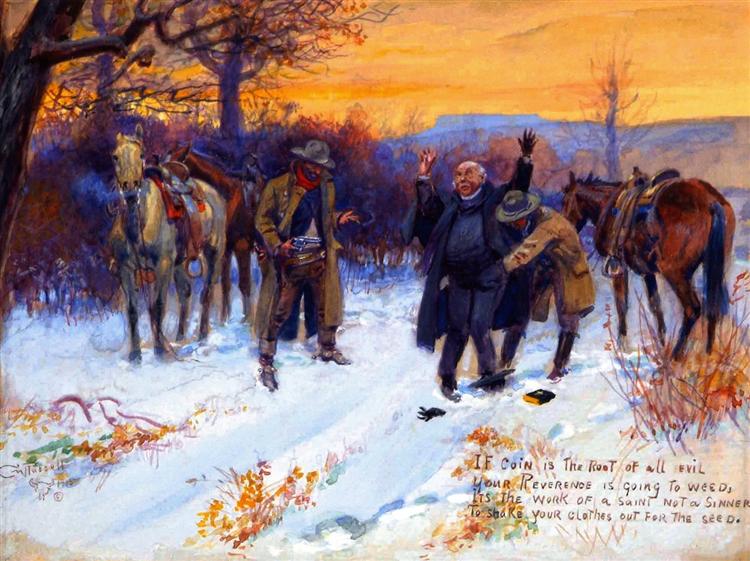

Outlaws, as such, are fairly rarely represented in Russell's work. However, a pair of highway robbers appears in Fleecing the Priest, and, as the painting's title indicates, their victim is a man of the cloth. As one of the robbers holds a gun on the clergyman, who stands between the two outlaws, his hands overhead, looking frightened, the other reaches deep into the left pocket of the unfortunate soul's trousers. The lining protruding from the other pocket suggests that it has already been searched. Four lines of partially rhyming verse explain the villains' attitude toward the man they are robbing:

If coin is the root of all evil
Your reverence is going to weed;
It's the work of a saint, not a sinner,
To shake your clothes out for seed.

When Russell's depictions of the Wild West depart from the heroic white Westerner to the criminal element, the deviation is also one from the sublime to the ridiculous, for the painter almost always depicts the cowboy or the sheriff or the soldier as an exalted hero, while he portrays the outlaw as an absurd buffoon. The True West, he implies, is about the men who tamed the wilderness and civilized the frontier; it is not about those who, like robbers, attempted to subvert law and order, nor is it about those who, like Native Americans, fought against or stood in the way of progress.


Russell's paintings show rugged Western terrain, its plains and mountains, canyons and gorges, deserts and snowy highlands, rivers and lakes, pines and cacti. The landscapes also depict the wildlife of the West: buffalo, mustangs, wolves, bears, big horn sheep, elk, and deer. Such paintings reflect the reality, in the untamed West, of the need to “kill or be killed.” The frontier is a land “red in tooth and claw,” in which “only the strong survive” in a constant contest in which “the survival of the fittest” is enacted every day, whether among plants, animals, or men.


Signs of stable, established civilization—white civilization, that is—are few and far between in Russell's oeuvre: an occasional cabin, a trading post, a saloon, a fort, storefronts along a boardwalk adjacent to false-fronted buildings built mostly of wood. Only rarely is there a brick or stone edifice suggesting commitment and permanence. Most of the signs of white civilization, the foil of which, in Russell's art, is the nomadic culture of the Native American, as represented by temporary camps of tepees and clothing of blankets, loincloths, beads, moccasins, robes, and headdresses, buckskin dresses or skirts, and coarse blouses, are transient: chuck wagons, buckboards, stagecoaches, trains.
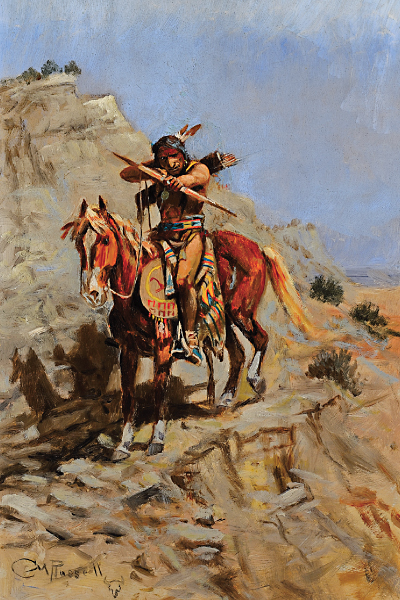

Russell's vision of the West is flawed. Stereotypical at best, it borders upon racism at times in its depiction of white men as the rowdy, uncouth bringers of civilization to the untamed West and of Native Americans as typically (that is, stereotypically) savage and militant, uncivilized and hostile, wild and brutal. White men have come to tame the West, and that includes the savage, uncivilized Native Americans who attack the newcomers' camps, settlers' cabins, wagon trains, and railroad cars. For the West to be tamed, the Native American must be defeated, killed, banished, and otherwise controlled. These ideas are implicit in Russell's art. It is politically incorrect.


There is, however, truth in his depictions of Native Americans as well as implicit falsehoods or misrepresentations. The cowboy, the farmer, the rancher, the sheriff, the railroad worker, the miner, the soldier, and the other white figures of the West did bring civilization—their civilization—to the West. They built towns. Schools. Churches. Telegraph lines. Railroads. Stockyards. Gold and silver mines.


Russell's heroes built cabins and houses and towns on plains. They laid rails so that trains could travel over mountains, bridge canyons and gorges, and cross miles of desert wasteland. Their boats journeyed up and down rivers and across lakes. They built houses from oaks and pines and quenched their thirst on the juices of cacti. They hunted buffalo, elk, and deer. They captured and domesticated mustangs. They killed dangerous wolves and bears. They made the West habitable and safe—or safer, at least, than it had ever been.

Eventually, they, or their children, also built newspaper offices, libraries, museums, art galleries, department stores, and a host of other pedagogical, religious, commercial, technological, journalistic, and artistic institutions; they spread Western culture throughout the New World. In that sense, the Western heroes Russell's art depicts were heroic, indeed; they were larger than life; they were knights in Stetsons and gun belts and boots.


Despite Russell's lopsided and oversimplified view of Nature and Civilization and their respective human masters, the Native American and the mostly white Westerner, the painter constructed a vast, panoramic vision of this conquest of the Wild West that continues to have a powerful effect on the imagination and the emotions. It is a vision which, although in need of correction and further development, is one that can still be considered inspirational to a significant degree.

Friday, July 17, 2020

The A. B. Seelye Company: A Story of Notions, Lotions, Potions, and Riches

Copyright 2020 by Gary L. Pullman


As Ann Anderson points out in Snake Oil, Hustlers and Hambones: The Anerican Medical Show, the entertainment that these carnival-style performances provided (between snake oil salesmen's product pitches) was “perfectly suited to isolated rural audiences” who enjoyed simple amusements (163). Performers included “blackface” comedians, musicians, mind readers, ventriloquists, magicians, and others (82).


Both comedies, such as the movie Poppy (1937), starring W. C. Fields, and a Walt Disney production, Alice's Medicine Show (1927). starring Lois Hardwick, and Westerns, including Little Big Man (1970), starring Dustin Hoffman and Faye Dunaway, and The Outlaw Josey Wales (1976) starring Clint Eastwood.


Some members of show audiences were easily convinced, or duped into believing, that the salesmen offered the elixirs of life. Others were skeptical (as were the physicians of the day). In Western films, though, medicine shows, as might be expected, were usually played strictly for laughs.
The very phrase “snake oil” suggests chicanery. In Europe during the 1800s, rattlesnake “oil” was regarded as a cure for arthritis and rheumatism. Whether or not this is true hasn't been proved, but the question, with regard to the “medicines” said to have been derived from vipers, including rattlesnakes, is moot, since, as Laurence M. Klauber points out, in volume two, of his Rattlesnakes, it's unlikely that snake oil ever actually contained snake oil (or any parts of these vipers).

Snake oil products are also known as “patent medicines.” The National Museum of American History explains why:


Patent medicines are named after the “letters patent” granted by the English crown. The first “letters patent” given to an inventor of a secret remedy was issued during the late 17th century. The patent granted the medicine maker a monopoly over his particular formula. The term “patent medicine” came to describe all pre-packaged medicines sold “over-the-counter” without a doctor’s prescription. In the United States very few preparations were ever actually patented.


The label on the front of a bottle of Seelye's Wasa-Tusa, a medicine “For Man and Beast, Internal and External,” lists its ingredients as “63% non-beverage alcohol, 10 minims [of] sulphuric ether and 7 minims of chloroform per ounce [of] alcohol derivative.”

Like most patent medicines, it's touted as effective in the treatment of a host of maladies: “Muscular Soreness, Bruises, Strains, Sprains, Simple Headache, Simple Neuralgias, Toothache, Simple Earaches, minor Irritations of the Throat, and where a counter-irritant would be used.”

A few drops taken “internally,” with water or milk, likewise remedies “Colic and Cramps due to Gas.” The product is also “Useful for Wire Cuts, Swellings, Etc., and on Animals” and works as effectively to alleviate “Colic in Horses” as it does to relieve the same malady in humans.

Wasa-Tusa cures so many conditions and diseases that it's hard to see why anyone would ever need to buy another medicine after purchasing The A. B. Seelye Company's nostrum. Considering all the ailments from which the product provides relief, if not, indeed, a cure, it is certainly worth its $1.25 retail price.


One of the most interesting facts about Alfred Barns Seelye (December 20, 1870 - February 14, 1948) is that he took the theatrics out of snake oil sales, treating the production, marketing, and distribution of his patent medicines as a business. In addition, as we shall see, he found innovative ways to entertain his customers and potential customers. If, after the passing of the medicine show, due to its ever-increasing extravagance and attendant expenses, Seelye would bring the show to the clientele--or a semblance of it, at least. As a result, he was immensely successful for years, his customer base and profits increasing dramatically.

Seelye studied both medicine at one college and literature at another, without graduating from either. In 1890, after moving from Illinois, where he'd grown up, to the famous cowtown, Abilene, Kansas, of which Wild Bill Hickock had once been marshal, Seelye set up a laboratory and began making Wasa-Tusa, Fro-Zona, and about a hundred other concoctions.

His success was tremendous, his company growing to the point that, at the pinnacle of his success, he employed over three hundred traveling salesmen, among other workers. He had to move his operations into a larger building, which also housed his Seelye Theater, which sat an audience of eight hundred.
He married Jeanette Taylor in 1893, and the couple increased Abilene's population by two, their daughters Mary Eleanor and Helen Ruth.

Founded in 1890, in Abilene, Kansas, Seelye's company was incorporated nine years later. By 1905, its snake oil sales had made Seelye a wealthy man, indeed.

It's not hard to understand why. The company offers something for everyone—and for every ailment.


A three-ounce jar of its Fro-Zona Company ointment is a superb after-shave, its menthol, camphor, and oils (peppermint, eucalyptus, and pine), and, of course, its petroleum, constituting a “soothing preparation” for everyday use. It cools “prickly heat, sunburn, insect stings, chafing, frost bites [sic], head colds, chapped skin, nasal irritation, superficial burns, and simple headaches.”

It can be rubbed “between the eyes,” daubed up the nostrils, or dabbed “behind the ears,” preferably before “retiring at night.” Apparently, it also works on toys: the front of the product's label shows a physician making a house call to examine a little girl's doll, as he holds a jar of the panacea.

The fact that Fro-Zona is a patent medicine is indicated on the bottle by a stamped notice of the balm's registry with the U. S. Patent Office.


In promoting his medicines, Seelye is sure to offer his customers more than their money's worth. A 1903 promotional “almanac” is also a “health guide,” and the combination almanac-health guide is also a cook book—three useful publications in one. In short, the booklet contains, “besides the weather forecasts, some excellent Cooking Receipts [sic] . . . and general information, as well as a history of the Seelye Medicines and their method of cure.”

In addition, it's chock full of advertisements for his lotions, potions, and nostrums. The fifty-two-page publication promotes “Ner-Vena, Wasa-Tusa, Magic Cough and Consumption Cure, Seelye's Wintergreen Ointment, Wintergreen Soap, A. B. Seelye's Happy Life Pills, Seelye's Universal Stock and Poultry Powder, Horse Liniment, Seelye's Hair Tonic and Restorative, and other remedies.”

The brochure's “Introduction” boasts of the company's success. Business was “excellent” in 1902, and sales in 1903 promise to be no less flourishing, as the company marks its “13th year” of continual growth,” satisfied customers singing the medicines' praises as products that not only “cure folks” but also “prolong life.” The booklet is quite a bargain for free (although, should readers care to do so, they're more than welcome to send in their testimonials concerning the benefits of the company's cures).


The brochure contains many delightful, if not always informative, illustrations as well. One, labeled “The Human Body,” shows the figure of a man, lines connecting the animals of the zodiac to the various organs of the human anatomy over which these signs are said to govern: Gemini, the arms; Leo, the heart; Taurus, the neck; and so on.

The booklet contains all manner of trivia and esoteric information. In addition to the astrological associations with human anatomy, a list of religious holidays and their respective dates appears, beneath which the year's “Morning and Evening Stars” are identified.

As might be expected, advertisements and testimonials make up a substantial part of the publication, appearing either as full-page texts or as sidebars, complete with a photograph of the gentleman or lady who offers an endorsement of a particular product.


Mrs. Julia Weathers, for example, of Sedgwick, Kansas, who once suffered, it seems, from “weak nerves,” contends that “Dr. Seelye's Ner-Vena is the greatest medicine” for treating this condition that she has ever seen. “Dizzy spells” had afflicted her, causing her to “stay in bed half a day at a time,” before “three bottles” of Seelye's “remarkable remedy” remedied her condition, curing her. And that's not all! She adds, Ner-Vena also benefited her heart in some way. (She doesn't say how, exactly.) Whatever the wonderful nostrum did to help her heart, though, prompted her to declare, in no uncertain terms, “Ner-Vena was indeed a God send to me.”

These features weren't live acts, of course. There were no magicians and clowns, no ventriloquists or men on stilts, but there were interesting articles, loads of trivia, intriguing illustrations, esoteric lore, and, of course, apparently heartfelt thanks, product recommendations, and personal testimonials from satisfied customers. On the frontier, especially in rural areas far from the nearest town, the arrival of Seelye's combination almanac-health guide-cook book must have been welcome, indeed. Its pages provided escape from boredom and drudgery while acquainting its readers with the wonderful nostrums that could cure nearly any ailment known to medicine, and, best of all, it was delivered free to one's doorstep, upon request.

A help wanted advertisement in the May 15, 1902 issue of the Abilene Weekly Reflector also suggests that the company was doing well. Despite having forty employees, the company was seeking ten to twelve more salesmen and had hired the Abilene Carriage Company to build “ten new wagons” to carry products directly to the customers who ordered them.

Despite the announcement's headline, “Good Chance for Hustlers,” it seems that the newspaper found the company to be a good place to work: “Dickinson county young men need not hesitate to engage with the A. B. Seelye Medicine company as they are reliable and do well by their salesmen.”


Yes, whatever the effectiveness of its many “medicines,” The A. B. Seelye Company was good to its founder. With the fortune he earned, he built the fabulous 11,000-square-foot, twenty-five-room Seelye Mansion in Abilene, Kansas.


A beautiful home in the Georgian style, this magnificent mansion, built in 1905 for $55,000, boasts Edison light fixtures, a Tiffany fireplace, eleven bedrooms, a ballroom, a music room featuring “gold French furniture and a grand Steinway piano,” and a bowling alley. The house was also home, at one time, to Seelye's laboratory (where, it seems likely, plenty more nostrums were concocted),Seelye was even more extravagant in purchasing the mansion's elegant furniture. He bought most of it at the 1904 St. Louis World's Fair, paying more for it than he paid to build the house!


The bowling alley, which “was ordered at the Chicago World's Fair,” was constructed by the American Box Ball Company, Indianapolis, Indiana. It not only automatically returns the ball, but features an unusual feature: the pull of a lever resets the “drop-style pins.”

As a youngster, Dwight D. Eisenhower delivered ice to the mansion; later, of course, the boy would become Supreme Commander of the Allied forces during World War II and the president of the United States, but, for the Seelye daughters, Helen and Marion, who lived in the house following their father's demise, Ike would remain “a man from the wrong side of the tracks.”

Dwight D. Eisenhower and Frank Lloyd Wright

Another famous person associated with the Seelye Mansion is architect Frank Lloyd Wright, who “suggested renovated the interior” of the home in the 1920s.


Seelye's Wasa-Tusa, his Fro-Zona Company ointment, his Magic Cough and Consumption Cure, his Wintergreen Ointment, his Wintergreen Soap, his Happy Life Pills, his Universal Stock and Poultry Powder, his Horse Liniment, his Hair Tonic and Restorative, and all his other preposterous products—and his innovative and tireless efforts in promoting them—made the purveyor of dubious notions, lotions, and potions a remarkably wealthy man who lived out his life in luxury, perhaps tinkering with formulae and concocting new “medicines” right up to the end of his days.


Tuesday, July 7, 2020

Reading, Writing, and Researching the Old West

Copyright 2020 by Gary L. Pullman

Writing any novel is challenging, but historical fiction adds a few layers of difficulty. A writer has to research the times in which his or her story is set.

Despite such due diligence, a mistake is apt to occur, and some readers are notoriously unforgiving about such errors. Quite rightly, they expect their Westerns to have the ring of truth, especially in regard to facts. How much did a sewing machine cost in 1863? What type of blacksmith's tools were available in Gold Hill, Nevada, in 1863?

Readers sometimes boost their own enjoyment of the genre by doing what writers do: researching topics that are unfamiliar or somewhat forgotten. Learning historical, linguistic, cultural, technological, and other details of the latter half of nineteenth-century America makes fiction more rewarding and fun to read.

In this post, for readers and writers alike, I offer a few resources to add to their browser's favorites.

Maps

Knowing what a trail, a route, a town, a state, or the country itself looked like at a particular time in history is invaluable for readers and writers of the Western genre.


Click the image to enlarge it.

When did a territory become a state? What historical sites existed in Washington, DC, in 1881? What was the White House called, or the Oval Office, before these terms became commonplace? What was the exact route of the Pony Express, the transcontinental railroad, or the cattle trails? What hotels existed in Tombstone, during Wyatt Earp's residency in the famous Western town? What were the names of the streets in Deadwood? Was there really a Long Branch Saloon in Dodge City? Maps answer these questions and many others, accurately and definitively.


Click the image to enlarge it.

A great resource for historical maps is Old Maps Online.

This resource allows users to “Find a place” or “Browse old maps.” Instructions make the process easy, and an “Exact Area tool” allows users to focus on precise regions of the map. A zoom feature allows up-close looks at specific sites. Advanced features let users select a timeline, a specific publisher, and more. Search results are shown in a panel at the right side of the screen, complete with identifications of the maps thus displayed.

Old Maps Online is an invaluable tool for both readers and writers alike—and it's FREE!

Newspapers

There's nothing like vintage newspapers to mine pertinent and intriguing facts about the life and times of a past year, decade, or century, and the Library of Congress's Historic American Newspapers provides just this service—and it's FREE!


States are listed alphabetically, down the left side of the screen, and newspapers related to each state's cities, towns, and other sites are listed, by state, down the center of the screen—and not just a newspaper or two, but bunches and bunches of them!

The index also provides information about the number of issues available for each newspaper, its earliest issue, and its latest issue. With a click of a button, users can access the newspaper or newspapers of their choice.

https://www.amazon.com/dp/B07THD35QX?searchxofy=true&ref_=dbs_s_aps_series_rwt

Click the image to order.

My series, An Adventure of the Old West, is set in Nevada, after the Civil War, so Nevada newspapers of this period have been especially useful to me. The database contains thirty-two Nevada newspapers, including Carson City's Daily Appeal, Morning Appeal, and Daily State Register; Elko's Daily Independent, Weekly Elko Independent, and Weekly Independent; Pioche's Ely Record and Pioche tri-Weekly Record; Eureka's Eureka Weekly Daily Sentinel; Gold Hill's Gold Hill Daily News; and Unionville's The Silver State. (The newspaper of record in my series is the fictitious Excelsior Times).

When a newspaper is accessed, further information appears: alternative title(s), place of publication, geographic coverage, publisher, dates of publication, description, frequency of publication, language, subjects, notes, related links, holdings, and views.

When reading the papers themselves, users can magnify the text, toggle to full page (which can also be enlarged several times simply by clicking it), locate all issues, and access text, .pdf, and .jpeg files.

The newspapers are also introduced with a detailed summary of their origins and histories. This one is for the Gold Hill Daily News:

Gold Hill, Nevada, was one of the first settlements in the Comstock mining district after the discovery of a rich deposit of free gold on a hill above Gold Canyon in January 1859. Soon, silver supplanted gold in yield throughout the Comstock, and Virginia City quickly overshadowed Gold Hill in size and sophistication. The population of Gold Hill reached 8,000 at its peak, primarily working-class residents, including many Cornish miners.
On October 12, 1863, the Gold Hill Daily News was established as a Republican newspaper by Philip Lynch and his stepson John H. Mundall, former publishers of the Placer Courier in Forest Hill, California. They hired as their editor Hiram R. Hawkins, an acquaintance and fellow publisher. When Hawkins left in 1865, Lynch bought out Mundall, becoming the sole editor and publisher. According to the Nevada historian Myron Angel, under Lynch the Gold Hill Daily News gained a reputation as "the best-printed [paper] of any on the Pacific Coast."


 Click the image to enlarge it.

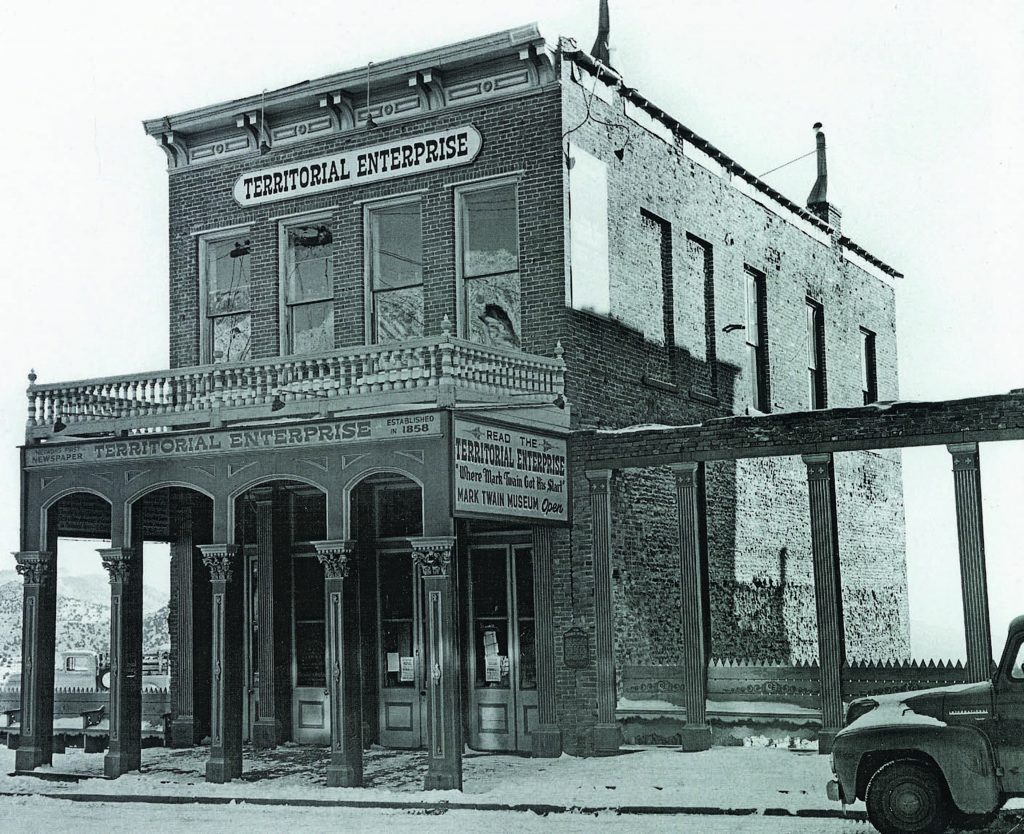
On November 14, 1867, Alf Doten left his job as a local reporter for the Virginia City Territorial Enterprise to become the associate editor and reporter for the Gold Hill Daily News. Doten held that position until Lynch's death on February 13, 1872. A Nevada journalist who is now best known for his diaries chronicling the daily life of Gold Rush California and the Comstock, Doten laid claim to the position of sole proprietor and editor of the News in the paper's masthead, securing the title on the paper March 9th when he purchased it from Lynch's widow for $10,000. That same year John P. Jones, the co-developer of the Crown Point Mine, and William Sharon, a Comstock banker made wealthy through foreclosures on loans through the Bank of California, were vying for the U.S. Senate seat in Nevada held by James Nye. Doten first approached Jones, asking him either to buy the News or to provide him with a loan. When Jones declined, Doten went to his rival Sharon, who agreed to lend him $7,000.

Sharon withdrew withdrew from the Senatorial battle during a contentious campaign. When another seat in the Senate opened up in 1874, he was successful in attaining it. During that campaign Sharon purchased the Territorial Enterprise and fired its longtime editor, Joe Goodman, who had written unfavorable editorials about him in 1872. Although Sharon maintained tight editorial control over the Enterprise, he did not seem to actively exert his influence over the Gold Hill Daily News; however, the newspaper did strongly endorse Sharon and savaged his opponent, Adolph Sutro, in the 1874 race. Comstock newspapers did not claim to be non-partisan.

Wells Drury, who worked as a reporter for the Gold Hill Daily News from 1876 to 1880 wrote in An Editor on the Comstock Lode that Doten bore an honorable part in Nevada journalism: "While he sought to produce a neat and workmanlike sheet, and succeeded admirably, he always recognized the primacy of news in the making of a paper, and did what few proprietors would do these days - that is, cut out column after column of advertisements to make room for good live news."

Faced with debts, Doten was forced to turn over the ownership of the Gold Hill Daily News to Charles C. Stevenson (doing business as the News Publishing Company) in February 1879. Doten remained the paper's managing editor until December 1881 when he moved to Austin, Nevada, to edit the Reese River Reveille. On April 8, 1882, the Gold Hill Daily News printed its last issue, with this statement appearing at the head of the editorial column: "Owing to the great depression in business interests of this town, the stagnation of mining industries in the district and unfavorable prospects for the near future, the News Publishing Company has decided to suspend further publication of the Gold Hill Daily News until July next." July 1882 came and went, and no more issues of the paper were published. The boom times of the Comstock were long gone.


The newspapers of the Old West are a fascinating treasure trove of historical information, and they're provided FREE, courtesy of the Library of Congress's Historic American Newspapers website!

Videos


YouTube is another invaluable resource for Western readers and writers. It offers videos that explain and demonstrate just about everything: Colt .45 six-shooters, Gatling guns, a fantastic variety of Western terrain, ghost towns, locomotive engines and trains, gold mining equipment and procedures, tracking techniques, procedures for handling horses, historical sites, military tactics, and much, much more, all for FREE!

Books

Another website that offers a whole library of resource material is Google Books. Some are FREE to download, but others, available only online (unless a user wants to buy a copy) provide “previews” of their contents which is often all a reader or a writer needs to bone up on a particular topic.


Click the image to enlarge it.

The number and variety of books is amazing. The few examples listed here aren't even the tip of the iceberg:


The Donner Party: A Doomed Journey

The Pony Express - Volumes 16-18

The Last Gunfight: The Real Story of the Shootout at the ...

Annie Oakley: Wild West Sharpshooter


Internet Archives

Internet Archives doesn't contain everything that's ever been uploaded to the Internet, but it is a huge depository of the World Wide Web's glorious past—and it offers many FREE resources that can be read or viewed or listened to online or downloaded.


Click the image to enlarge it.

Resources include Web articles, videos, television shows and documentaries, Hollywood and independent movies, audio, software, images, books, magazines, and more. In addition to the many FREE offerings, there's a huge supply of items that can be borrowed from libraries.

The array and multitude of the resources on Internet Archives is so huge that the site has to be viewed to be appreciated. It contains:

Online Etymology

Words we take for granted seem always to have been in use. Of course, that's not the case; like everything else, they have origins and histories—often interesting in themselves. An excellent source for determining just when a word was recorded (for example, in a newspaper, magazine, journal, or book) as having been first used is the Online Etymology Dictionary.


Click the image to enlarge it.

The dictionary is easy to use. A search window appears, centered, at the top of the screen. Simply type the term in the window and press the Enter key on the keyboard or click the image of the magnifying glass to the right of the search window. The etymology of the term will appear on the screen below the search window.

If there are additional pages regarding a word, the page numbers will be shown at the bottom of the screen; by clicking them, a user advances to the related page.

For many words, “related entries & more,” shown as a link at the bottom of the screen will apply. For example, for the term “chuck wagon,” “wain” appears, once the link is clicked:

wain (n). Old English wægn “wheeled vehicle, wagon, cart,” from Proto-Germanic *wagna, from PIE *wogh-no-, suffixed form of root *wegh- “to go, move, transport in a vehicle” (source also of Latin vehiculum). A doublet of wagon. Largely fallen from use by c. 1600, but kept alive by poets, who found it easier to rhyme on than wagon. As a name for the Big Dipper/Plough, it is from Old English (see Charles's Wain).”

Although some of these related entries won't pertain to Westerns, many do.


Click the image to enlarge it.

Suppose you were reading or writing a Western novel concerning a cattle drive, during the course of which you encountered or planned to use these words:

barbed wire”
brand”
branding iron”
chuck wagon”
cowboy”
drover”
mustang”
open range”
rustler”
stampede”
stockyard”
wrangler”


Click the image to enlarge it.

A reader might want the lowdown on one or more of these words, or a writer might want to make sure the word was in use at the time his or her novel or short story is set. No worries: the Online Etymology Dictionary will let you know!

Consulting this FREE source, we find that the first recorded uses of these words were:

barbed wire”: 1863
brand”: 1550s
branding iron”: 1828
chuck wagon”: 1880
cowboy”: 1849 (“cowhand”: 1852)
drover”: mid-1500s
mustang”: 1808
open range”: not listed, but “free range” dates to 1821
rustler”: 1882
stampede”: 1844, from the 1839 term “stampedo”
stockyard”: 1802
wrangler”: 1888

Finally, for writers, research itself may suggest plot ideas—and another book! That's what happened for me, when reading about the marvel of the transcontinental railroad and the history and politics related to this vast enterprise, I conceived the idea, and eventually the plot, for my forthcoming novel On the Track of Vengeance, book four in An Adventure of the Old West.

In a future post, I'll provide another list of great research sources for readers and writers of Wild West adventures.

List o f 19th-Century U. S. Western Frontier Forts, Part VIII: Montana

Note : This is the eighth of a series of lists of the  U. S. forts of the Wild West. It is intended for use in research by writers, readers,...