Thursday, July 13, 2023

Fascinating Facts About Famous Figures of the American Wild West: Part 2: James Butler “Wild Bill” Hickok

 Copyright by Gary L. Pullman

A Blond


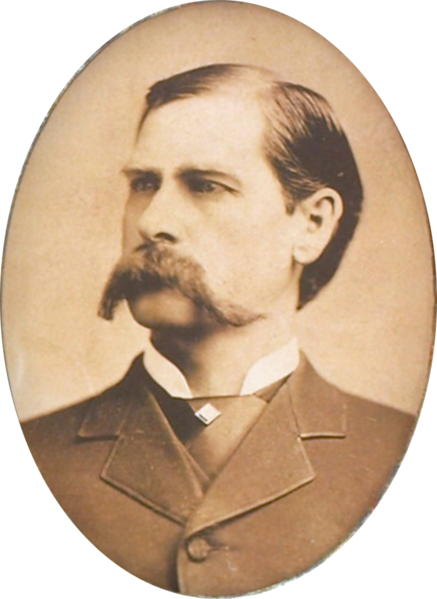
Wild Bill Hickok. This image is in the public domain.


A casting director who chooses an actor with black shoulder-length hair to portray Wild West legend Wild Bill Hickok might suppose that such a choice would be historically accurate, since surviving photographs of Hickok show him to have been a brunette. In fact, however, descriptions of the hero who was, at various times of his life, a fugitive, a stagecoach driver, soldier, an army scout, a town marshal, a cattle thief, a gambler, a showman, and an actor, reveal that Hickok was actually a blond.


A Bear Fighter


When Hickok crossed paths with a bear with her two cubs while he was hauling freight westward from Independence, Missouri, on his way to Santa Fe, New Mexico, he shot the mama bear in the head. She was hardheaded, though, and the bullet bounced off the animal's head, accomplishing nothing more than enraging the beast.


As the bear crushed him against her body, the teamster got off another shot, this time wounding his attacker in the paw. The bear responded by seizing Hickok's arm in her mouth. He could have lost the appendage, had he not been able to slash his attacker's throat with his knife. After four months in bed, he was dispatched to Rock Creek Station, Nebraska, to recover from his injuries while taking on the duties of a stable hand. This is the account of the incident, at least, provided by D. M. Kelsey, author of Our Pioneer Heroes and Their Daring Deeds.


Joseph G. Rosa, author of They Called Him Wild Bill, is more skeptical, declaring, “This legend has been repeated countless times, bowdlerized, twisted, and warped, and just how much truth there is in it has always been in doubt,” and probably originated with J. W. Buel, the city editor of the St. Louis Dispatch and an early Hickok biographer, who used the story to “boost the heroics of his character,” rather than with Hickok himself.


A Showman


Well before his friend (and later, briefly, his employer) “Buffalo Bill” Cody assembled his Wild West Show, Hickok put on his own version of a similar extravaganza. According to Life and Marvelous Adventures of Wild Bill, The Scout, by J. W. Buel, the show, featuring four Comanches and a half-dozen buffalo, took place in Niagara Falls, but attendees refused to cough up the admission fee, and, since the show took place outdoors, they couldn't be required to pay. There would be no repeat performance.


A Painter


He faced down Texas outlaw John Wesley Hardin, who claimed he'd turned the tables on Hickok by performing the maneuver known as the road agent's spin, twirling his six-gun around so that the barrel, rather than the butt, faced the lawman. The story is regarded as highly unlikely, given Hickok's own experience and skill as a gunfighter.


When Phil Coe and his business partner Ben Thompson painted one of the exterior walls of their establishment, the Bull's Head Saloon, with a painting of a bull sporting an erect penis, even the citizens of the rough-and-tumble cow town, Abilene, Kansas, were offended, demanding that Hickok order that the portrait be removed. When they balked, Hickok had the offending member painted over, causing further bad blood between the saloon owners and himself.


Complaining to Hardin of Hickok's high-handed response to their masterpiece, Thompson made a case to him for assassinating the marshal: “He's a damn Yankee. Picks on rebels, especially Texans, to kill.” Hardin, himself a Texan, as Thompson knew, did not take the bait. “If Bill needs killing, why don't you kill him yourself?” Hardin replied.


As Sarah Smarsh recounts in Outlaw Takes of Kansas: True Stories of the Sunflower State's Most Infamous Crooks, Culprits, and Cutthroats, Coe tried a different gambit. Hoping to cow Hickok, he boasted that he could “kill a crow on the wing.” The saloon owner's adversary asked, “Did the crow have a pistol? Was he shooting back? I will be.” Subsequently, as Hickok was dealing with a crowd during a street fight, the marshal killed Coe when the latter tried to shoot him.


On the same occasion, Hickok mistakenly killed his own deputy, Mike Williams, who was rushing to Hickok's assistance. As a result, Hickok was suspended and, later, traveled west, eventually to his death in Deadwood, Dakota Territory.


A Husband


Between Abilene and Deadwood, he briefly became a member of Buffalo Bill's Wild West Show, but his aversion to acting led to his departure from show business. Along the way, he married Agnes Thatcher Lake (Agnes Lake Hickok: Queen of the Circus, Wife of a Legend by Linda A. Fisher and Carrie Bowers).


A Dead Man


In Deadwood, while playing poker in a saloon, he was shot in the back of the head by Jack McCall. Hickok died almost immediately, and his prediction that he would be killed in Deadwood was fulfilled. The cards he was holding at the time of the shooting, a pair of aces, spades and clubs, and a pair of aces, also spades and clubs, became known as “the dead man's hand.”


The Butt of an Everlasting Practical Joke


Most of Deadwood's citizenry attended Hickok's funeral. Had Charles Rich, another of the gamblers participating in the game the night that Hickok was killed agreed to either of the famous gunfighter's two requests to change seats with him so that Hickok could face the saloon's door, Hickok would, in all likelihood, have dispatched McCall, had the drunken killer been bold enough to have tried to shoot Hickok face to face instead of in the back of the head.


Despite his marriage to Lake, Hickok's admirer was buried beside him, as had been her wish. According to some accounts, those who honored her last wish did so for their own amusement, it seems, as they explained their action by starting that Hickok had had “no use” for Jane, so they'd supposed their planting her next to him for eternity would be an appropriate prank.


* * *


My series An Adventure of the Old West is available on Amazon, as a prequel novelette and and four single novels or as a boxed set of all five works.


Wednesday, July 12, 2023

Fascinating Facts About Famous Figures of the American Wild West: Part 1: Bat Masterson

 Copyright 2023 by Gary L. Pullman

Bat Masterson. This image is in the public domain.


Collecting Money Due

Hired, along with his brother Ed and their friend Theodore Raymond, to grade a five-mile stretch of railroad bed, Bat Masterson collected the $300 pay overdue to them at gunpoint when he encountered Raymond Ritter, the man who'd hired them before skipping out aboard a Santa Fe-bound train that stopped in Dodge City, Kansas. Reportedly, a crowd cheered.

Royal Gorge. This image is in the public domain.

Recruiting Mercenaries

Masterson also recruited a small army of fighting men to oppose the Denver & Rio Grande Western Railroad's mercenaries, who sought to prevent the Santa Fe Railroad from using the Royal Gorge near Pueblo, Colorado. The latter company claimed that it held an exclusive right-of-way to the gorge and that the former company had no legal access to it. When guns weren't sufficient to end the situation, the “Royal Gorge War” was resolved in an out-of-court settlement.

Committing Election Fraud

During elections in Denver, Colorado, presumably drunken saloon patrons were escorted to the polls, and “mobs” were paid $2 each for voting for the candidate of the payer's choice, i. e., the city's “liquor dealers” who fronted the money for such payments. Police and bartenders did their part to ensure “the flow of ballots for mayoral candidate Wolfe Londoner,” including those of the town's soiled doves. As a not-so-surprising result, Londoner handily defeated his opponent, Elias Barton. During Londoner's tenure, cronyism reigned, with the mayor's favorites filling so many municipal offices that the city was on the verge of bankruptcy. During a trial, it was determined that Bat Masterson and his pal, infamous con man Soapy Smith, had had a hand in the shenanigans, “compiling voter registration lists” that included names of the dead and out-of-towners.


George Gould, Denver and Rio Grande Western Railroad executive. This image is in the public domain.


Acting as a Bodyguard

After moving to New York City in 1895, Masterson served, briefly, as a bodyguard for George Gould, an executive for the Denver and Rio Grande Western Railroad, the same company that was involved in the 1878-1880 Royal Gorge War. It seems the stint was more pleasurable than arduous, including, as Masterson wrote to friends, fishing from aboard Gould's yacht.

Writing a Newspaper Column

After this employment, Masterson became a columnist for the New York Telegraph, writing “Masterson's Views on Timely Topics.” He also penned some fanciful biographical sketches of men he'd known during his days in the Wild West: Ben Thompson, Wyatt Earp, Luke Short, Doc Holliday, and Bill Tilghman, and Buffalo Bill Cody, which appeared in Human Life: The Magazine About People Edited by Alfred Henry Lewis.

Serving as a U.S. Marshal

Masterson was fast friends with President Theodore Roosevelt, who paved the way for Bat's appointment as deputy U.S. Marshal for the Southern District of New York, a position that paid $2,000 per year, which Masterson held until 1908, when William Howard Taft, who was not a fan of the Wild West lawman, “abolished” Masterson's “position.”

Bat Masterson in New York City. This image is in the public domain.

Having a Massive Funeral

Masterson died at his desk in the office of the Morning Telegraph, after suffering a heart attack. He had just finished his final column for the newspaper, His funeral service was attended by nearly 500 mourners.


* * * *


Enjoy my four-novel series An Adventure of the Old West AND the novella prequel!


This series is also available as a box set!


Wednesday, August 10, 2022

Wednesday, July 6, 2022

Wyatt Earp: A Celebrity among Celebrities

Copyright 2022 by Gary L. Pullman 

File:Wyatt Earp portrait.png

Wyatt Earp

Source: Public domain

Although his name is well known today, Wyatt Earp (1848-1929) did not become a national celebrity until his controversial decision regarding the illegal boxing match between Bob Fitzsimmons (1863-1917) and Tom Sharkey (1873-1953) that took place at San Francisco's Mechanics Pavilion on December 2, 1927. Although the favorite, Fitzsimmons, “dominated Sharkey throughout the fight,”1 Earp stopped the match, declaring that Fitzsimmons had hit Sharkey below the belt and awarded the bout to the underdog.2 Earp's decision was widely publicized in newspapers across the country, bringing Earp lasting fame, even as the reports sullied his reputation, even though doctors confirmed that Sharkey had, indeed, been struck below the belt.3

File:Jack London young.jpg

 Jack London

Source: Public domain

As far back as 1899, Earp had encountered some literary lights, including Jack London (1876-1916), author of The Call of the Wild (1903), White Fang (1906) and other novels of the Alaskan frontier, with whom Earp became friends, and playwright Wilson Mizner (1876-1933), who also wrote the screenplays to The Little Giant (1933) and “One Way Passage,” an episode of Lux Video Theater produced in 1957, as well as future novelist Rex Beach (1877-1949), who would write the bestseller The Spoilers (1906), The Silver Horde (1909), and others.4

File:Charlie Chaplin in unknown year.jpg

 Charlie Chaplin

Source: Public domain

Even before realizing national fame (or, initially, infamy), Earp was known, admired, and respected among Hollywood's glitterati as well. After joining London for a visit to the set of a film being directed by Raoul Walsh (1887-1980), Earp made the acquaintance of Charlie Chaplin. The director of such films as The Birth of a Nation (1915), The Big Trail (1930), and The Roaring Twenties (1939), and High Sierra (1941), among others, took his guests to dinner at Al Levy's Cafe, during which another diner stopped at their table to say hello to Earp and London—the actor Charlie Chaplin (1889-1977), who greatly admired the adventurous former frontier lawman (and London).5

File:William S Hart.jpg     File:Tom Mix - Aug 14 1920 EH.jpg

William S. Hart (left) and Tom Mix

Source: Public domain 

Earp was also friends with silent movie stars William S. Hart (1864-1946) and Tom Mix (1880-1940), the latter of whom was one of Earp's pallbearers the depth of whose friendship is reflected in the fact that Mix wept at the late lawman's funeral.6 Earp also visited the sets of John Ford (1894-1973), who directed Stagecoach (1939), The Searchers (1956), The Man Who Shot Liberty Valance (1962), and many other Western films. There, Earp met actor Harry Carey (1878-1947), who starred in numerous movies from 1910 throughout the 1940s.7

File:Eddie Foy, vaudeville, stage comedian (SAYRE 1350).jpg

Eddie Foy, Sr.

Source: Public domain

Well before his own celebrity, when Earp had been well-known only in Kansas, Arizona, and California, although he'd visited or lived in other places familiar to historians and fans of the Old West, including Deadwood, Dakota Territory, Wichita, and Cheyenne, Wyoming, Earp had perhaps seen or met comedian Eddie Foy, Sr. (1856-1928), in Dodge City, Kansas, who flung himself on the boards of the Comique Theater when intoxicated cowhands shot up the place during his Foy's act.8


1 Barra, Alan (November 26, 1995). "Backtalk: When Referee Wyatt Earp Laid Down the Law." The New York Times. Archived from the original on October 2, 2013. Retrieved July 6, 2022.

2 Shillingberg, William B. (Summer 1976). "Wyatt Earp and the Buntline Special Myth". Kansas Historical Quarterly. 42 (2): 113–154. Archived from the original on February 1, 2012. Retrieved July 6, 2022.

3 Mulvaney, Kevin (October 26, 2013). "The fight, the foul and the lawman." Archived from the original on March 29, 2014. Retrieved July 6, 2022.

4 Barra, Alan. "Who Was Wyatt Earp?" American Heritage. Archived from the original on May 7, 2006. Retrieved July 6, 2022.

5 Barra, Alan (May 7, 2012). "Wyatt On the Set!" True West Magazine. Archived from the original on December 19, 2013. Retrieved July 6, 2022.

6 Reidhead, S. J. (October 4, 2006). "Book Review: Wyatt Earp: Frontier Marshal". Archived from the original on September 28, 2012. Retrieved July 6, 2022.

7 Barra. Retrieved July 6, 2022.

8 Shillingberg, William B. (Summer 1976). "Wyatt Earp and the Buntline Special Myth." Kansas Historical Quarterly. 42 (2): 113–154. Archived from the original on February 1, 2012. Retrieved January 27, 2014.

Tuesday, October 26, 2021

Structural Elements of Westerns

 Copyright 2021 by Gary L. Pullman

An analysis of Western films discloses the use of a number of specific types of scenic elements that tend to recur frequently in such movies. The order in which these scenic elements occurs may differ, and not all may be present in a film, although, typically, many, if not all, do tend to appear. In addition, each scenic element can be shown by itself or in combination with another (for example, an offer of a bounty may be accepted or rejected, earned or lost). Scenic elements that occur in all the movies analyzed below are indicated by bold font.


In Tombstone (1993), these scenic elements occur in this order:

Despicable deed: An action, usually criminal, that is beyond the pale, even for outlaws

Relocation

Reunion

Health problem

Character flaw

Stake: A source of income, often temporary

Murder

Arrest

Law enforcement

Gunfight

Ambush

Retaliation

Refuge: a place of safety

Challenge

Substitution: the replacement of an expected or intended character or object with an unexpected replacement

Showdown

Vendetta: protracted revenge against several parties

Marriage


In The Good, the Bad, and the Ugly (1966), these scenic elements occur in this order:

Interrogation: formal or informal, legal or otherwise

Murder

Surrender to authorities: of oneself or one's prisoner

Rescue

Abandonment

Revenge

Duplicity: often as a means of double-dealing or double-crossing

Reunion

Capture

Escape

Sabotage

Intelligence: information gained through personal observation, primary sources, or secondary sources

Robbery

Rescue


In The War Wagon (1967), these scenic elements occur in this order:

Relocation

Revenge

Intelligence

Hiring of expert(s)

Robbery

Rescue

Offer of bounty

Drunkenness

Negotiation

Intervention

Diversion

Theft

Forced detour

Division of forces

Drunkenness

Ambush

Murder

Crash


In True Grit (1969), these scenic elements occur in this order:

Murder

Robbery

Hiring of expert(s)

Pursuit

Tracking of fugitive(s)

Partnership

Attempted abandonment

Discovery: information gained through a character's own action, rather than those of another party or from a primary or secondary source

Capture

Interrogation

Defiance

Attempted ambush

Feint

Gunfight

Death: loss of life due to a natural cause or a justified killing, as opposed to murder

Escape

Pursuit

Wounding

Kidnapping

Ultimatum

Attack

Injury

Snakebite

Commandeering of civilian vehicle

Payment

Promise

Wager

As this partial analysis of the recurring types of scenic elements common to Western films shows, such movies frequently use the same scenic elements, despite the dramatic details of their plots. A writer who is interested in writing a Western novel or screenplay can use these same scenic elements to construct a plot based on a structure that has stood the test of time.


Friday, August 13, 2021

ORDER HERE, ORDER NOW! An Adventure of the Old West series!


Don't miss these other great books in the exciting Adventure of the Old West series!

Order Here, Order Now!


  Bane Messenger Bounty Hunter

(A novella prequel to the series)

Available at Amazon, Apple Books, Barnes & Noble, and Kobo

(e-book format)

Click HERE to order from your favorite retailer.


A prequel to the series An Adventure of the Old West, this action-packed short story introduces Bane Messenger, a Union veteran of the Civil War, who teams with former Confederate commander Colonel Jake Miller to become a bounty hunter.

On the trail of a vicious outlaw wanted for kidnapping and murder during a series of robberies, Bane hones his tracking, reconnaissance, and fighting skills.

His final showdown with his deadly quarry will show Bane just how good he is with a gun and launch his career as a man who makes a living by bringing killers to justice, dead or alive.


Good with a Gun

(Book 1 of the series)

Available at Amazon, Apple Books, Barnes & Noble, and Kobo

(e-book format)

Click HERE to order from your favorite retailer. 


Bounty hunter Bane Messenger is good with a gun, but he wants more out of life than hunting down fugitives from the law. He wants a wife and children. He wants a home of his own. He wants to know why his father abandoned his mother and him. 

But all he knows is how to track and capture or kill the worst sort of men who roam the West, taking what they want, whether money, property, or women, at the point of a gun.

When he meets the right woman, though, he vows his life will change; he will change, if he can. 


The Valley of the Shadow

(Book 2 of the series)

Available at Amazon, Apple Books, Barnes & Noble, and Kobo

(e-book format)

Click HERE to order from your favorite retailer. 


Mysterious strangers. Big money. Corrupt politicians. Murder. Mayhem. Hired guns. After a drunk is broken out of Excelsior, Nevada's, jailhouse, former bounty hunter Bane Messenger joins a posse to hunt down the escaped prisoner and his accomplices.

Surviving an ambush in which the sheriff and deputy are killed, Bane tracks down the assassins. But, when he returns to Excelsior, he finds that the town's last lawman has also been murdered. Now, a cartel controls the town, using paid gunmen to enforce new laws for their own benefit.

Determined to bring law and order back to his hometown, Bane faces a fierce fight only guns can settle, but he learns there's more to enforcing justice than just being good with a gun.


Blood Mountain

(Book 3 of the series)

Available at Amazon, Apple Books, Barnes & Noble, and Kobo

(e-book format)

Click HERE to order from your favorite retailer. 


After years as a bounty hunter and a sheriff, Bane Messenger wants to enjoy a quiet life with his family. They buy land in Nevada's Great Basin, planning to build a remote family retreat, but when they visit the property, armed men attack them, intent upon forcing them to vacate the premises, claiming Bane and his family are trespassing on private property.

Before this new nightmare ends, Bane will strike it rich, be tried for kidnapping and murder, and take on an “army” of veteran soldiers determined to kill him and his entire family.

On the Track of Vengeance 

(Book 4 of the series)

Available at Amazon, Apple Books, Barnes & Noble, and Kobo

(e-book format)

Click HERE to order from your favorite retailer. 


The runaway action never stops in On the Track of Vengeance, the fourth book in An Adventure of the Old West series. When outlaw gangs sabotage railroads, resulting in the deaths of innocent passengers and crew members, the president of the United States becomes directly involved, appointing Bane Messenger a U. S. marshal answerable to him alone.

Teamed with trustworthy deputies, Bane takes on the desperate men, who care only for vengeance and are willing to do anything to strike back at the railroads and the government they blame for their misfortunes. But the stakes soar when Bane learns that the outlaws plan to sabotage a train carrying his wife and father.

With their lives hanging in the balance and no way to warn them, Bane races to the scene. Can he stop the outlaws in time or will Pamela and Bradford become the latest victims of the cruel men who care for nothing but vengeance?


Wednesday, June 30, 2021

The Wild West's Nevada Bordellos

 Copyright 2021 by Gary L. Pullman


Our review of some of Nevada's Wild West towns along Highway 50 and Interstate 80 reveal some of the motives westward travelers and frontier settlers had in migrating from points east. Watering holes and bodies of water along overland trails (like the existence of the trails themselves); the building of the Transcontinental Railroad; discoveries of silver, gold, lead, and other ores; and politics brought men, women, and children west, where the frontier seemed a land of possibilities and, perhaps, for some, wealth, as well as adventure.

We can pretty well guess why prostitution was widespread throughout the West. There were few women and lots of men. The law of supply and demand made brothels lucrative business ventures—for their owners, at least—and provided employment for women, which was scarce on the frontier. There were, after all, only so much demand for laundresses, schoolmarms, seamstresses, store clerks, waitresses, and the like, and, aside from these occupations, respectable women had few options. Sometimes, a woman became a “soiled dove” simply because she had no other alternative.

 
Today, Donna's Ranch continues to cater to its clientele.Source: Yelp

What else can we discern by investigating some of the brothels known to have existed in Nevada during the nineteenth century? A fairly well documented establishment of this type was Donna's Ranch in Wells. During its Wild West heyday, this bordello, which has been in operation since 1867, had two major types of clients: the men constructing the Central Pacific Railroad and the cowboys who drove herds to the railroad's cattle-boarding locations and sometimes paid for the prostitutes' services with cows in lieu of dollars. Its more recent owners have included heavyweight champion Jack Dempsey (1895-1983).

 The Desert Club's contemporary look. Source: Desert Club Girls

 The Desert Club, a Battle Mountain brothel that first opened its doors in the late 1800s, includes only five rooms. It's back in business, having reopened under new management in 2016, after closing in 1991, having been temporarily transformed into a mining museum during the interim. Unfortunately, nothing much is known about its operations during its frontier days.

 
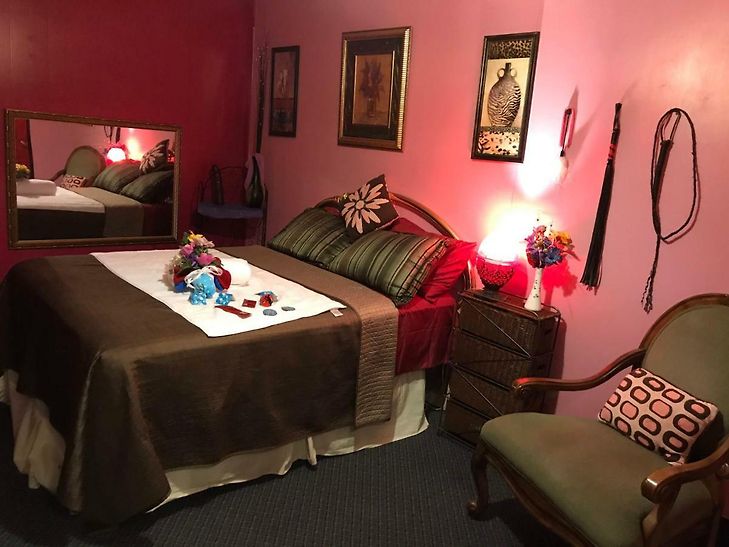
The whips on the wall of a bedroom at today's Rainey's Dance Hall (now Big Four) provide unique decor. Source: booked.net
 
 Rainey's Dance Hall was open for business beginning in the late 1800s. As Big Four, it still operates in Ely, Nevada, but, of course, under new ownership. It has in common with the Desert Club the fact that little remains known of its glory days.

The Pussycat Ranch (aka Pussycat Saloon, aka Pussycat Brothel) once stood on Riverside Street in Winnemucca, but it has since not only close but been demolished. In its flower, the Pussycat boasted a large, ornate bar, among its other diversions.


The Cosmopolitan, presumably, has seen better days. Source: nevadaadventures.com

Located in Belmont, the Cosmopolitan Saloon satisfied the needs of his clientele during the latter half of the 1800s. The July 27, 1874, edition of the Belmont Courier's June 27, 1874, noted that the law provided the means by which to quickly suppress such business enterprises and suggested that local government officials had the moral duty to do so. Such a “hurdy dance house,” the paper proclaimed was “a moral wrong,” if ever there was one, injurious to young and old alike, should they succumb to the establishment's “alluring temptations.”

The Cosmopolitan was a dangerous place to visit because of the gunfire that sometimes occurred on the premises as well, the article noted, although, admittedly, recent shootings had not resulted in any fatalities. Should a death occur as the result of such irresponsible conduct, however, the Courier reckoned that the county was likely to bear a cost of “$3,000 to $10,000 to prosecute the case.”

In commenting on the Courier's article, in “Hurdy houses, hurdy girls flourished in boom towns,” an installment in the Pahrump Valley Times's series of articles concerning Nevada's “history of prostitution,” the author, historian Bob McCracken, points out that “prostitutes were among the first arrivals in a mining boom town” and that they were held in esteem by men, who “generally saw them as tough and resourceful, passionate and fun-loving people with big hearts who provided an essential human service.”


 Belmont, Nevada. Source: Pinterest

Among the other bordellos that the article mentions is the Crook Shop. Regarding this establishment, McCracken reports on the double standard of the times regarding men, women, and prostitution. Men who availed themselves of “hurdy girls” might retain their respectability; the prostitutes, on the other hand, who were guilty of the same risque behavior, were regarded as disgraceful:

“It was noted that a woman who danced in the Crook Shop (a local brothel) was not admitted to a 'respectable party' while the man who danced with the 'hurdy-gurdy girl' suffered no diminished in respectability. Why should that be, the item asked: 'If there is any difference between Tweedle Dee and Tweedle Dum, we confess our ignorance' (Belmont Courier, June 27, 1874).”

  Hurdy gurdy girl. Source: hurdygurdyanthropology.
 

Note: Most historians make a distinction between "hurdy gurdy girls," German frauleins who played the hurdy gurdy and danced with men for a price (usually fifty cents per dance and another fifty cents for the couple's drinks) and "soiled doves" who entertained their clients in a much more "intimate" manner.

List o f 19th-Century U. S. Western Frontier Forts, Part VIII: Montana

Note : This is the eighth of a series of lists of the  U. S. forts of the Wild West. It is intended for use in research by writers, readers,...