Sometimes, the
stories of the actors behind the figures of the Old West—at least,
as they are portrayed in Hollywood Westerns—are as interesting as
those of the cowboys, gunfighters, outlaws, and sheriffs themselves.
A case in
point: character actor Chill Wills, who was known as much for his
gravely voice and his gruff demeanor as he was for his rugged
appearance.
He starred in
many Westerns, alongside some of the most famous leading men of the
genre, including John Wayne, Clark Gable, Gary Cooper, Robert Taylor,
Gene Autry, and Robert Preston.
It was after his role as Bee Keeper in the
1960 film The Alamo,
starring John Wayne, that Wills got into trouble. Bee Keeper was the
sidekick of Davy Crockett (John Wayne). According to Cynthia Brideson
and Sara Brideson, authors of the highly
recommendedAlso
Starring Forty Biographical Essays on the Greatest Character Actors
of Hollywood's Golden Era, 130-1965,
Wills's role won him “his first Oscar nomination,” and he wanted
the award badly enough to hire a publicity agent to conduct a
campaign for him.
His
agent, W. S. Wocjiechowicz, conceived the idea of blanketing
“Hollywood trade papers” with an ad containing the copy, “We of
The Alamocast are
praying harder—than the real Texans prayed for their lives in The
Alamo—for Chill Wills to win the Oscar.”
Wayne,
who had great respect for the real men of the West, was offended. Not
only did he deny that “any of the cast had condoned” Wills's
slick campaign, but he also “condemned” it.
The Academy of
Motion Picture Arts and Science also found the campaign offensive. As
a result, the Academy forbade any future such campaigns by stars who
were nominated for the award.
Wills
didn't win the Best Supporting Actor Oscar. Instead, he lost to Peter
Ustinov, who won for his part as Lentulus Batiatus, the owner of the
gladiator school in Spartacus.
To get a true idea of the
complexity of the American West, as it is suggested by the posters
that promote John Wayne's many Western films, it's necessary to
analyze many of these advertisements. In this post, however, only one
is considered, so, admittedly, only the surface has been scratched
here.
The point of this post is
to identify some of the elements that Hollywood filmmakers
considered, at the time of the poster's appearance, to be of
sufficient interest to the genre's fans that they could be used to
persuade them to part with the price of the movie's admission.
McLintock, released
in 1963, stars John Wayne, Maureen O'Hara, Patrick Wayne, Stefanie
Powers, Jack Kruschen, Chill Wills, Jerry Van Dyke, and Yvonne De
Carlo. Three women in a Western are two (or, in many cases, even
three) more than usual; consequently, their presence suggests that
this film focuses on the relationships between men and women of the
Old West more than many other such films.
Despite the presence of
Patrick Wayne, Jack Kruschen, Chill Wills, and Jerry Van Dyke,
there's really only one male character of importance in the motion
picture: Wayne's character, George Washington (“G. W.”)
McLintock. As the movie's poster
makes clear by focusing on him and O'Hara, the flick is
primarily about his
relationship to her.
Wayne
is shown as huge, his portrait taking up the upper two-thirds of the
poster's space. He appears to be laughing, except that he looks more
pained than merry (but, then, Wayne often
looks pained, on screen and in posters). The fact that the film is a
comedy suggests that he is, in fact, laughing.
Beneath
his image, the movie's title, “McLintock!,” appears, complete
with exclamation point.
Beneath
the title, three pictures, looking much like snapshots, are featured,
the middle one of which slightly overlaps the one before and the one
after it. Comprising a sort of triptych, these smaller images seem to
be the soil, so to speak, out of which the comparatively gigantic
head and shoulders of McLintock arises, as if his being is rooted in
the activities the “snapshots” depict. The order of the smaller
images also suggest a beginning, a middle, and an end, and all of
them suggest violence of a sort.
The
first picture shows two men engaged in a fistfight, while a third
lies on the ground, apparently recovering from a blow.
The
second shows a man pursuing a woman dressed only in her underwear; he
holds part of her torn dress; she, the rest of it. One of the
buildings behind the couple is the McLintock Hotel. Probably to
maintain an element of suspense, neither of the two figures (or those
of the fighting men) are identifiable as members of the cast and, in
fact, look like any of the actors, so viewers can't tell whether the
fighters include Wayne or the couple consists of him and O'Hara.
The
third of the smaller pictures shows another brawl, in which one man,
shown in the foreground, knocks his opponent down, while, in the
background behind them, a third man holds a fourth, while a fifth
falls to the ground. Most of the men, of course, wear six-shooters,
holstered on their hips.
The
poster seems to indicate that McLintock is a man of violence, a
fighter and (by today's understanding) a perpetrator of domestic
violence. A businessman, probably of some social and economic
standing in town, he's outwardly respectful, but he's certainly no
saint. Like his business rivals, physical combatants, and his own
wife, others are subject to his will; a dominant personality he's
able and willing to impose his will on men and women alike. Somehow
(perhaps because the bigger image of him is laughing), he appears to
be likable.
With
some speculation, based on the poster's imagery, these notions are
about all a viewer can discern concerning the movie's likely plot.
Filmmakers were betting that these inferences would be enough to lure
fans of Westerns in general and of Wayne in particular into theaters
in 1963.
By
consulting a summary
of the movie, we can see whether the implications suggested by the
movie's poster (or the interpretation of it, at least, that's offered
in this post) are close to the content that the film actually
delivers, are far afield, or are somewhere between these polar
possibilities.
The
movie, we find, is based “loosely” on William Shakespeare's
comedy The
Taming of the Shrew. G. W.
is more financially successful than his name on the hotel, as shown
on the poster, suggests, and he's not primarily a hotel owner; he's a
rancher, a cattleman, and a mine operator as well.
His
wife Katherine (O'Hara) has left him, to live back east, after
suspecting he's committed adultery. His daughter Becky (Powers), a
college student, lives with him. In Katherine's absence, G. W.'s
hired a homesteader, the beautiful widow Louise Warren (De Carlo),
whose adult son Devlin (“Dev”) (Wayne's son Patrick) lives in
McLintock's house with her.
All
is cleared up between G. W. and Kathleen, after G. W. spanks her with
a coal scuttle, a technique he picked up from his daughter's fiance,
Dev, who earlier delivered the same punishment to Becky, using the
same instrument, whereupon the quarreling younger couple became
engaged.
The
poster is vague about the fistfights it depicts, but, it seems, they
reference the brawls that occur in the movie. The man pursuing the
woman in the central picture at the bottom of the poster is G. W.;
the woman he pursues, his wife (although their identification is,
perhaps intentionally, left unclear in the poster).
Wayne,
who developed the script, included the spanking scenes to indicate
his own aversion to domestic violence. However, according to O'Hara,
Wayne “really spanked me! My bottom was black and blue for weeks!”
Although
the poster seems purposely vague about the motives of the characters
and the particular details of the situations in which they are
depicted, again, probably to preserve suspense, it does a fair job of
hinting at the nature of the film and its general theme.
Fans
of the Western who enjoy action and adventure that includes sex
(symbolized on the poster by O'Hara's half-dressed state) and
violence (suggested on the poster by the pictures of fisticuffs) and
features a manly, if familiar, star as protagonist were likely to
fork over the price of admission to enjoy McLintock,
the filmmakers apparently believed, since this poster was released to
promote the film.
The
persistence of these ubiquitous dramatic (and narrative) elements,
which have become more and more explicit and pervasive in Westerns,
as in other genres of film, suggests that today's audience remains at
least as interested in these elements of the genre as was the same
genre's audience in 1963.
Western
movies tend to do well at the box office, especially when their
leading character is a star of the magnitude of John Wayne or Clint
Eastwood.
How
much do posters and lobby cards designed to promote these films help
sell tickets? The answer is anybody's guess, but, apparently, even in
the digital age, Hollywood believes that there is magic in such
advertisements. Movie posters and lobby cards have long been staples
of the promotion of movies of all genres, Westerns included. They
remain so today.
Like
movie posters that promote other genres, those that advertise Western
films can pinpoint some of the features of such fare that
screenwriters have found appeal to viewers. The same features, one
might suppose, would also appeal to readers of Western novels.
Let's
take a look at a Western movie poster, with an eye toward what,
specifically, they advertise that's central to this genre.
The
poster for Pale Rider,
featuring Clint Eastwood, shows
a
lone gunman fanning his Colt
a
lone gunman who is dressed well by the standards of his time
seven
men standing in a line
a
block of buildings typical of Western towns
a
caption, in small letters, at the heart of the sun-like circle to
the right of Eastwood's head
the
colors yellow, orange, red-orange, and reddish-brown
What
can we infer from the images, design, colors, and text?
Typically,
the Western hero is a solitary figure who's good with a gun and who
is willing to risk his life to defend himself, another person, or his
own values. He tends to be larger than life. The poster focuses on
Eastwood's character, a lone gunman who is shown as a giant among
men; the seven other figures shown in the poster are not only
literally beneath him, but they are tiny in comparison, and, while he
is shown in full color, they are little more than shadows. Next to
him, the other men are insignificant, more like pesky gnats than
worthy foes.
Not
only is the lone gunman bigger than anyone else, but he is also
central: he is shown near the center of the poster's focus. Thanks to
his size, his facial features are easily discernible; he has an
identity; he is an individual, a person with character. His weathered
appearance, leathery skin, and sharp features mark him as an
independent, hard-bitten man who's been around and knows the score.
In his eyes, we see steely determination; his bared teeth show
aggression. He is focused, intent, one with his gun. A man on a
mission, he stands and delivers. These are the qualities of
personality, the poster suggests, that are important to the audience
for this actor's films. Moviegoers (or readers) who enjoy Westerns
want a man who, even alone, will take a stand, risk his own life, and
combat forces which would defy or destroy the principles he holds
dear.
The
lone gunman dresses better than many of his day, which suggests that
he enjoys financial success. He may make his living by his gun. He
may, in other words, be a gunfighter or a mercenary. (Those familiar
with the “spaghetti Westerns” in which Eastwood starred will
know, of course, that, in Pale Rider,
he plays a bounty hunter).
The
sun behind him isn't a halo exactly, or, if it is, it doesn't fit him
precisely, but the effect is similar; the concentric circles of the
high desert sun frame him closely enough to suggest that there may be
more to him than meets the eye, even if he himself is not altogether
holy.
The
poster's colors are bright and vibrant, but the sun's brilliant
yellow, by degrees, merges with the brown of the hero's coat and the
sky, the element of air merging with the element of earth. Perhaps
the lone gunman is a demigod, the Wild West's version of Hercules.
Western fans want their heroes to be Heroes, to be writ large, to be
of nearly supernatural dimensions.
The
fact that the movie is set in the West is presented almost as an
afterthought. The stretch of low buildings with false fronts and the
line of small figures in Western garb are more like quick sketches
that suggest, rather than depict, the setting. It is clear that the
film is not so much about the West itself as it is about this one
individual, the lone gunman who stands out.
White
adds touches of sunlight to the brim of the gunman's hat (which is
not a Stetson; this man is a gunman, but he's no cowboy). White also
highlights his left cheek, the top of his shirt, the cuffs of his
shirt sleeves, and the handle and the cylinder of his second gun, the
Colt stuffed in his gun belt, a phallus not quite hidden and ready to
hand, doubling his manhood.
In
the yellow circle of the sun, the poster's caption, in small letters,
whispers part of a verse in the book of Revelations: “. . . and
hell followed with him,” suggesting the consequences of the Pale
Rider's visit and connecting him to a figure of the Biblical
apocalypse: “And I looked, and behold a pale horse: and his name
that sat on him was Death, andHellfollowedwithhim.”
If there was any doubt as to the lone gunman's identity, the caption
spells it out: the Pale Rider is, in fact, Death personified.
Without
seeing the movie itself, these suggestions are all the poster's
viewer has by which to decide whether to see the film. According to
Box
Office Mojo,
Pale
Rider
grossed over $41 million, a fourth of this amount during its opening.
Although other factors contributed to the film's success, it seems
that potential viewers liked what the poster showed them. If they
were attracted by the themes, the type of hero, and the character
traits suggested by this poster, it's likely that they would be drawn
to similar themes, heroes, and character traits in Western novels as
well.
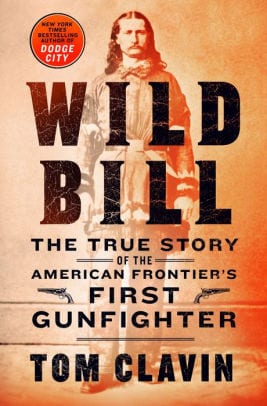
In Wild Bill, his biography of Wild Bill Hickok, Tom Clavin relates an anecdote about Hickok's alleged encounter
with a cinnamon bear.
Wild Bill Hickok
According
to Clavin, the story probably happened, although “a few researchers
have disputed that the encounter” between Hickok and the bear “ever
took place” (38).
It
seems that the gunfighter was working as a teamster when “he found
a bear blocking the road,” whereupon he climbed off his wagon “and
shot her in the head.” The gunshot didn't do anything but anger the
mother bear, causing her to attack, "crushing Hickok against her”
(38).
He
responded by shooting her in the paw, after which the bear locked
onto his left arm and began to bite; Hickok jerked his Bowie knife from his belt and slashed "the bear's
throat” (38).
Somehow, Hickok managed to drive his “freight wagon
to the next town,” despite his extraordinary pain, and the local sawbones treated his patient “for broken bones in” Hickok's “chest, shoulder, and arm” (38).
Clavin mentions a film that features a bear attack: TheRevenant, starring
Leonardo DiCaprio (37). (Another movie, set in Canada, that features a horrific bear attack is Backcountry.)
Several weapons that first
appeared during the days of the American Wild West are named
for famous people.
Richard Jordan Gatling
Richard
J. Gatling
(1818-1903), a medical doctor, invented the Gatling gun in 1861 and
patented it a year later. He hoped that his spring-loaded,
hand-cranked weapon(Handbook of the Gatling Gun,
Caliber .30, Models of 1895, 1900, and 1903,
Metallic Carriage And Casement
Mount,
13),
would lead to armies of fewer troops, thereby reducing wartime deaths
and casualties (Harold A. Skaarup, Shelldrake:
Canadian Artillery Museums and Gun Monuments,
133). It was an early rapid-fire weapon, preceded only by the French
mitrailleuse
(Skaarup, 133).
French mitrailleuse
Since
the gun required the gunner to crank a handle to fire the weapon, it
is not an automatic weapon; the first automatic wouldn't be invented
until 1884, when the 7.92-millimeter Maxim machine gun, appeared.
(Skaarup, 133).
Gatling gun
The
Gatling gun, however, was superior to other weapons of its day,
because the time that it took to eject a spent cartridge and load the
next round of ammunition during “the firing/reloading sequence”
allowed the barrel to cool a bit, permitting “higher rates of fire
. . . without the barrel['s] overheating” (Skaarp, 133). (Today, the U.
S. Army's .50-caliber machine gun fires so many bullets so quickly
that the barrel must be replaced at frequent intervals.)
The
Model 1873 Winchester rifle was sold as “The Gun that Won the
West,” although, technically, of course, a rifle is not a “gun,”
since a rifle is rifled, whereas the bore of a gun is smooth.
Originally, the rifle fired a .44-40 centerfire cartridge. The bullet
could travel at a velocity of about 1,500 feet-per-second. The rifle
also featured “a sliding breech cover . . . that [kept] dirt and
snow out of the breech,” and “an integrated safety sear . . .
prevented accidental discharge of the rifle when the hammer was
cocked” (Martin Pegler, Winchester
Lever-Action Rifles).
Buffalo Bill Cody's 1873 Winchester rifle
Various
lengths of barrels were available, as were a
number of embellishments: “silver or gold plating, engraving, set
triggers and special carrying cases” and “an all-in-one reloading
tool” (Pegler).
The
standard version of the rifle cost $27 ($439 today), the carbine $24
($390 today), but “these prices were often doubled by the time the
guns had shipped west” (Pegler).
Oliver Fisher Winchester
Oliver Winchester
and his family became fabulously wealthy. His son, William Wirt
Winchester, served as the treasurer of the Winchester Repeating Arms
Company. After his demise, William's widow Sarah became convinced that
their house was haunted.
The ghosts of Native Americans and others who'd been killed by her
family's rifle, she believed, were out for revenge.
To protect
herself, psychics told her, she had to continue to add on to the
eight-room farmhouse
she'd purchased in San Jose, California, after leaving her home in
New Haven, Connecticut. The work had to continue
non-stop, twenty-four hours a day, year after year—and it did, to
the tune of $5
million ($71 million today), until her own death in 1922.
Sarah Winchester
To
confuse the spirits, the 24,000-square-foot mansion (as it came to
be) incorporated some decidedly strange features. For example, only
one bathroom has a “working toilet”; the others were constructed
to confuse the ghosts (Gia Lui, “Take a Tour of San Jose's
Winchester Mystery House”).
Several weapons that first
appeared during the days of the American Wild West are named
for famous people.
The Armstrong
breech-loading gun was named after its English designer Sir William
Armstrong (1810-1900). In 1854, Armstrong sold the Secretary of State
for War on making a rifled breech-loading three-pounder for testing
purposes. Later models fired ammunition of higher calibers, including
the largest among them, a 100-pounder. Although the guns were more
expensive, they were also safer, but, ultimately, their design was
found to be too complicated, and loading them was a time-consuming
process involving several discrete steps. The Ordnance Selection
Committee reported its conclusions:
The
many-grooved system of rifling with its lead-coated projectiles and
complicated breech-loading arrangements is far inferior for the
general purpose of war to the muzzle-loading system and has the
disadvantage of being more expensive in both original cost and
ammunition. Muzzle-loading guns are far superior to breech-loaders in
simplicity of construction and efficiency in this respect for active
service; they can be loaded and worked with perfect ease and abundant
rapidity.
As a result, the military
resumed its use of muzzle-loading guns.
Sir William Armstrong
Armstrong, a man of many
talents and abilities, is considered the father of modern artillery.
A well-respected inventor and philanthropist,” he was knighted,
and Queen Victoria later elevated him to the peerage as a baron
(Robert P. Dod, The Peerage, Baronetage
and Knightage of Great Britain and Ireland
93). In addition to the breech-loading gun named for himself,
Armstrong also developed the hydraulic
accumulator.
Samuel Colt
Samuel Colt began making
weapons in the 1830s, securing a British patent for an improved
revolver design in 1836. According to True West,
the weapon that Wyatt
Earp used during the 1881 Shootout at the OK Corral in Tombstone,
Arizona, Earp “probably” used a Colt single-action revolver with
a ten-inch barrel. A Tactical Life
article indicates that Bat Masterson “ordered a total of eight
single-action revolvers from Colt’s,” the “most notable” of
which was a customized “nickel
plated short .45 calibre”
(source's italics):
Bat Masterson
.
. . make it very Easy on the trigger and have the front Sight a
little higher and thicker than the ordinary pistol of this Kind. Put
on a gutta percha handle and send it as soon as possible, have the
barrel about the same length that the ejector rod is (source's
italics).
Wild Bill Hickok
“The
favorite sidearms” of Wild Bill Hickok, who earned his living as a
lawman a bit earlier than Earp and Masterson, were a pair of “a
pair of elegantly engraved, ivory-handled 1851
Navy Colt cap and ball .36 caliber revolvers
[source's bold]. . . [the cylinders of which were] engraved with a
naval battle scene between Texas and Mexico” (“Wild
Bill's Colts”).
Employed by his
father, Colt worked on several ideas for inventions, one of which was
the first pistol he'd ever created. Unfortunately, when the weapon
was fired, it blew up (R. L. Wilson,
Colt: An American Legend
8). The rifle on which he was working at the same time fared better
(Colt: An American Legend
8). Leaving his father's employ, he traveled across the United States
and Canada, demonstrating the effects of nitrous oxide, calling
himself the Celebrated Dr. Coult of New York, London, and Calcutta”
(Gardner
Soule, The Story of Sam
Colt's Equalizer” in Popular Science. 179
(6): 89.
8).
After
focusing on a handgun with one barrel, rather than multiple barrels,
he managed to find a financial backer and was able to secure a patent
in 1836 for the first model of his Colt revolver (Soule, 89).
Eventually, with modifications and refinements, his revolver would
become one of the most popular handguns in the Wild West.
In
1852, Henry Deringer gave the world the small handgun with a large
bore that is named (but misspelled) for him. Muzzle loaded, the
percussion-cap pistol fired one shot. Usually sold in pairs for $15
to $25 for both, these weapons were known in the Wild West as “boot
pistols” (Gettysburg
Museum), “Vest
Pocket Pistols,” or “sleeve
guns”
According to Pinkerton
detective Charles (“Charlie”) Siringo, a year after Dodge City's incorporation, 81 men had been buried in the town's graveyard.
Eighty of them had been killed, only one having experienced “a natural death”
(A
Cowboy Detective 315).
It
was in this wild West town that Siringo first encountered Bat Masterson,
the nighttime bartender at the Lone Star dance hall. Siringo,
attracted by the hall's good-looking women and the establishment's
“Texas flavor,” visited the place with a cowboy friend, “Wess”
Adams (315). Wess, complaining of having been insulted by Jim White,
a buffalo hunter, enlisted Siringo's assistance (315).
Bat Masterson
In
the ensuing barroom fight, Masterson intervened, tossing a handful of
“heavy beer glasses” at Siringo, one of which, breaking, drew
blood (135). A dozen men were involved in the fracas; Masterson
didn't differentiate between brawlers and bystanders, but struck
anyone in range of the ice mallet he'd taken from its
place behind the bar (135).
Jim White
Some
of the fighters clubbed others with their pistols. When Siringo saw
White “lying on the floor apparently dead, with blood flowing from
wounds in the head,” and witnessed Adams being stabbed “in the
back,” he beat a hasty retreat, Adams in tow, to their horses, hitched
out front, and threatened a police officer, Joe Mason, who barred their way, before riding
out of town (136-137).
Siringo
and Adams took refuge in a stock yard “shanty.” Examining Adams's
knife wound, Siringo saw that it was, indeed, “serious”:
.
. . The knife had been thrust in and then brought around in a
semi-circle in the shape of a large horseshoe. The open part of the
shoe was where the flesh was not cut, and the other part of the wound
[was where] the flesh stood out several inches from the body. The
clothing was saturated with blood (317).
Charles Siringo
There
was nothing to do but ride back into Dodge. Suspecting that the
police might be waiting to ambush him, should he return to town,
Siringo took a different route back to Dodge, where he bought
supplies at the local drug store: “needles and thread, sticking
plaster, and a candle” (318).
Returning
to the shanty by the same route he'd ridden back to town, Siringo
tried, unsuccessfully, to stitch his friend's wound, but found that
“the horseshoe[-] shaped protruding flesh could not be pushed back
into place on a level with the rest of the body” (318).
Siringo
had no alternative but to apply the sticking plaster, before the men
rode eighteen miles “to the Bates & Beals cattle camp,” as
Adams became progressively weaker “from loss of blood” (318).
Later,
Siringo learned that White, “the boss of a large gang of buffalo
hunters,” had survived; he ultimately “recovered” from his
“many wounds” and the multiple cracks in his skull (319). Siringo
also learned, years later, upon meeting Masterson, that he'd been
right to take a different route back into Dodge than the one he and
Adams had taken out of town, as Masterson “and a gang of officers”
had, indeed, been lying in wait to ambush him, had he ridden back to
Dodge by the same path he'd left town. “Armed with rifles and
shotguns,” the posse had “stood guard till morning,” intent
upon making “angels” of the suspects “if [they] returned” (318).
Siringo
ends his account of “how near” he'd come “to being put out of
business by Bat Masterson” (315) by drawing a moral for his story:
“This little scrape illustrates what fools cowboys were after long
drives over the rail” (319).